Tramontane and Rain
Climate
Narbonne sees an average of around three hundred sunny days a year. That sounds idyllic, but for the vine it mostly means stress: little rain, heavy evaporation, and soils that crack open in midsummer. What makes this dryness bearable is a wind with a name of its own.
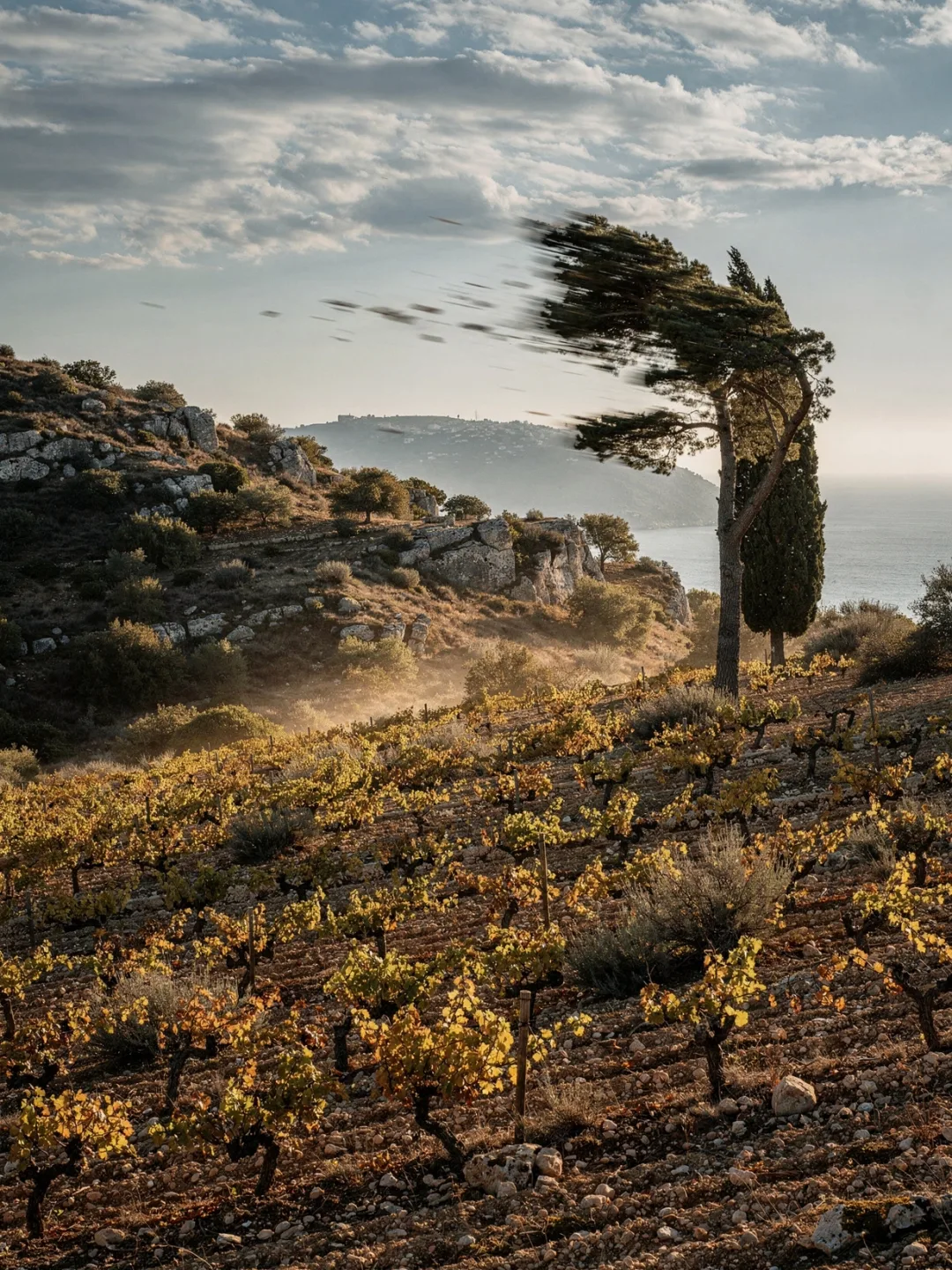
The Tramontane blows from the northwest, cold and dry, often exceeding a hundred kilometers per hour. It's noticeable here on roughly a hundred and seventy days a year. It sweeps clouds away before fungal diseases can take hold in damp grapes—one reason why many Languedoc vineyards still need very little spraying today. Young vines suffer nonetheless: they must root deep and firmly, or the wind will simply pull them out of the ground.
In autumn, the picture flips. So-called Cévenol episodes—moist Mediterranean air rising against the Cévennes and dumping as rain—can bring as much water in a few hours as normally falls over months, sometimes forcing growers to halt harvest mid-pick. Between these extremes there's hardly a gentle middle ground.
Anyone wanting to escape the heat heads uphill. At Pic Saint-Loup, thirty kilometers north of Montpellier, vineyards sit between two hundred and four hundred meters. The cool nights there do more than any cellar technique: acidity is preserved while down in the valley the grapes are already tiring. About seven hundred millimeters of rain fall here annually, more than on the coast. That's what gives the area's Syrah-heavy wines their fresher character.
On the coast, a different rule applies. At La Clape, where the sea lies barely a kilometer away, the proximity to water tempers the sharpest heat spikes, while pebbles heated during the day release warmth back at night, helping the grapes ripen further. Frost is practically unheard of here.