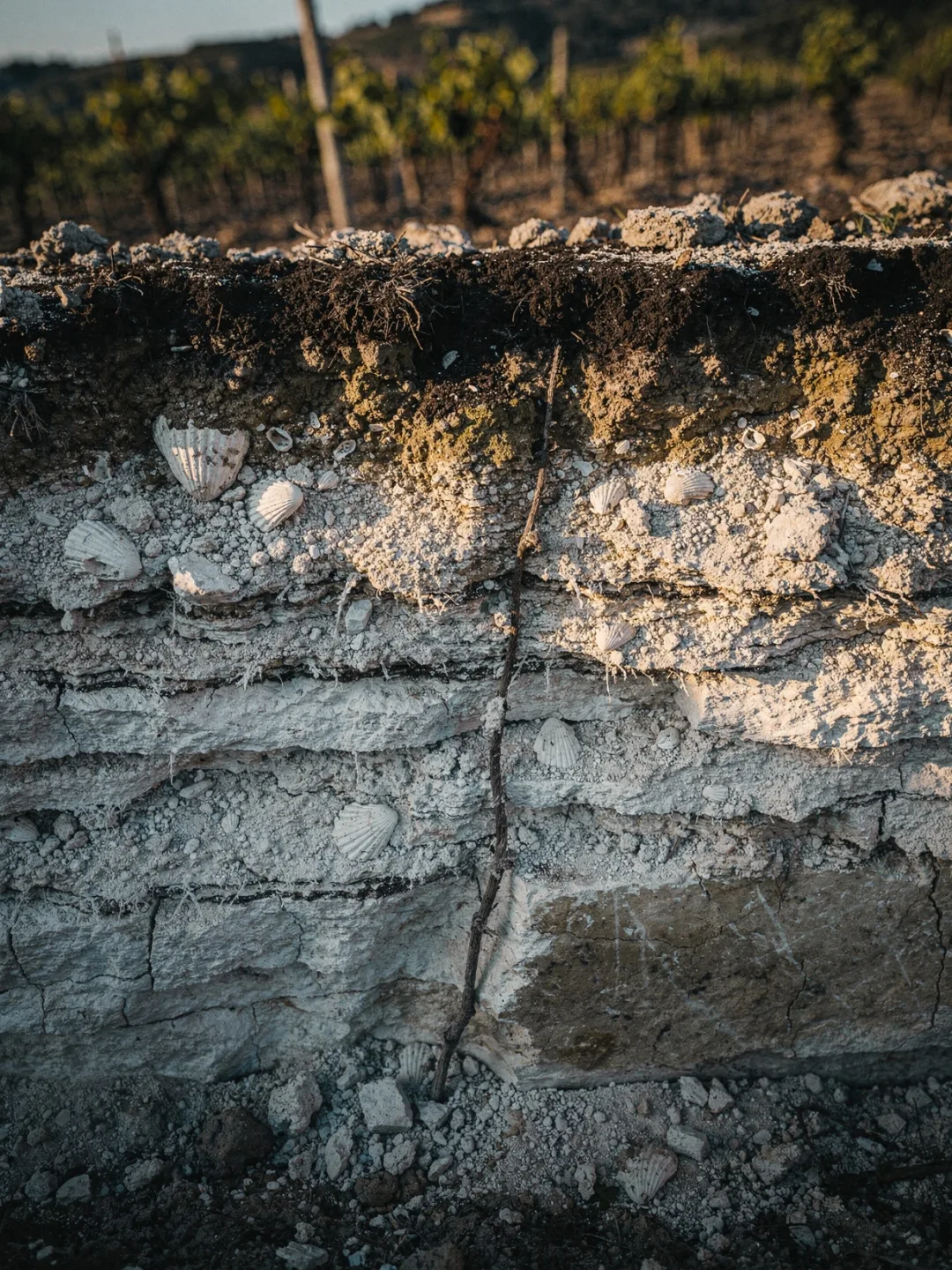
Limestone Marl & Oysters
Soils
Dig a hole in a vineyard near Chavignol, the most famous village in the Sancerrois. After just a few spade strokes, the earth turns gray and crumbly, and if you look closely, you'll find tiny, comma-shaped shell fragments. These are fossilized oysters, and they're around a hundred and fifty million years old.
Their story begins in a shallow, warm Jurassic sea known as the Kimmeridgian. Oysters lived there in vast numbers; their shells sank to the seabed and mixed with fine mud to form a clayey limestone marl. When the sea receded and the river cut its valley, these layers remained behind as soft, pale hills. The winemakers call it terres blanches, white earth.
For the vine, this soil is a compromise — and that's exactly where its strength lies. The clay holds water back when summer turns dry, yet stays loose enough for roots to push through and go deep. Wines from terres blanches tend to feel fuller and rounder than those from pure rock. They carry more weight on the tongue and less of the cutting edge that Sauvignon Blanc otherwise shows.
Just a few kilometers further, the picture changes completely. There you'll find silex, a clay-sandy soil embedded with flint nodules. This is thought to be responsible for the smoky character you pick up in the glass as pierre à fusil, struck flint — and further downstream still, around Vouvray and Saumur, the soil is no longer limestone marl but tuffeau. This soft white limestone can be cut so easily that entire châteaux were built from it. The empty quarries it left behind became cellars, which stay cool all year round.
The idea that the vine absorbs minerals directly from the rock and passes them into the wine is a stubborn misconception. What enters through the roots are dissolved salts in amounts so minuscule that no one could actually taste them — the smoky note in the glass comes from fermentation, from sulfur compounds that occur in concentration on exactly these soils. The soil works through water, warmth, and the depth it forces the roots to reach. A direct taste from the stone, it is not.
A thin, dark layer of rotted grass and vine wood, rarely thicker than a hand's width in the hills around Chavignol.
The root: This is where the fine roots sit, absorbing the first rain after a dry spell — the first to dry out, and the first to get wet again.