Melon, Sauvignon, Chenin
Grape Varieties
Tuscany has Sangiovese, Burgundy has Pinot Noir. The Loire has four varieties, and each one rules its own stretch of the river. Remember that, and you've already understood half the region. Melon near Nantes, Sauvignon Blanc around Sancerre, Chenin Blanc in Touraine and Anjou, Cabernet Franc around Chinon and Saumur.
Far to the west, close to the Atlantic, stands Melon de Bourgogne. Despite the name, the variety has nothing to do with Burgundy — it only arrived at the Loire later. On its own, Melon tastes fairly neutral, almost shy. It's the aging on the lees, sur lie, that changes everything, giving Muscadet its fine bread-crust character and the slight prickle that sets it apart from an ordinary dry white.
About two hundred and fifty kilometers upstream, around Sancerre and Pouilly-Fumé, Sauvignon Blanc dominates. After phylloxera, it pushed out almost everything else here, since it grafted most reliably. Its whites smell of gooseberry and boxwood, and on the stony soils, of flint as well — though to many people's surprise, red and rosé Sancerre are made entirely from Pinot Noir, not Sauvignon.
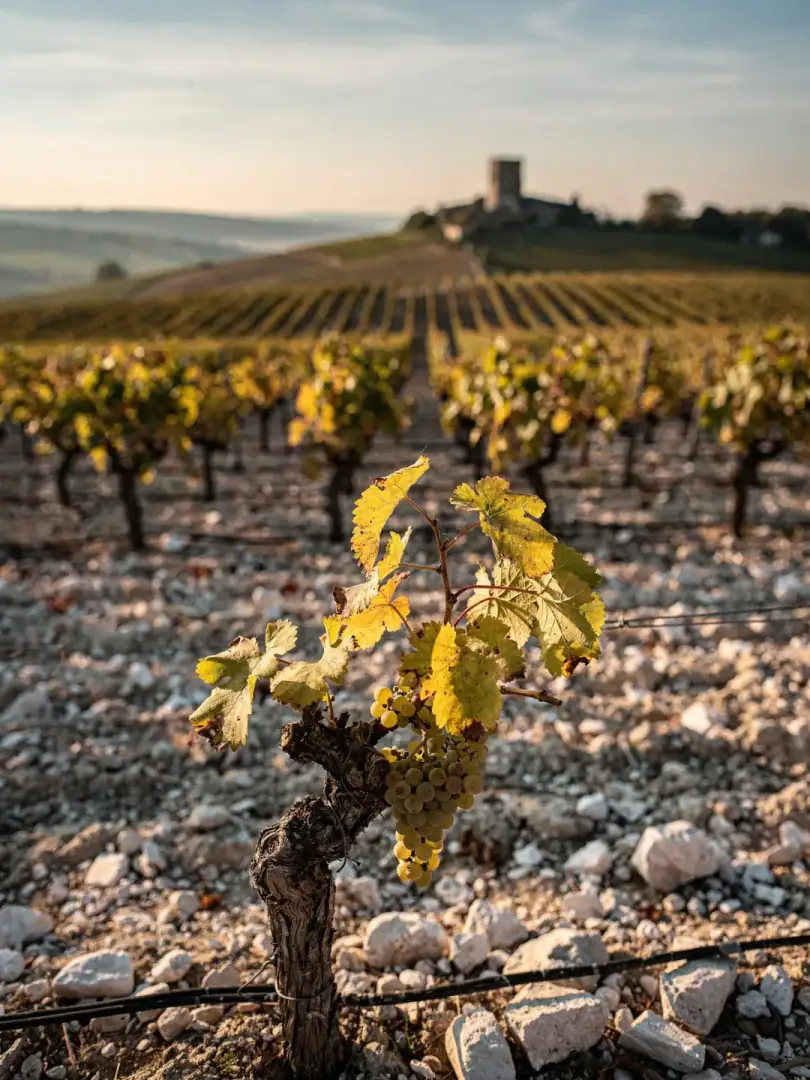
In between lies the realm of Chenin Blanc. Also known as Pineau de la Loire, it's been documented on the Loire since the ninth century, and no other white variety is so versatile: bone-dry in Savennières, honeyed and sweet in Vouvray or the Coteaux du Layon, sparkling in Crémant de Loire. One and the same grape, three completely different wines, depending on how ripe it's harvested.
Cabernet Franc, here usually called Breton, is responsible for the red wines. An old story claims a monk named Breton brought the variety from the Basque Country to Chinon on the orders of Cardinal Richelieu. It's not documented, but it's a nice tale nonetheless. What is documented is what genetic testing at the University of California, Davis showed in 1997: around four hundred years ago, Cabernet Franc crossed by chance with Sauvignon Blanc and became a parent of Cabernet Sauvignon. So the Loire has its own varieties — and it also stands at the origin of the world's most famous red wine grape.