Galets & Schist
Terroir
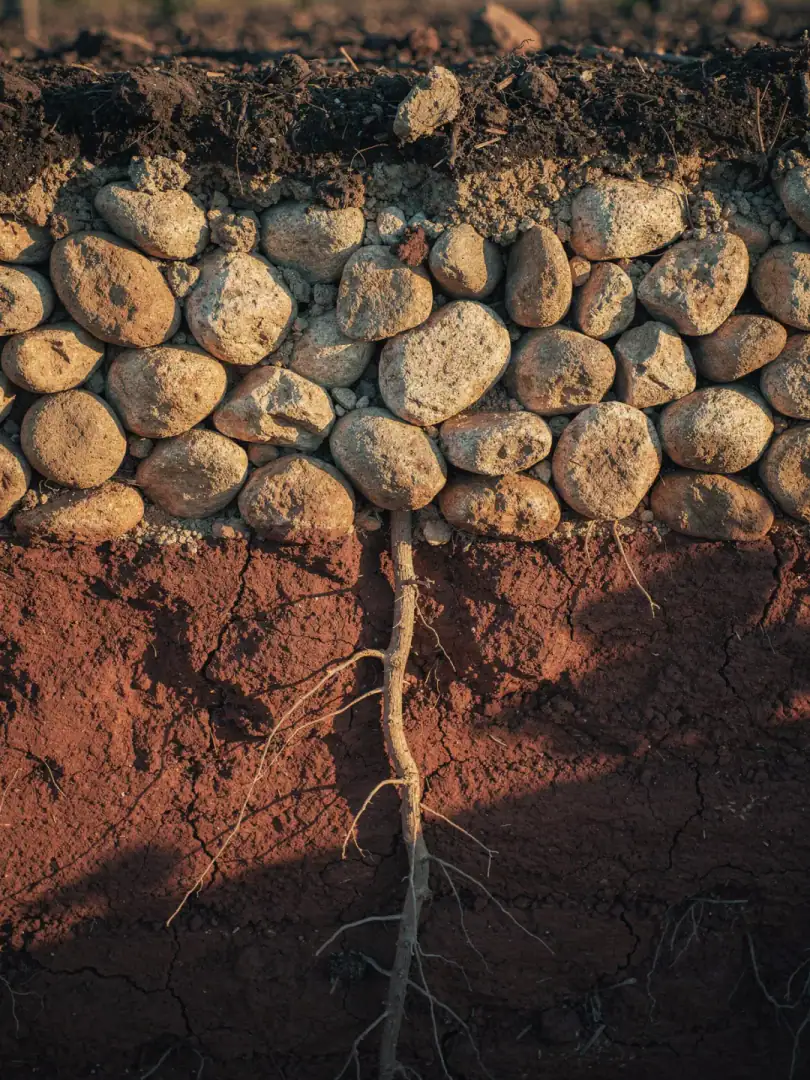
Dig a hole in a vineyard near Châteauneuf-du-Pape and you'll hit stones almost immediately: fist-sized, rounded pebbles, smooth as beach stones — which, in fact, they are. They're called galets roulés, rolled pebbles. Here they lie by the millions.
Their story begins in the Alps. Glaciers and the young Rhône pushed the rubble many kilometers downstream, rounding the chunks along the way. When the water retreated, a thick layer of these pebbles remained on a terrace of red clay. This very terrace now carries a large share of the vines at Châteauneuf-du-Pape.
The stones work like an oven: during the day they store the sun's warmth, at night they release it back to the grapes. Even in the hottest August, barely any water evaporates from the clay beneath the pebble layer. Still, the roots must reach deep, down to three meters, since there are almost no nutrients to be found up among the stones.
In the north, on the Côte-Rôtie, the soil looks completely different: no round pebbles, but fractured rock. The Côte Brune consists of dark, iron-rich mica schist that gives the wine austerity and longevity, while the Côte Blonde sits on pale gneiss, yielding softer, more fragrant wines. The two slopes lie only a few hundred meters apart, yet taste as if they came from different continents.
What both soils share is poverty: neither pebbles nor schist give the vine much to work with. That's exactly what forces it to root deep and bear few, but concentrated, grapes. A rich, moist soil would never produce great wine in the Rhône Valley. It would only produce more of it.
A thin, often bone-dry layer of grass and decomposed leaves between the first pebbles.
The root: Only the finest root hairs sit here — the first to dry out in summer.