Schist & Scree
Soils
On the terraces of Banyuls and Collioure, the slopes drop toward the sea at gradients of up to fifty percent. You feel it in your calves after just a few steps. Small dry-stone walls of layered schist hold each individual terrace in place. Where rainwater needs to drain during a storm, angled stone channels guide it down in a controlled way — the winegrowers call these channels peus de gal, cock's feet, after their shape.
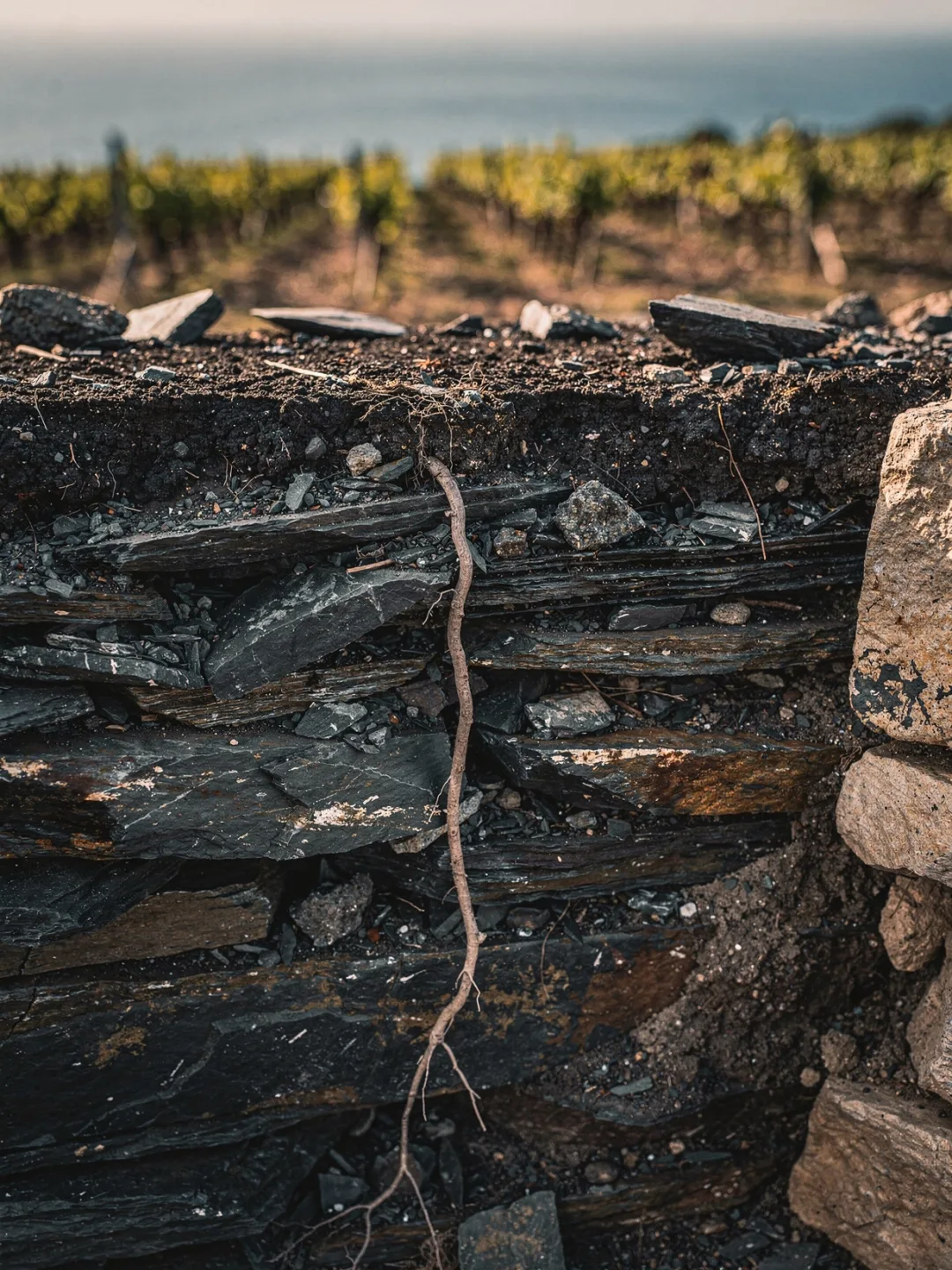
Beneath the thin layer of humus lies almost the same rock everywhere: dark, brittle schist. It breaks apart into plates and is covered by barely twenty to fifty centimeters of loose weathered debris. Below that, the massive bedrock begins immediately. The vine root has to force its way through, finding hardly any nutrients, but plenty of warmth: schist stores solar energy during the day and releases it again at night, which speeds up the ripening of the berries.
The soil looks completely different just a few kilometers inland, on the terraces of the Agly and Têt near Rivesaltes. There, rounded river pebbles, galets roulés, are embedded in red clay, sometimes six to eight meters deep. At a depth of roughly thirty to forty centimeters, lime cements these pebbles into a hard layer called taparas. It stores water like a sponge and releases it to the vine only during the hottest weeks of summer.
A misconception persists here too: people often read that you can taste schist in the wine as minerality. That's not quite true. What reaches the vine from the rock are dissolved minerals in such tiny quantities that no tongue could ever identify them as such. The soil works indirectly: through the warmth that dark schist stores, and through the small amount of water that taparas or schist crevices hold back. Together, both force the vine into small, concentrated berries. It's this detour that matters, not the rock itself.
A thin, dark layer of decomposed vine wood and hillside herbs. On steep terraces, often no more than a hand's width.
The root: This is where the fine roots sit. After a dry day of Tramontane wind, they're the first to run out of water.