Wind, Sun, Drought
Climate
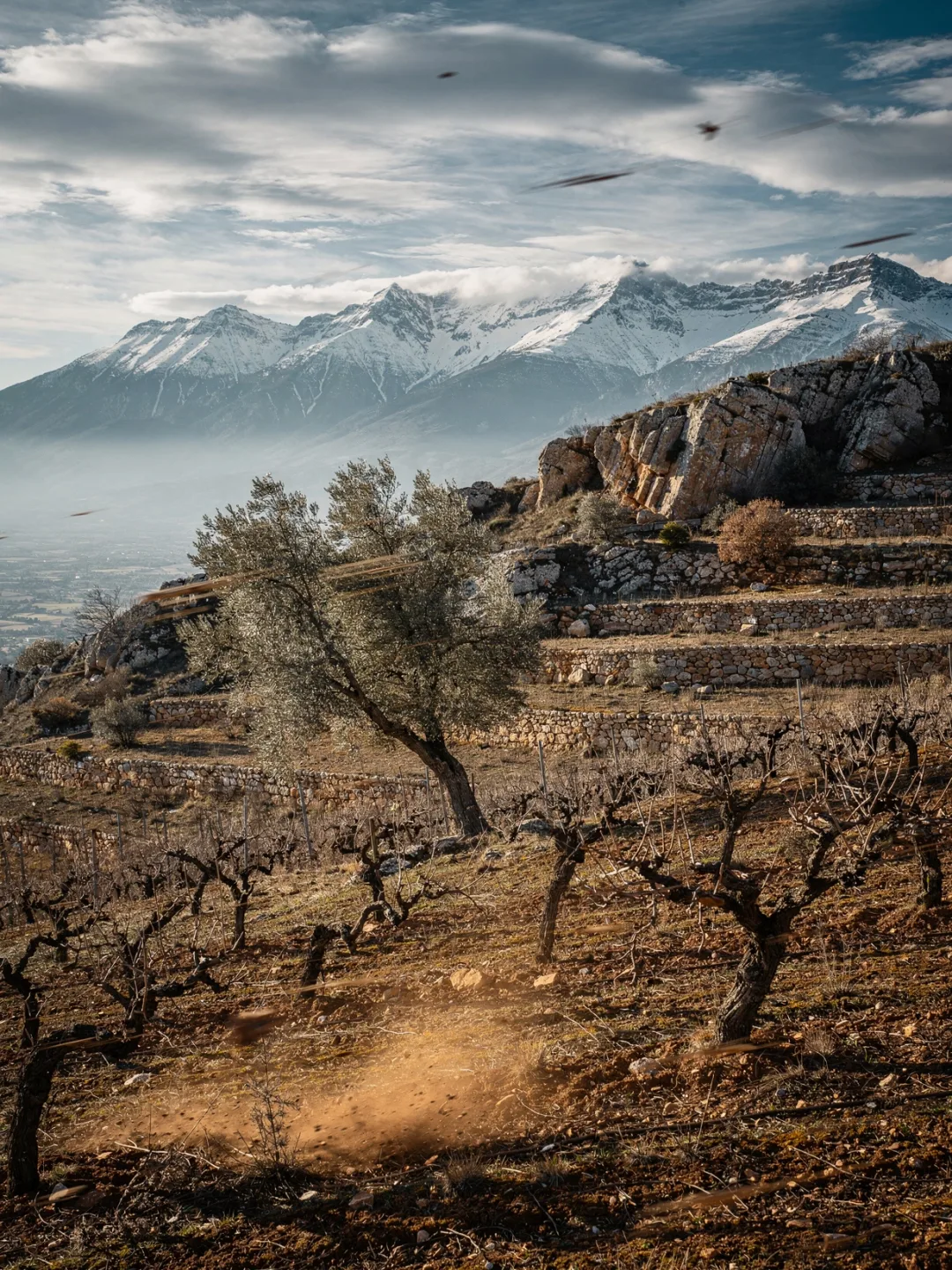
The Roussillon is one of the driest major wine regions in France, and the reason has its own name: the Tramontane, the cold, dry northwesterly wind that sweeps down from the snow-capped Pyrenees onto the plain. In Perpignan, it blows on average around 120 days a year, with gusts exceeding 60 kilometers per hour, and in strong years on more than 130 days. It dries the grapes within hours after rain, keeping fungal disease at bay. At the same time, it draws away every drop of water the vine actually needs.
Add to that abundant sunshine. The sun shines here for around 2,500 hours a year, with sunshine recorded on roughly 300 days. Rainfall, by contrast, is tightly concentrated: 500 to 650 millimeters a year, mostly in heavy thunderstorms during spring and autumn, with weeks of nothing in between. For a vine that needs water between May and September, this makes for a harsh equation.
Winemakers answer with an old training method: the gobelet, the free-standing bush vine without wire or stake. Kept low, it casts its own shadow on the ground and needs no trellis, which the Tramontane would tear apart anyway. Yields stay small, often under thirty hectoliters per hectare on the old Grenache and Carignan plots. This very scarcity is what later shows up in the glass—quantity was never the goal here.
The temperature swing between day and night is what saves the acidity. In the mountain villages of the Fenouillèdes, at three to four hundred meters elevation, the air cools noticeably at night. Down on the coast at Banyuls, by contrast, conditions stay almost Mediterranean-mild. These two climate zones lie barely forty kilometers apart, explaining why a wine from Tautavel tastes tauter than one from Collioure.