Gravel Terraces & Causse
Soils
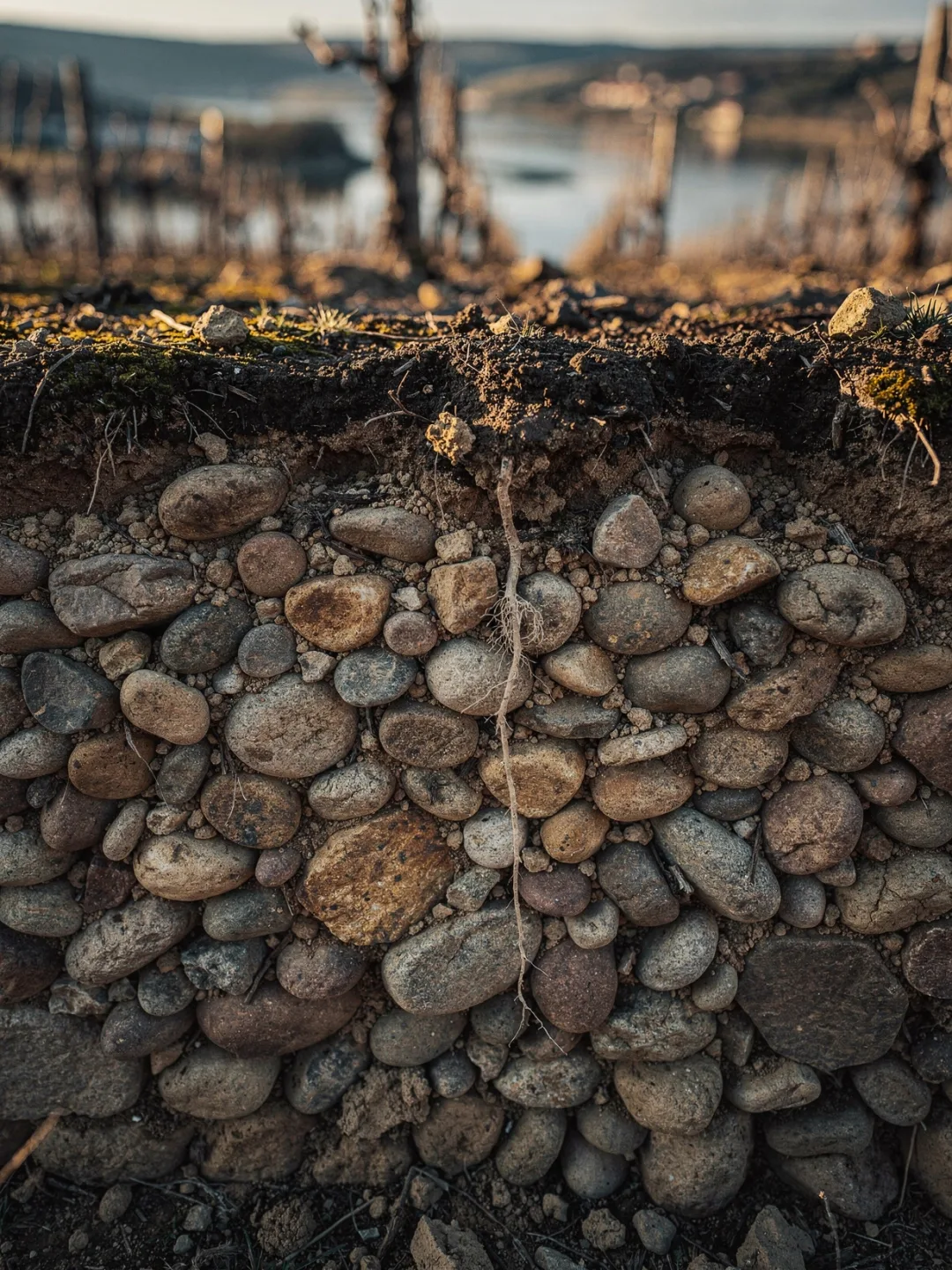
Dig a hole in a vineyard on the first terrace above the Lot. You won't get far. After just a few shovel strokes, round, fist-sized pebbles clatter against the tool—gravel that the river left behind roughly twenty thousand years ago, when its bed lay much higher than today.
Since then, the Lot has carved itself ever deeper, leaving behind three terrace levels, each its own window in time. One river, three eras. The oldest and highest is roughly five hundred thousand years old and today covered with coarse limestone rubble. The middle one, a good two hundred thousand years old, carries dense layers of rounded gravel. The youngest, barely twenty thousand years old, lies directly along the river's current course and consists of sandy, finer material. Three soils, one river, and winegrowers choose their plots accordingly.
These pebbles store heat during the day and release it again at night, which speeds up ripening. Water drains quickly between them, and the vine's roots must dig deep just to find anything at all. That's exactly what counts. This forces the plant to produce small, concentrated berries—and with Malbec, more skin means above all one thing: even more of the color that makes vin noir so black.
High above the valley, a completely different soil begins. Nothing comes easily here. The Causse, a barren limestone plateau between two hundred fifty and three hundred fifty meters, has barely any soil covering the bare rock. Vines here dig meters through cracks in the stone, extracting whatever moisture remains, producing wines that are more austere and mineral than those from the gravel terraces down by the river.
In Madiran, meanwhile, two soils alternate within the smallest of spaces: calcareous clay on the hills and boulbène in the valley, a fine, poorly draining silty soil that turns wet underfoot in winter and bone-dry in summer. Both remain lean. In Jurançon, finally, only a thin layer of soil covers the Poudingue in many places—a cemented conglomerate of rounded limestone pebbles once washed down from the Pyrenees. This rock barely breaks apart. But it holds enough water to let Petit Manseng ripen through an entire autumn.
A thin, dark layer of leaves and grasses over the gravel terrace. After heavy rain, it dries out quickly again, because the water immediately sinks into the stones below.
The root: The fine roots sit here and drink first—in every dry summer, they're the first to run out.