Autan, Foehn, Ocean
Climate
The Atlantic lies just a hundred kilometers west of Madiran, and its moisture shapes the spring. Plenty of rain in April and May pushes the vines to sprout quickly. After that, the Pyrenees take over, rising thirty to sixty kilometers to the south and giving the region its own weather moods. That's really all it takes.
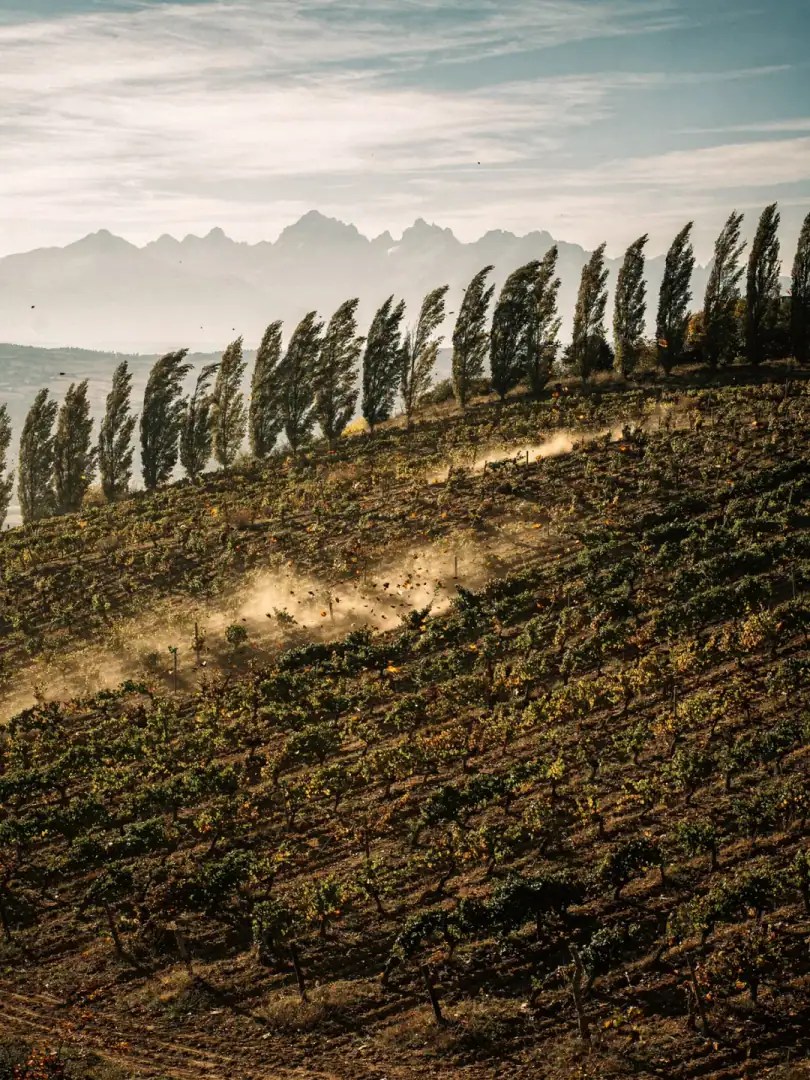
A wind ensures that the grapes stay dry despite this. The Vent d'Autan blows warm and dry from the southeast across an area of roughly thirty-five thousand square kilometers, usually between May and September, sometimes for days on end. Farmers once called it the wind devil, because it can flatten entire harvests. Usually they exaggerate. For the vineyard, though, it's still a blessing: it dries wet foliage within hours and keeps fungal diseases at bay that would otherwise explode in humid air.
Over Jurançon, the same effect appears in a different form. A foehn-like downslope wind streams down from the Pyrenees, warm and drying, especially in autumn, when Petit Manseng spends its final weeks on the vine. This dryness is the reason the grapes can shrivel into raisins here at all, instead of rotting on the vine. Elsewhere, that's barely possible.
In Madiran, the difference between day and night ripens the grapes without stripping away their acidity. Hot late-summer days are followed by cool nights, and this shift slows the breakdown of acid while the sun continues to ripen sugar and tannin during the day. At night, temperatures drop quickly. It's no coincidence that one of France's most tannin-rich varieties calls exactly this place home.
Cahors lies in between: more continental than the coast, milder than the Pyrenean foothills. On the limestone plateau above the Lot, between two hundred fifty and three hundred fifty meters, it blows noticeably cooler than down in the valley. Winegrowers who plant higher therefore harvest later and retain more acidity in the wine—an advantage now that harvests in warm years start earlier and earlier.