Taming Tannin, Shriveling Grapes
Production
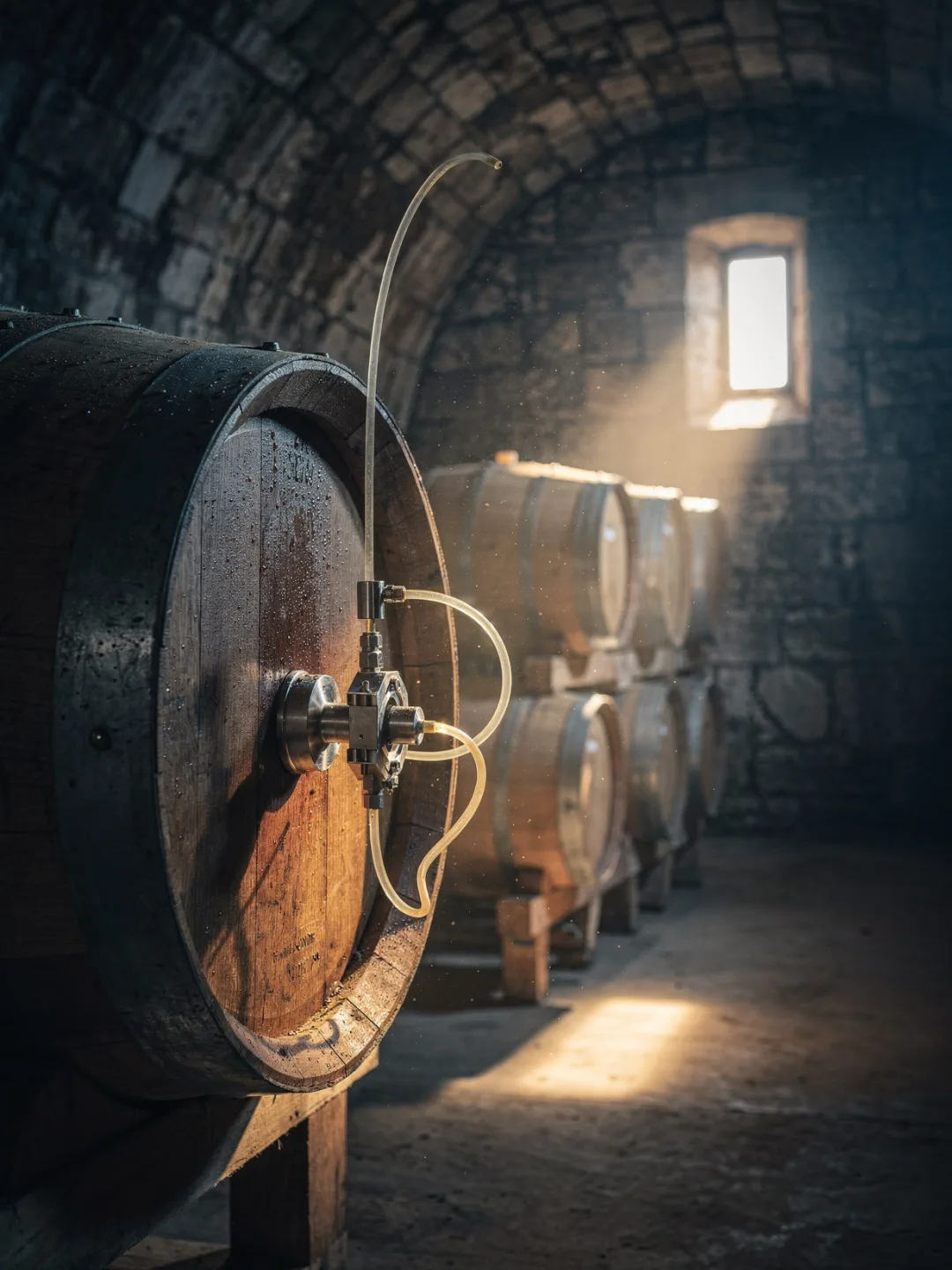
In Madiran, a single winemaker invented a technique in the early nineties that is now used in cellars worldwide. Patrick Ducournau was troubled by the aggressive, harsh tannin of his Tannat and began feeding wine small, controlled doses of oxygen—micro-oxygenation. A simple idea. The method mimics what a barrel does anyway, just more precisely and measurably. In 1996 the European Union officially permitted the process, and cellar masters from Bordeaux to Chile have used it ever since.
Cahors, by contrast, relies on time rather than technique. After fermentation, the Malbec stays on its skins for several weeks so that color and tannin are fully extracted, after which it ages for at least six months in barrel or tank, often considerably longer. Time instead of chemistry. This long maceration explains why a young Cahors appears almost black in the glass and only reaches full drinking maturity after years.
Jurançon takes the opposite path, forgoing almost all cellar technique, because the work happens in the vineyard. Petit Manseng stays on the vine well into November or even December, long after other regions have finished harvesting. That takes patience. The dry downslope wind from the Pyrenees causes the berries to shrivel like raisins in the process, called passerillage. For the latest stage, vendanges tardives, the regulations require at least 281 grams of sugar per liter of must—more than double that of a dry wine.
Gaillac, meanwhile, preserves a sparkling wine method older than the one from Champagne. In the méthode ancestrale, here also called méthode gaillacoise, the still-fermenting wine is bottled early. Nothing is added. Fermentation finishes there, the resulting carbon dioxide has no way to escape, and the carbonation binds into the wine—entirely without added sugar or dosage. Already in the sixteenth century, an Occitan poet described this sparkling wine from Gaillac, made purely from Mauzac.
What unites all four methods is the same underlying idea: the cellar master responds to a characteristic of the grapes rather than suppressing it. Never the other way around. Too much tannin in Tannat, too little sweetness in late-harvested grapes, too much residual sugar in fermenting Mauzac—every answer in the Southwest emerged from a concrete problem posed by its own grape variety.