Rain Instead of Drought
Climate
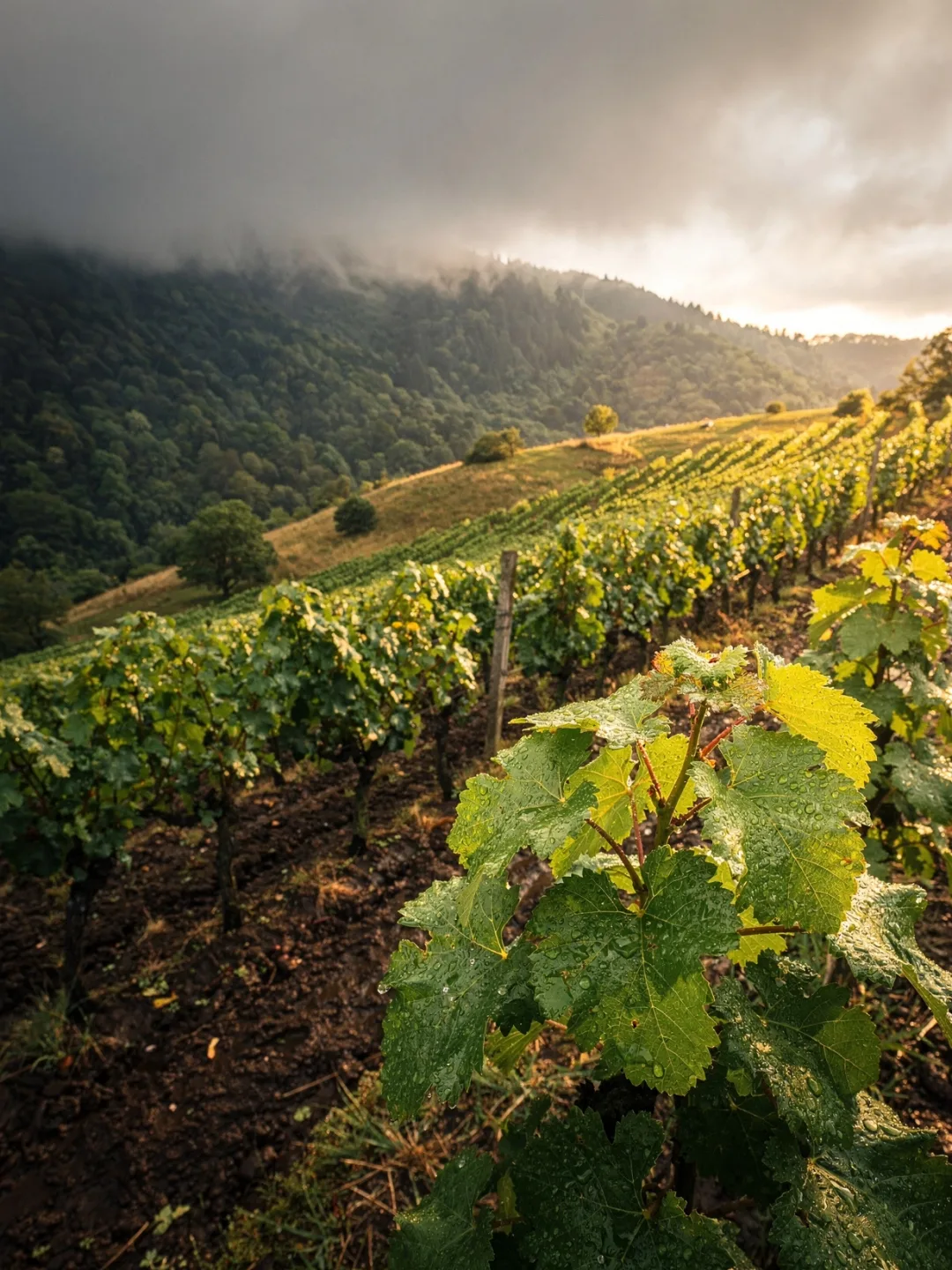
In Sviri, roughly a meter and a half of rain falls each year. That's about twice as much as in eastern Kakheti, where the well-known wine town of Telavi averages around seven hundred fifty millimeters. The difference has a name: the Likhi Range, which splits Georgia from north to south. It catches the moist winds coming off the Black Sea in the west, before they can reach the drier east.
It's still warm, though. The average annual temperature around Sviri is fourteen degrees Celsius. In August it climbs on average past twenty-four degrees, while in January it usually stays just above freezing, at plus four degrees. Between late March and late November, daily temperatures reliably exceed ten degrees. That's more than two hundred thirty consecutive days in which the vines can grow.
This warmth comes at a price: high humidity. Downy mildew and powdery mildew, two different fungal diseases despite the similar names, rank among winemakers' biggest worries, which is why traditionally trained vines are grown high on the double-sided Georgian trellis, so that wind and sun can pass between the leaves and dry them out faster.
Of all times, it's in August, right in the middle of the ripening season, that the picture reverses. Then only around seventy millimeters fall, barely more than evaporates in the same period. In some years, winemakers even have to irrigate their vineyards — right in the middle of one of Europe's rainiest wine regions.
The vineyards themselves sit low by European standards, mostly between fifty and five hundred meters. Around Sviri it's about two hundred twenty meters, and in the new Obcha zone between one hundred twenty and four hundred twenty. Altitude, then, matters less here than elsewhere. What matters more is whether a slope gets enough wind to dry out again between two downpours.