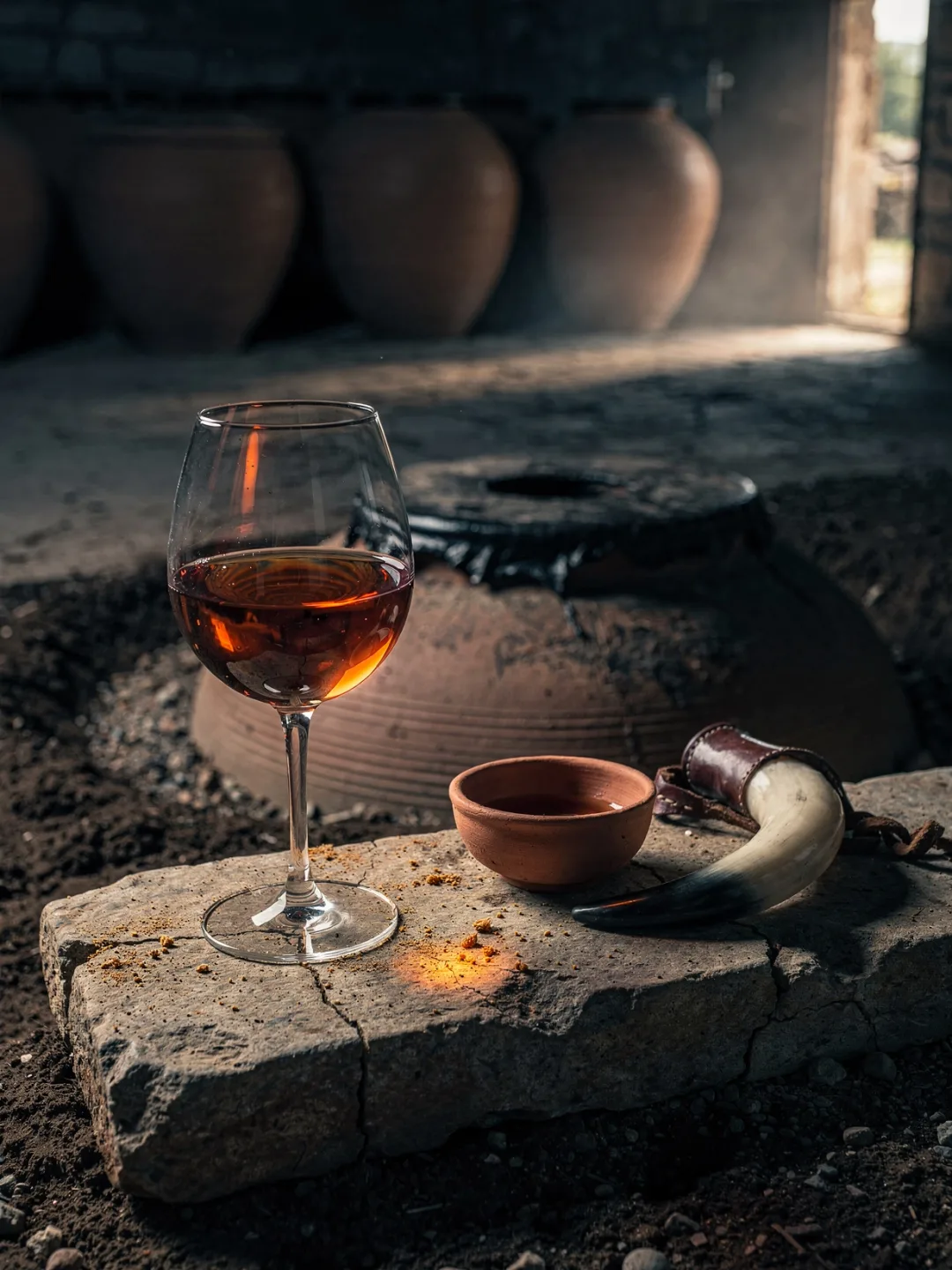
Horn and Glass
Glassware
Anyone toasting with a khantsi at a grand Georgian feast, the supra, must empty the drinking horn in one go before setting it down. Still, it's no good for real tasting. It has neither a base to stand on nor an opening to swirl. Kakheti's wines need a second, calmer vessel.
Amber wines made from Rkatsiteli, Mtsvane, or Kisi spend months on the skins. They carry tannin usually associated only with red wine. A too-narrow white wine glass traps this structure and makes the wine seem flat. A rounder glass with a wide opening, similar to a red wine glass, works better, giving the wine room to breathe and truly releasing its dense aromas of quince, dried apricot, and walnut.
In terms of temperature, amber wine sits between white and red. Twelve to fourteen degrees Celsius is a good benchmark — cooler than red wine, but noticeably warmer than a crisp stainless-steel Rkatsiteli. Served too cold, exactly the aromas that make qvevri aging worthwhile tend to disappear.
Saperavi, in turn, calls for a large, tall glass, the kind used for robust Bordeaux blends. Its acidity is high, and so is its tannin. A narrow glass would push both to the forefront instead of holding them together. Sixteen to eighteen degrees Celsius is enough for a young wine; a ten-year-old Mukuzani can comfortably be a touch warmer.
A young Saperavi handles air well. It benefits from half an hour in a decanter before it hits the glass. The old bottles from Tsinandali, some resting in the cellar for over a hundred years, are rarely seen by any guest, but they show that a wine from Kakheti, properly stored, can carry through decades — far beyond anything the horn at the dinner table ever demanded.