From Qvevri to Barrel
Production
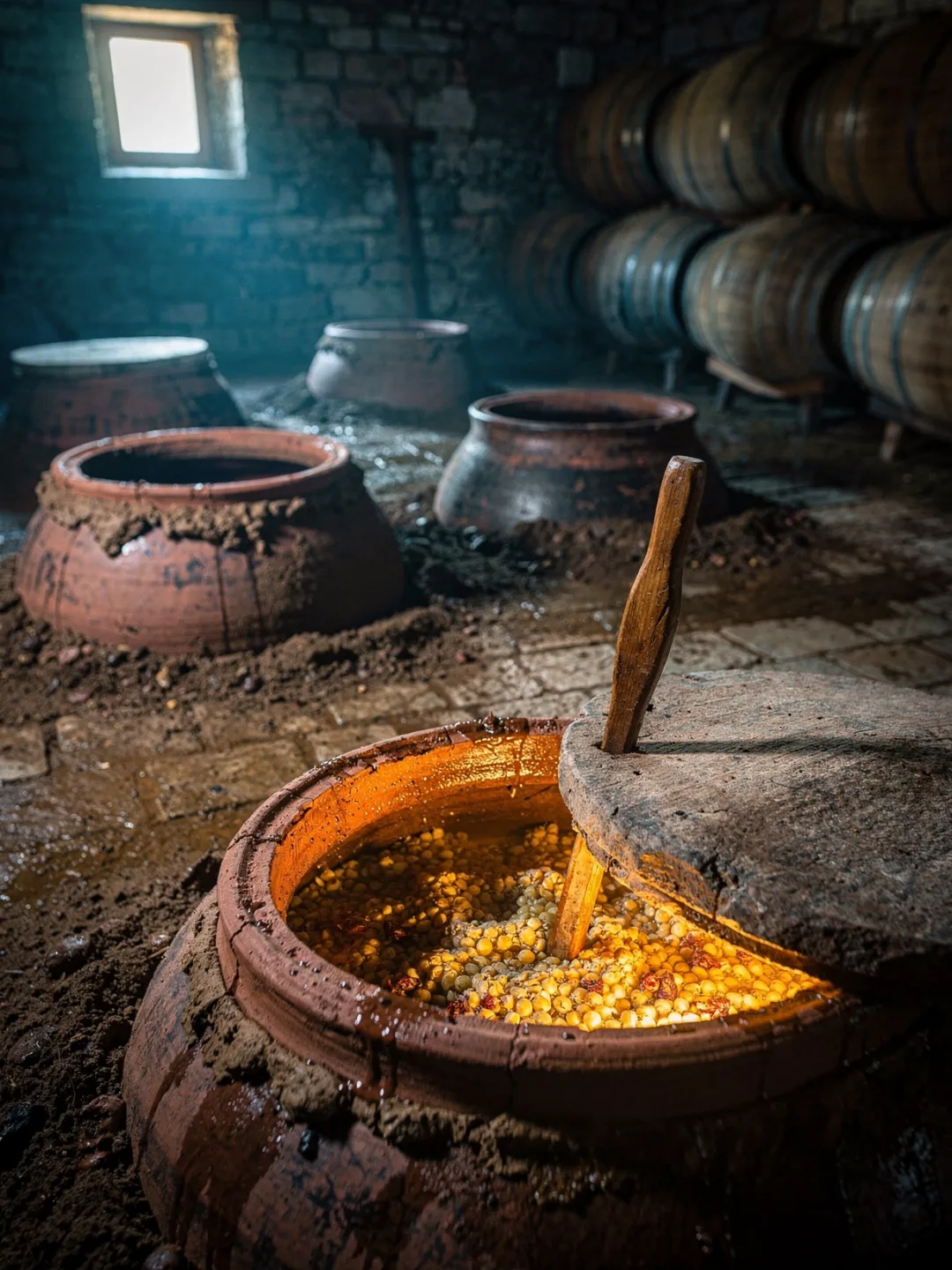
A potter in Vardisubani starts with the base of a jar. He keeps building for weeks. In thin coils of clay, an egg-shaped vessel rises upward, often holding more than a thousand liters — a qvevri. Lined inside with beeswax, it ends up buried to the rim in the earth of the marani, the wine cellar. There, the temperature stays between thirteen and fifteen degrees Celsius year-round, without anyone needing to cool or heat it. In Vardisubani near Telavi, potter families still build these vessels today just as their grandfathers did.
Whole grapes go into the qvevri, skins, seeds, and often stems included, and stay there on the skins for five to six months. This is exactly what sets the Kakhetian method apart from almost every other white winemaking tradition in the world, and it's how white grape juice becomes an amber-colored wine with tannin, long before anyone outside Georgia ever coined the term orange wine.
The egg shape of the qvevri is no accident. During fermentation, the must naturally circulates up and down on its own, without any pump. At the tapering bottom, the pomace collects. From this, chacha is distilled, a clear pomace brandy found in nearly every Kakhetian household.
For Saperavi, skin contact time is shorter. Two to four weeks are enough for color and tannin. Stricter rules apply for the Mukuzani appellation: at most ten tons of grapes per hectare, at least nineteen percent sugar at harvest, fully fermented wine, and then at least three years in oak barrels before the bottle can be filled.
Since Chavchavadze's time, a stainless-steel tank or an oak barrel often stands alongside the qvevri, and many producers today do both: part classically Georgian in clay, part European in barrel. Winemakers still argue over which path is better. In the end, both versions usually end up on sale side by side.