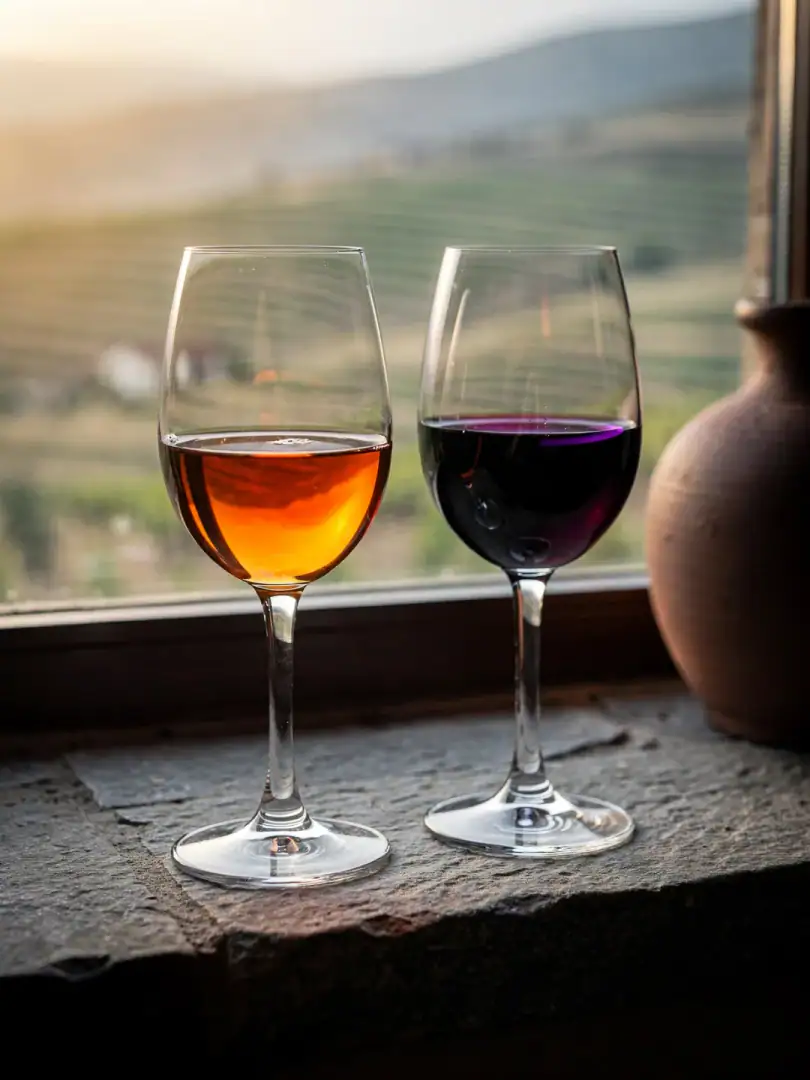
An Amber Wine
Tasting
A glass of amber wine made from Rkatsiteli reveals its journey through the qvevri right away in its color. Hold it up to the light. The color ranges from pale amber to deep copper, depending on how long the skins stayed in the qvevri — an ordinary white wine stays pale, while a Kisi macerated for six months looks almost like a light red wine. With Saperavi, the color is even more extreme. Because the flesh itself is dark, the glass fills to the rim with an almost black violet through which barely any light passes.
Smell twice, once with the glass still and once after swirling. With a Kisi, ripe pear comes first, along with a hint of marigold. Then walnut follows, with a touch of tobacco that only emerges through contact with air. With Saperavi, beneath the dark fruit there's often a scent of dried herbs and black pepper, sometimes even a hint of ink, fitting for a name that means dye.
On the palate, both styles share the same Kakhetian signature: plenty of acidity, plenty of tannin, little compromise. In amber wine, the tannin comes from the long skin contact. In Saperavi, it also comes from the dark skin and the colored flesh. A young wine can seem almost austere at first, nearly like a strong tea, before the fruit underneath shows itself after a few minutes in the glass.
Anyone wanting to taste the same grape juice sweeter should try Kindzmarauli from Kvareli. Fermentation here is stopped before all the sugar converts, with no additions from outside. What remains is three to five percent residual sugar at just thirteen percent alcohol by volume. The acidity still stays high enough that the wine never tastes sticky, only round.
Finally, count the finish. With a simple Rkatsiteli, it might last five seconds. With a well-aged Mukuzani, it runs well past twenty, since tannin, acidity, and time in barrel together create a length that can't be added to a wine after the fact.