Limestone and Marl
Soils
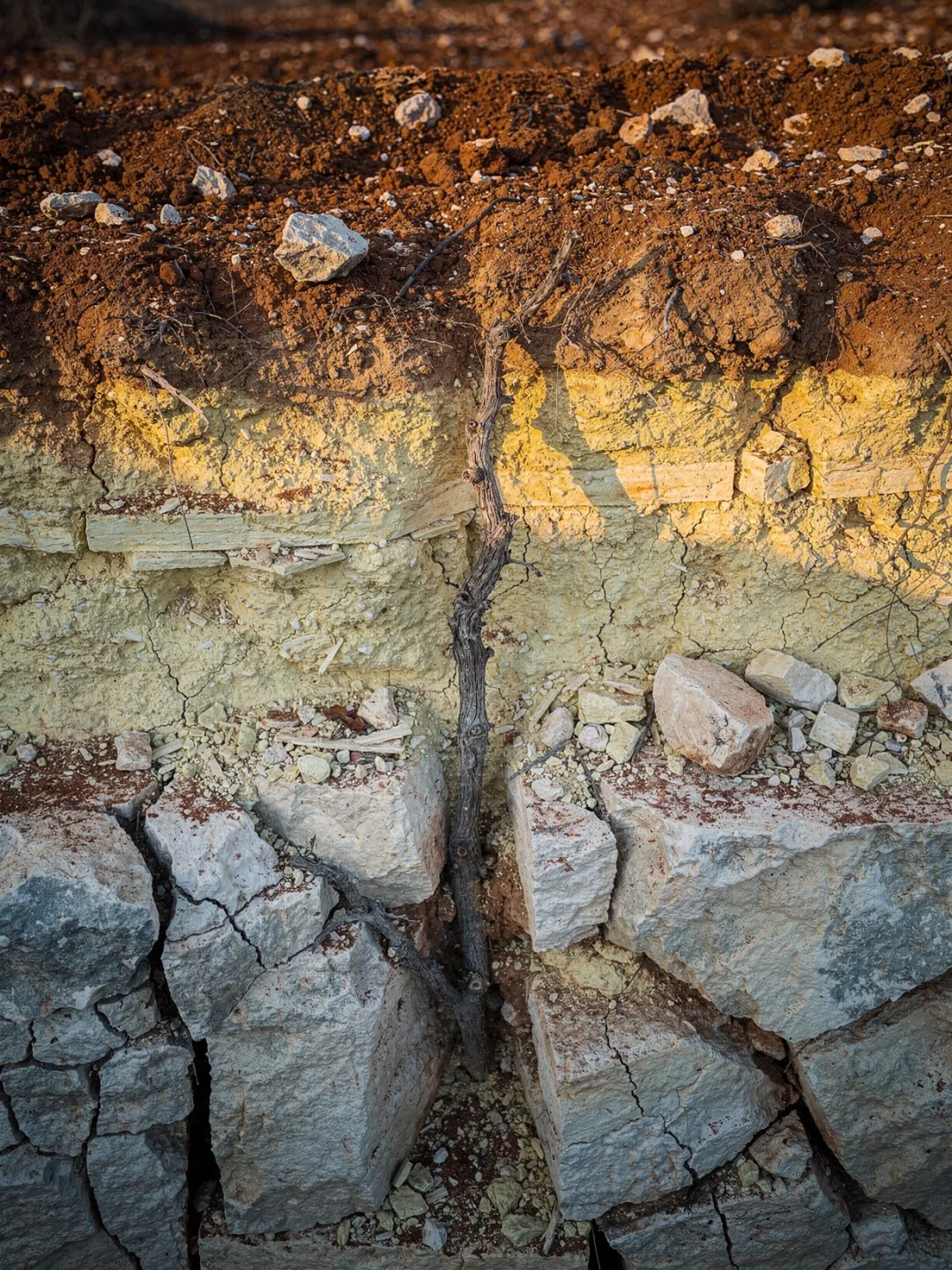
Dig a hole in a vineyard near Archanes. Before long, the shovel hits stone. Usually after twenty or thirty centimeters. Nearly seventy percent of the island consists of limestone, deposited when large parts of Crete were still seabed. This very rock underlies almost every vineyard from Peza to Sitia.
Around Archanes and Peza, the limestone has weathered into yellowish marl, a fine mixture of clay and lime, interspersed with pale, washed-out chunks of limestone. The vine root finds little nourishment here and must work its way far down to reach water. This very effort keeps yields low and the berries small.
In Dafnes, the soil is even leaner. It contains more stones and more calcium carbonate than in Peza, and the vines often stand on pure rubble. Liatiko thrives in these tight conditions. Where the soil gives little, the juice in the berry concentrates, and in the end, little water yields plenty of deep, complex wine.
A second soil type has spared Crete a catastrophe that struck half of Europe in the nineteenth century. Phylloxera, a root-feeding pest from America, struggles to move through loose sand, since it can't burrow from root to root in it, and the sandy soils of some sites kept it at bay until the 1970s. To this day, Crete has own-rooted vines that were never grafted onto American rootstock.
A stubborn myth persists here too: that the limestone somehow flavors the wine. That's not quite true — the root only absorbs dissolved minerals in tiny amounts, far too little to impart its own flavor. What limestone really does is store water and release it slowly, while absorbing heat during the day and giving it back at night. It's this detour through water and warmth that shapes the wine, not the rock itself.
A thin, reddish-brown layer of weathered limestone and clay, interspersed in places with pale limestone fragments.
The root: This is where the fine roots sit. They take up whatever the rare rain brings — and are the first to dry out.