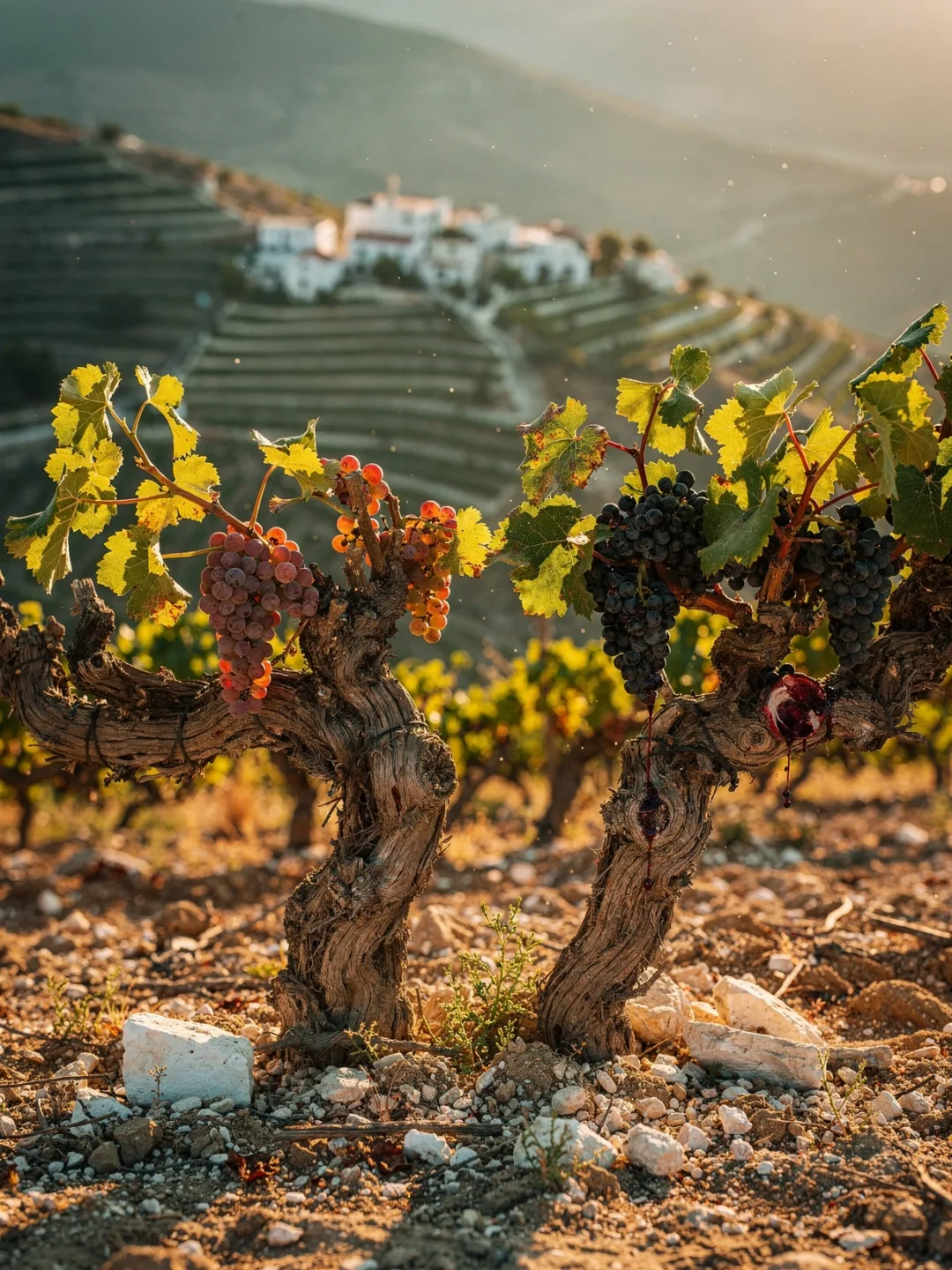
Kotsifali & Mandilaria
Grape Varieties
Kotsifali has barely any color. Its skin holds little of the compounds that make red wine red. Tannin, too — that rough coating on your gums after a sip — stays weak. But it's aromatic: ripe cherry, clove, and dried flowers, with plenty of sugar in the berry and correspondingly high alcohol in the glass. On its own, it would make a wine without backbone.
Mandilaria delivers exactly the opposite. Dark, almost violet, high in acidity, rich in tannin, and rather restrained on the nose — a variety that tastes hard and austere on its own. Only together do Kotsifali and Mandilaria make the standard red wine of Peza and Archanes: color and structure from one, fruit and softness from the other, and in Archanes both varieties must even be co-fermented. This has been the rule in both appellations' regulations since 1971.
In white wine, the island belongs almost entirely to a single variety: Vilana. Straightforward, high-yielding, citrusy. In Peza, a white wine must be made one hundred percent from it. Vidiano, by contrast, had nearly vanished twenty years ago and is now considered Crete's most exciting white variety. It carries aromas of apricot, peach, bergamot, and chamomile, with a full body that can even handle a year in oak.
Liatiko is the most contradictory of all Cretan grape varieties. It's classified as a red variety, yet it looks as pale as a rosé in the glass. The reason: barely any pigment in the skin — a trait it shares with Tuscany's Sangiovese. In Dafnes, a wine must be one hundred percent Liatiko, whether dry or sweet. In Sitia, it makes up at least eighty percent of the red blend with Mandilaria. Sun-dried, the same grape yields a honey-sweet wine that ages for decades.
Alongside these stand smaller names. Thrapsathiri complements Vilana in white Sitia at up to thirty percent, contributing more acidity and herbal aroma. Dafni and Plyto, rescued from extinction, still grow today in almost a single vineyard. Anyone who follows the eight stops of this journey will encounter Kotsifali, Mandilaria, Vilana, Vidiano, and Liatiko again — a combination found on no other Greek island. They are the true grammar of Cretan wine.