Barrel, Bottle, Law
Winemaking
Red wine from Xinomavro begins like any other: with the skins in the tank. Fermented under control at below 30 degrees Celsius, the must draws color and tannin from the blue-black skins. The colorless flesh itself contributes almost nothing. How long the skins stay in the tank is an especially delicate decision with this variety, since Xinomavro already brings plenty of tannin naturally.
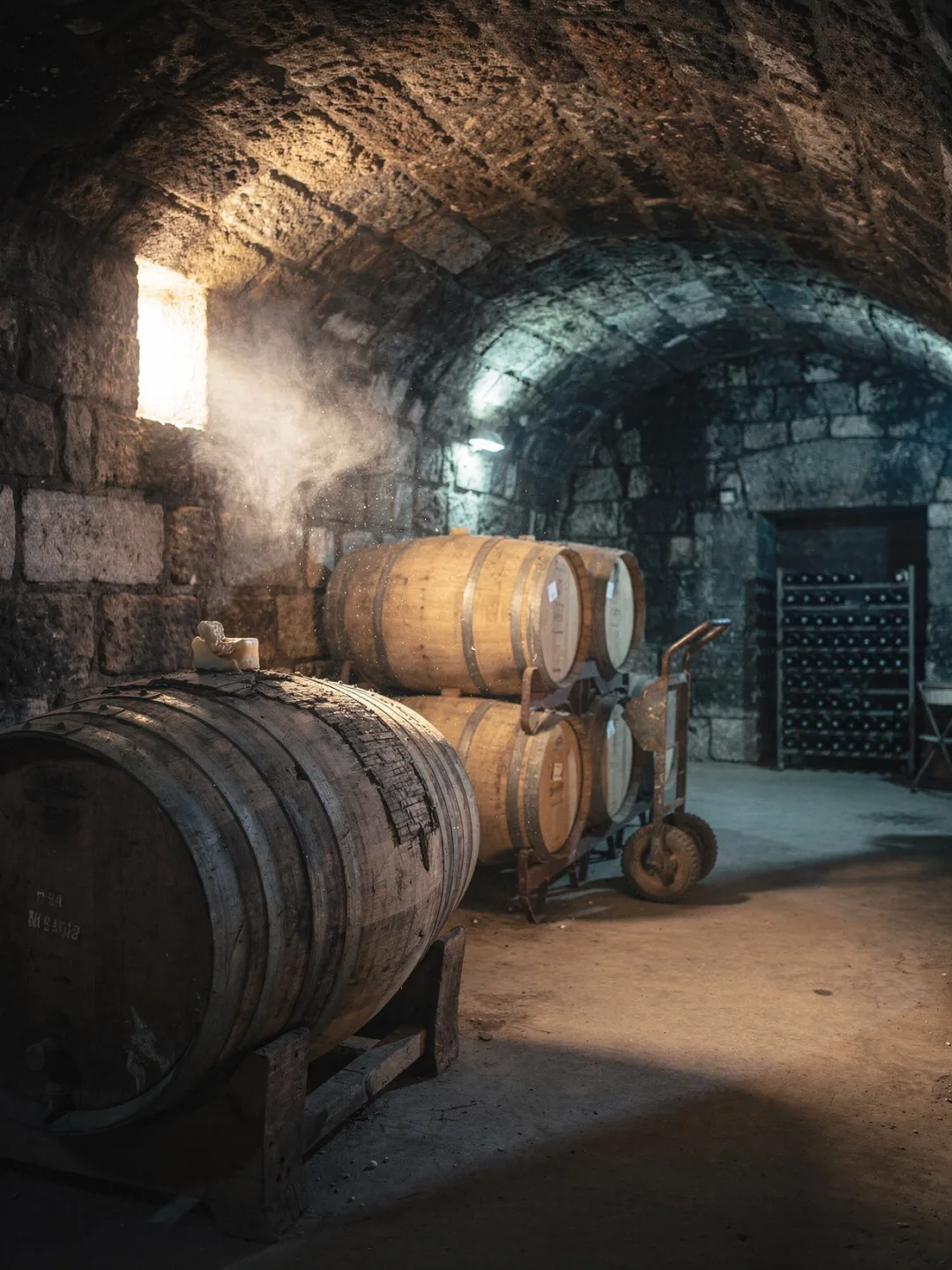
Many producers in Naoussa therefore leave the must on the skins for two to four weeks. Shorter maceration yields more approachable, fruitier wines; longer maceration produces the traditional, hard style that only softens after years. Then comes the real question of shape: a large old oak cask, which imparts almost no aroma and lets the wine breathe only slowly. Or a small French barrique with vanilla and toasty notes. At Kir-Yianni, the Ramnista still ages in large casks. The wine comes from the oldest Xinomavro vines; younger estates in the valley more often turn to barrique.
The law prescribes exact minimum aging times, and Naoussa is among the strictest zones in Greece. A simple ΠΟΠ Νάουσα must age at least one year in oak before it can be sold. This rule has remained practically unchanged in law since the designation of origin was established in 1971. For the label "Επιλεγμένος" or "Réserve," the total minimum is two years, of which twelve months in barrel and six in bottle; for "Ειδικά Επιλεγμένος" or "Grande Réserve," the total rises to four years, with eighteen months each in barrel and bottle.
Almost unknown is another allowance in the same legal text. Besides dry red wine, a semi-dry and a semi-sweet Naoussa are also permitted. At the sweetest level, up to 45 grams of residual sugar per liter are allowed. You'll hardly find them on shelves, since nearly every producer commits to the dry style. The variety itself, with its acidity and tannin, practically demands it.
In the vineyard, the work is no less strictly regulated. Vines are trained on double cordon, pruned short to about two buds, mostly grafted onto 110R or 41B rootstock. A maximum of ten thousand kilograms of grapes per hectare is allowed, yielding at most eighty hectoliters of wine — a ceiling that favors concentrated wines over abundant ones.