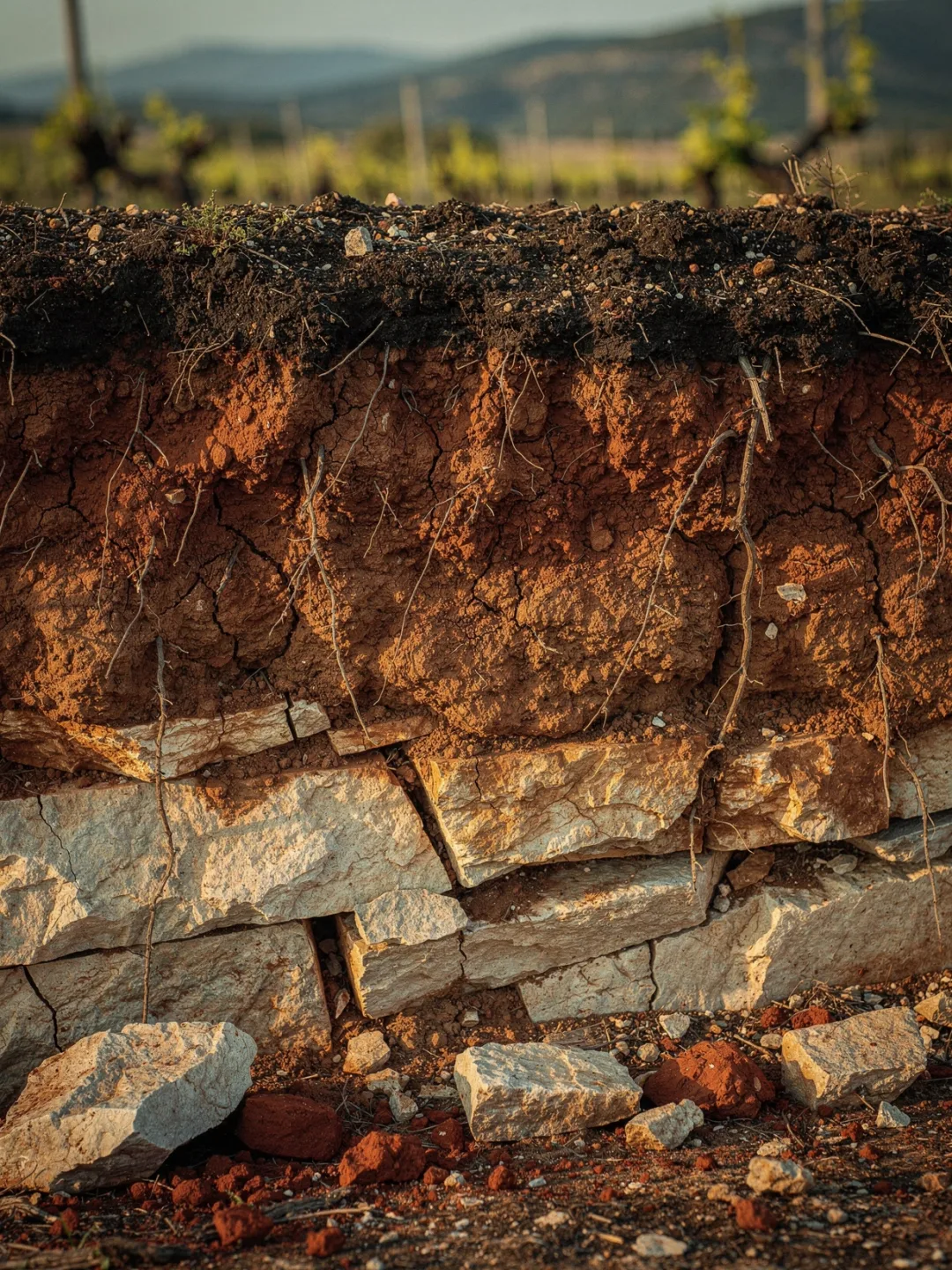
Red clay over limestone
Soils
Dig a hole in a vineyard near Koutsi, and after just a few shovelfuls the earth turns reddish. It is clay, formed from limestone weathered over millennia. Around the Mediterranean, it is known as Terra Rossa.
This red layer is surprisingly thin. Usually it reaches down only seventy to eighty centimeters before the root meets solid limestone bedrock, the very source from which the clay formed in the first place. Nutrients are scarce in this soil, organic matter nearly absent. This very poverty forces the vine to grow deep rather than wide.
Little nourishment means little yield, and little yield means small, concentrated berries. In a small berry, the skin — where color and tannin reside — makes up a greater share of the whole than in a large one. That is why the thin, poor soils of Koutsi have long been regarded by winemakers as among the region's finest sites. Some consider them Nemea's future grand cru.
Just a few kilometers away, the soil looks entirely different. Around Ancient Nemea lies deeper, heavier loam with clay and alluvial sand from the valley, which retains water and allows for higher yields. Around Gymno and Achladias, by contrast, you find coarse, gravelly, sandy soils. All three lie within a few kilometers of each other, and yet an Agiorgitiko from each of these soils tastes different, without a winemaker changing anything in the cellar.
One myth persists stubbornly: that a wine tastes mineral because the root draws minerals straight from the limestone and passes them directly into the glass. This isn't quite true — what a root absorbs are dissolved salts in quantities no palate on earth could taste. The limestone of Koutsi works only indirectly. By day it stores heat from the sun and releases it again at night. It also retains what little water falls here at all — just enough to carry the vine through the dry August.
A thin, dark layer of decomposed grass and herb remains. In the poor vineyards of Koutsi, barely a hand's width deep.
The root: This is where the fine roots sit. They catch the first rain and are the first to dry out in summer.