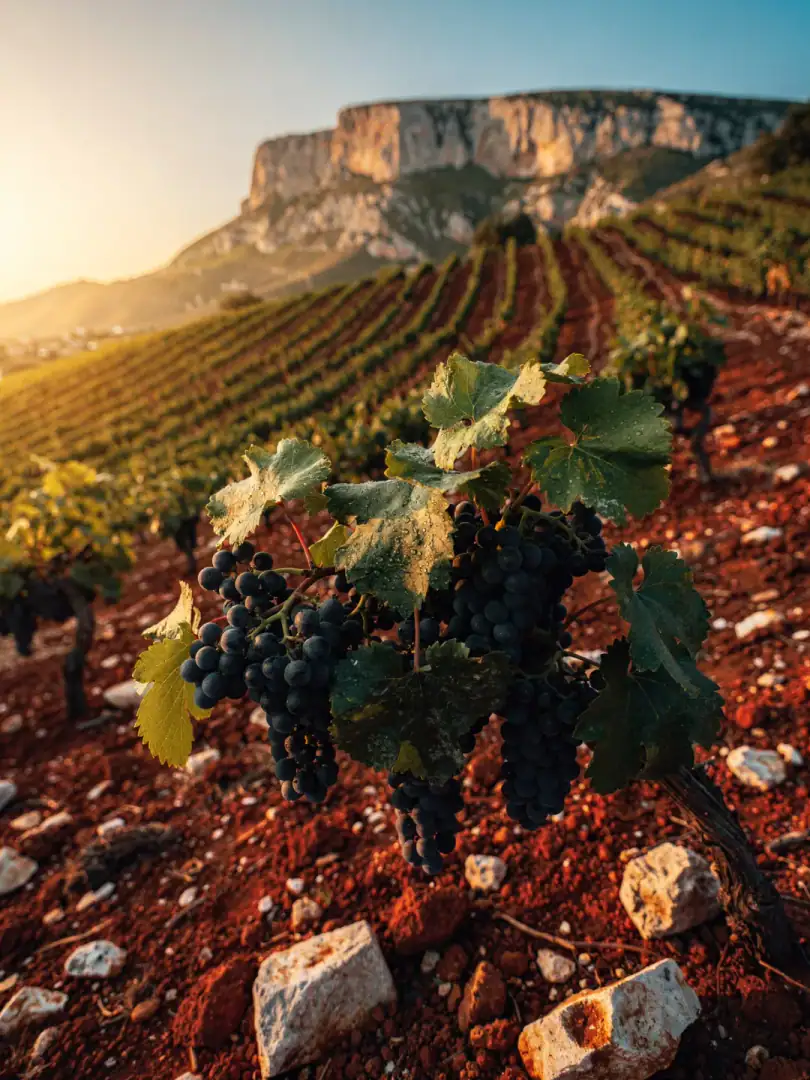
Agiorgitiko alone
Grape Varieties
Nearly every vine in Nemea carries the same grape. Since the region received its protected designation of origin, any wine bearing the name Nemea on the label must be made one hundred percent from Agiorgitiko. No other variety is permitted. The grape owes its name to a small chapel of Saint George that once stood in the middle of the old vineyards.
The berries are small, thick-skinned, and grow in loose clusters, which helps them resist rot in wet years. Even so, winemakers consider the variety tricky. Almost every Agiorgitiko vine in Greece carries some form of viral infection. On top of that, the variety is sensitive to potassium deficiency and to downy mildew, a fungus that attacks entire leaves in damp weather. Anyone who plants it needs plenty of patience in the vineyard before the cellar rewards them.
In the glass, the same grape can look astonishingly different. Vinified young with a short maceration time, the period during which must and skins ferment together, it yields a light, almost translucent wine that smells of strawberry and carries little tannin, the rough substance drawn from the skin. Leave the skins to ferment for weeks instead, and age the wine afterward in oak, and you get the exact opposite: deep garnet-red color, firm tannins, plus aromas of plum, sour cherry, violet, and tobacco. Most of the region's production falls somewhere between these two poles.
Nationwide, Agiorgitiko has become Greece's most widely planted red variety, though vineyards outside the Peloponnese often yield simpler wines. In old records it appears under the names Mavro Nemeas or Mavroudi Nemeas, meaning black grape of Nemea. For a long time it remained confined to bulk wines for the surrounding taverns, before becoming the foundation of one of Greece's most serious red wines.