Argilla & Marna
Soils
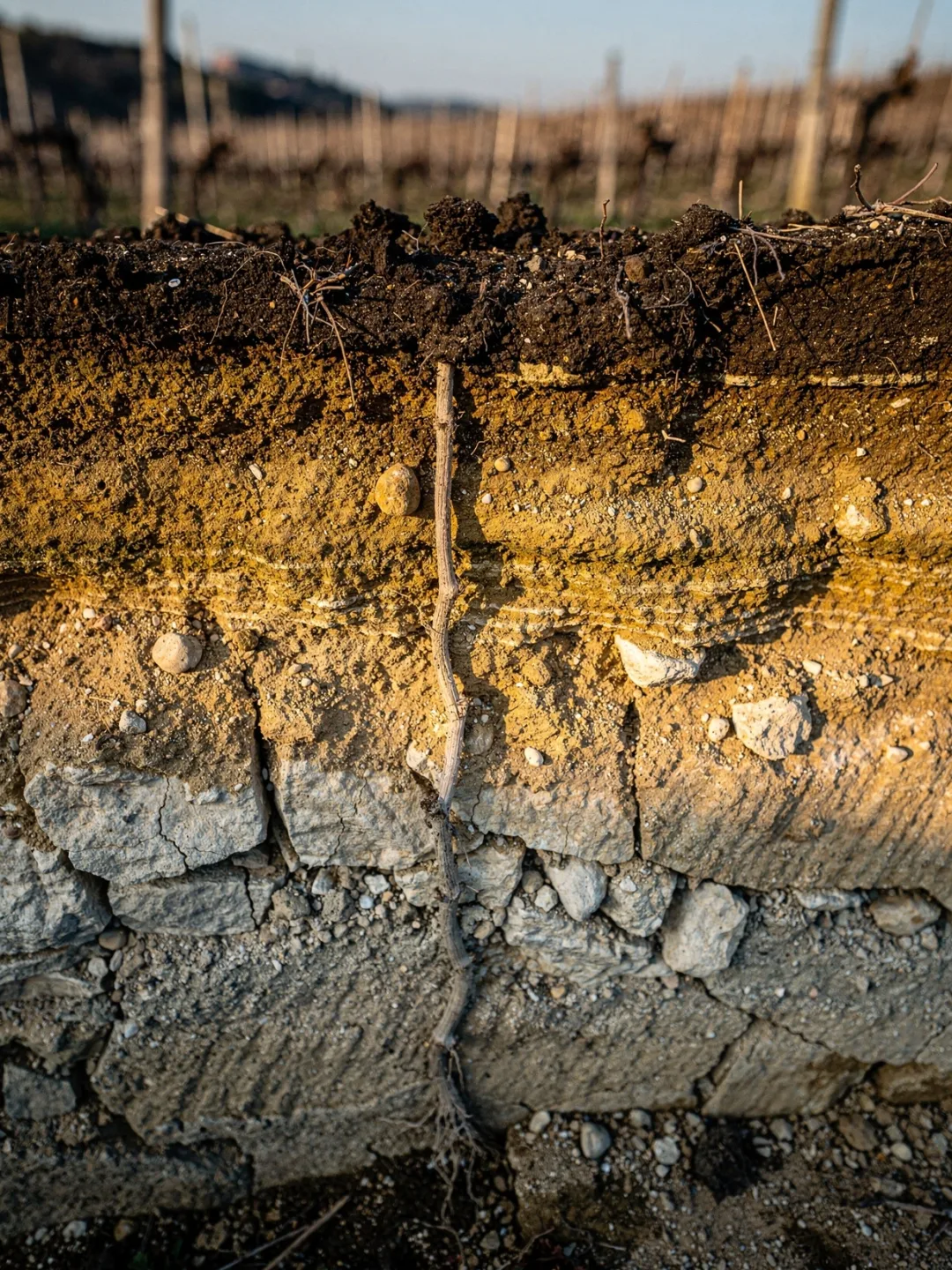
Dig a hole in a vineyard of the Colline Teramane, where the hills slope gently down toward the Adriatic. After just a few spade strokes, the earth turns ochre-colored and fine-grained: sandy loam mixed with clay. Loose enough for water to drain through, yet firm enough to hold it for a while — this is the soil on which most Montepulciano vines here stand.
Its history reaches back several million years, to the Pliocene. Where vineyards lie today, a shallow sea once stretched. Its sediments of sand and silt still form the uppermost layer of the hill chain. Further inland, closer to the Gran Sasso, the subsoil changes: there lies a harder limestone marl, called Marna, formed from the weathering of the limestone mountains.
Two soils, two characters. On the sandy loam, grapes ripen faster and the wines turn out fruitier and more approachable. On the limestone marl, by contrast, they take longer. The vine must work its way through firmer rock before arriving, and this is exactly what gives the wines of the Colline Teramane their depth and their ability to age a decade or more in the cellar.
In the river valleys, a third rule applies. Along the Tavo and Vomano, rivers have deposited sand, silt, and gravel over millennia. This is loose, warm material that heats up quickly and cools down just as fast. This is where white varieties like Cococciola and Passerina tend to grow, their freshness fed precisely by this rapid temperature shift in the soil.
How deep the root actually reaches also depends on the training system. Under the old pergola abruzzese, the leafy canopy raised on tall posts, roots often stayed shallow, because the plant put its energy into foliage. Modern Guyot training, with closer vine spacing, forces the root deeper into the marl instead, down to where moisture remains even in dry August.
A thin, dark layer of decomposed grass and root remains, on the hills of the Colline Teramane rarely thicker than a hand's width.
The root: This is where the fine roots lie. They take up whatever the rain brings, and are the first to run dry in drought.