Power & Cherry
Glassware
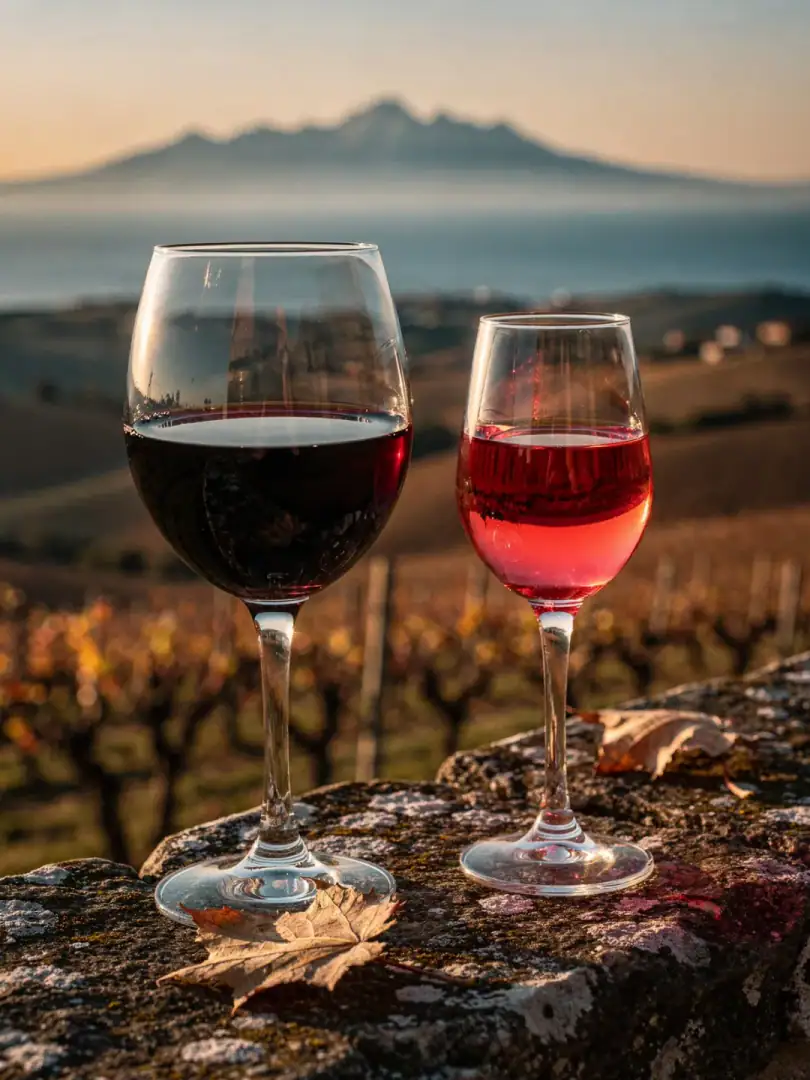
Montepulciano is one of Italy's darkest red wines, deep violet to nearly black, with tannin you can practically chew. It needs a large, bowl-shaped glass like a Bordeaux glass. The broad surface at the base draws oxygen to the wine and rounds out the tannin before it even reaches the tongue. A narrow glass would only trap its power.
Cerasuolo, the cherry-red rosé made from the same grape, calls for the opposite. It lives on freshness, not power, and belongs in a narrower, tulip-shaped glass that concentrates the aroma of red berries instead of letting it escape. Served cold, it shows best at ten to twelve degrees Celsius. Warmer, it quickly turns tired and flat.
With the whites, the biggest mistake lies in the size of the glass itself. A Trebbiano made in the style of Edoardo Valentini is dense, almost oily, with the extract of a small red wine, and a tiny, narrow glass meant for light white wines does it no justice. It needs room, much like a mature Chardonnay, so its aromas of honey and wax can unfold.
Temperature is where much goes wrong. A young Montepulciano tolerates sixteen to eighteen degrees Celsius. A mature Riserva from the Colline Teramane can happily take a bit more, since warmth softens its mature tannins. Pecorino and Cococciola, on the other hand, belong in the glass cold, at eight to ten degrees, or their acidity turns shrill and sharp.
An aged Trebbiano needs air like a red wine. Because Valentini's finest vintages age twenty or thirty years before reaching their peak, their aroma at first stays almost completely closed in the glass. Half an hour in a decanter opens up what would otherwise take much longer to reveal itself.