Petit Rouge & Fumin
Grape Varieties
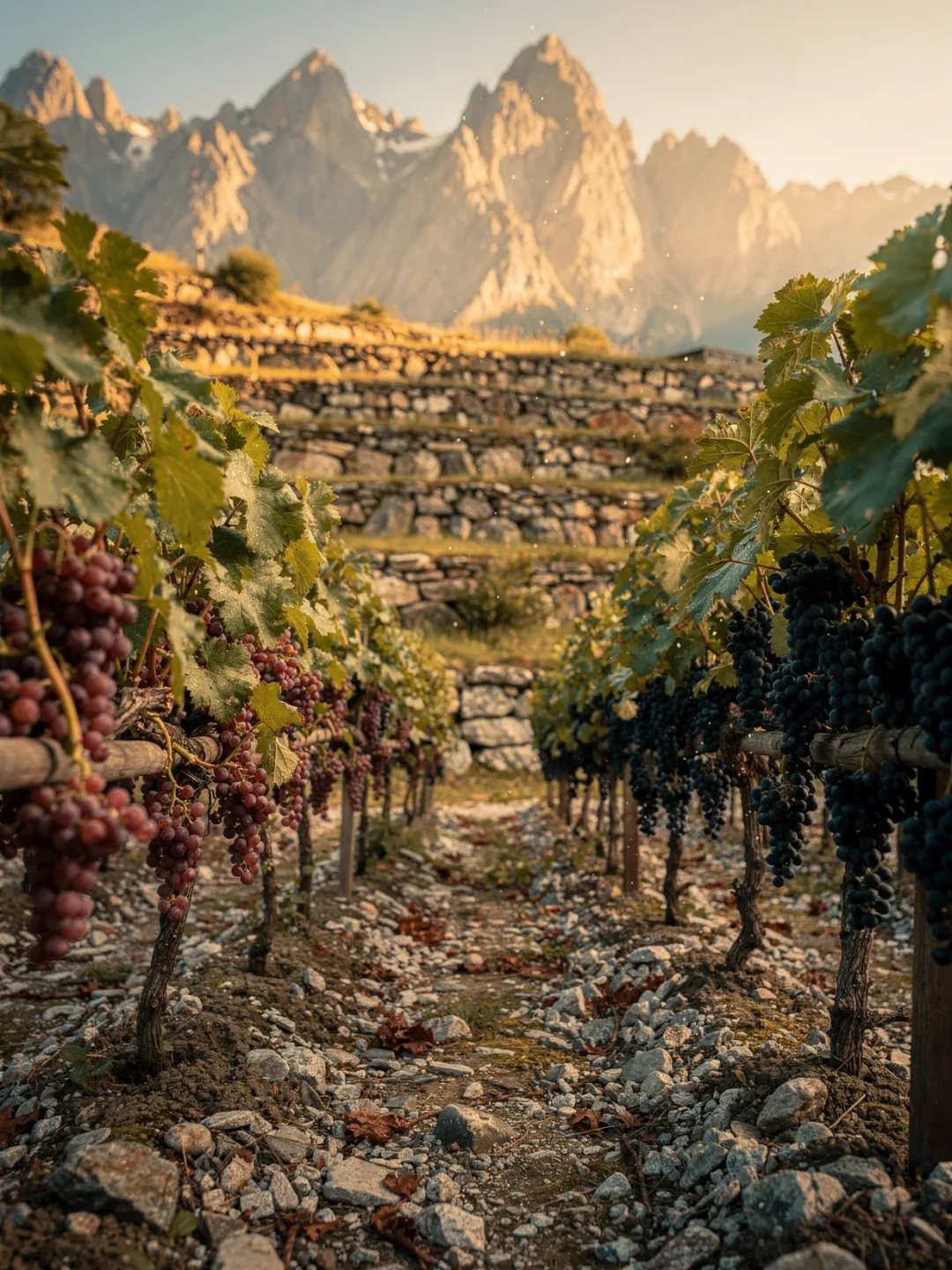
Nineteen grape varieties are allowed to appear by name on the label of Vallée d'Aoste DOC. Yet one alone defines the valley like no other: Petit Rouge. The berry is small, the bunch loose, and the name describes exactly that: little red. At just over a fifth of the total vineyard area, it is by far the most widely planted variety in the valley.
In the glass, Petit Rouge shows pale color and plenty of fruit: cherry, violet, a hint of spice. Tannin and acidity stay moderate. That's why the wine is approachable young and rarely ages for long, and that's precisely why the valley needs a counterpart with more power: Fumin.
Fumin grows almost nowhere outside this valley. Its berries are small and thick-skinned, brimming with color and tannin, so the resulting wine turns deep violet, almost opaque, with aromas of blackberry, black currant, and smoked herbs. It demands at least two years of aging before its hard tannins smooth out. Open it too young, and you'll hit a wall instead of a wine.
In between stand the old neighbors. Vien de Nus, also called Gros Vien, brings richness and grows mainly in the middle part of the valley. Cornalin, meanwhile, one of Italy's rarest grape varieties, delivers ruby red with wild berries, mountain herbs, and strikingly little tannin—almost the opposite of Fumin. In the Donnas subzone, a local strain of Nebbiolo called Picotendro plays the same role it does in neighboring Piedmont: pale, austere, long-lived.
Among the white varieties, Prié Blanc dominates the highest sites. Petite Arvine, originally transplanted from Valais, represents the valley's elegant white wines with citrus and salty minerality. And in Chambave, Moscato Bianco scents the air with apricot, in a spot where elsewhere in the valley only red-wine grapes still hang.