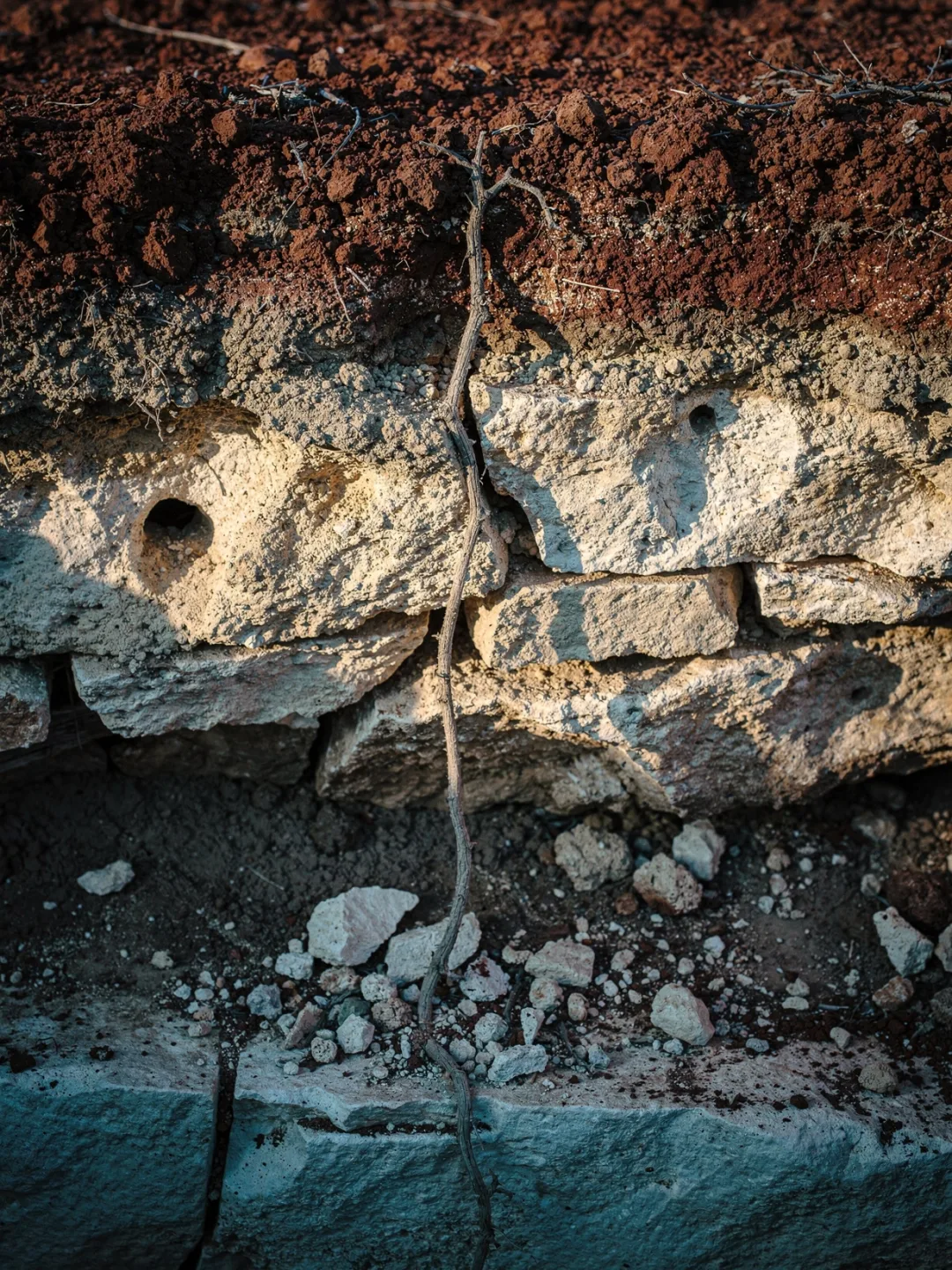
Terra Rossa & Limestone
Soils
Five to thirty centimeters: that's all the red earth the Murge offers to roots before the rock begins below. This thin layer is called terra rossa. It's not soil in the ordinary sense but a residue: limestone slowly dissolves in rainwater. What remains are iron and aluminum oxides – enough to color the earth deep red, but too little to supply many nutrients.
Below that begins the Calcarenite di Gravina, a porous, brittle limestone. It's named after the town of Gravina in the western Murge. It fractures into rough blocks. Water and roots still find their way through the cracks. Primitivo and Negroamaro push right into these fissures, sometimes a meter deep or more, in search of moisture that has long since evaporated from the surface by summer.
Only at around seventy centimeters does the third layer follow: the Calcare di Altamura. It's a considerably harder, more compact limestone from the Cretaceous period, storing water like a sponge made of stone, though releasing it only grudgingly. Roots that reach it survive even the driest summers. Vines with shallower roots often lose their leaves as early as August.
Along the coast near Manduria, the soil looks different. There, pale, sandy soils lie over a brittle limestone crust locally called tufo. In this loose sand, some Primitivo vines even survive ungrafted, since phylloxera finds no foothold there. The sand retains almost no warmth overnight, but here the grape often ripens earlier and with even more sugar than on the Murge.
Two soils, a few kilometers apart, produce two rather different wines. The red earth of the Murge keeps Primitivo and Negroamaro tight and tannic, while the sand around Manduria makes them soft and round, almost sweet in the fruit. Anyone who tastes both side by side will notice the difference without ever hearing a word about geology.
A thin red layer made from the insoluble iron and aluminum remnants of dissolved limestone, often only a few centimeters thick.
The root: This is where the fine roots sit. They gather what the rain brings and are the first to dry out in summer.