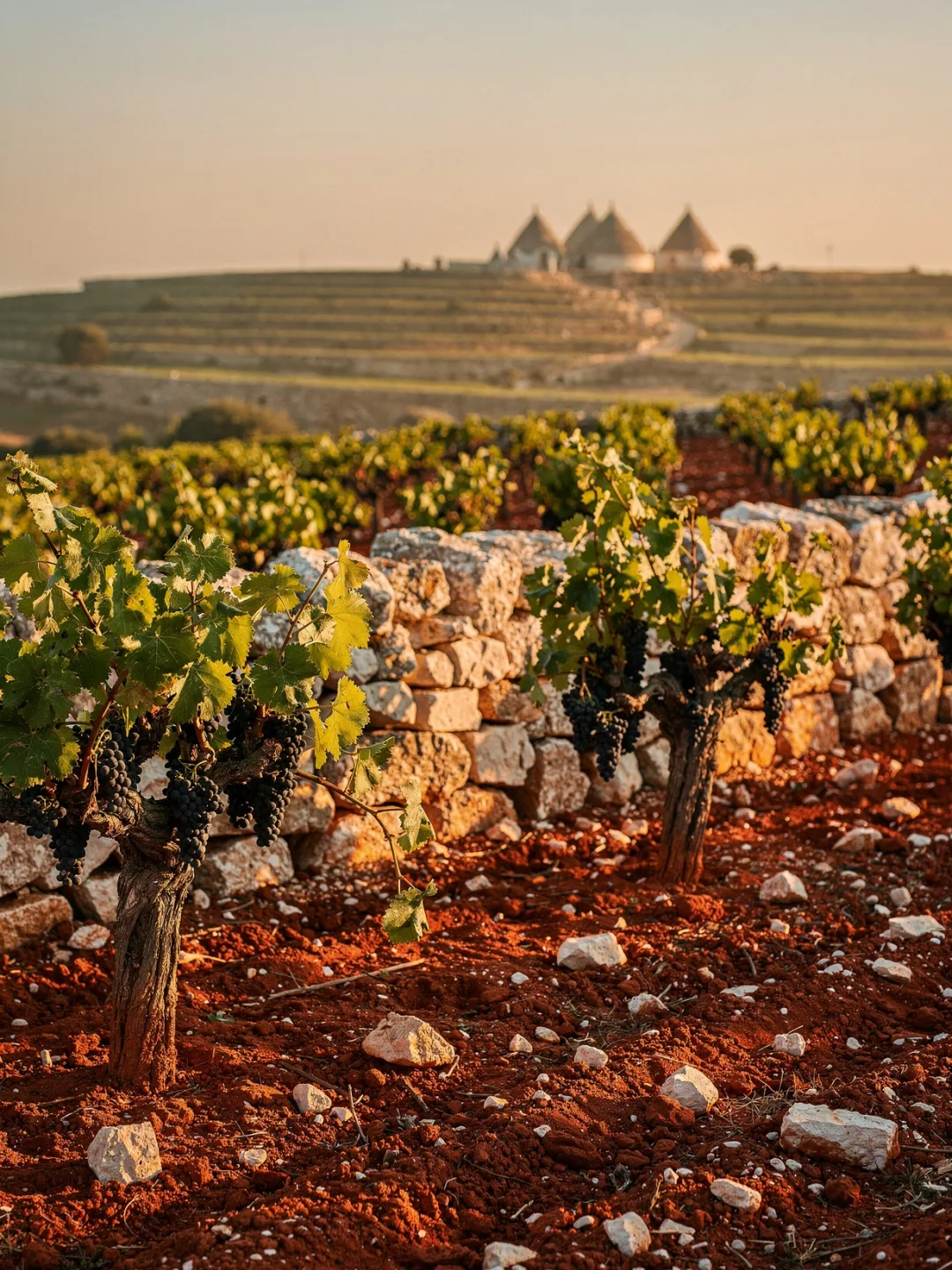
Primitivo & Negroamaro
Grape Varieties
Primitivo bears nearly black berries. The wine made from it looks darker in the glass than almost any other Italian red. The skin is thick, so the tannin – the rough, drying grip in the mouth – tends to be soft rather than harsh. In the Apulian heat, sugar levels rise so high that dry Primitivo di Manduria must contain at least 13.5 percent alcohol by volume. That's the highest mandatory minimum for any dry, unfortified wine in the world. In Gioia del Colle it stays tighter. Closer to the coast near Manduria it turns rounder, sometimes almost sweet.
Negroamaro carries its name twice over. Negro likely comes from the Latin niger, amaro echoes the Greek mavros – both mean black, a double emphasis for an almost black grape. Its home is the Salento. Especially around Salice Salentino, Squinzano, Copertino, and Brindisi, it must make up at least eighty-five percent of the red wines. Unlike Primitivo, Negroamaro tastes more austere, with dark cherry, herbs, and a bitter undertone that fits the name. This grape gave rise in 1943 to Five Roses, the first rosé wine ever bottled in Italy. An American officer wanted an Italian wine with an American-sounding name – that's the whole story.
Further north, in the Capitanata around the town of Troia, another dark variety grows: Nero di Troia. Legend has it that the Greek hero Diomedes brought vines to this coast after the fall of Troy. The more likely origin is simply the place name. Its tannins are firm and need time. That's why the Riserva of Castel del Monte DOCG must age at least two years, one of them in wood. Young, Nero di Troia seems almost closed; after a few years it opens up to sour cherry, leather, and dried herbs.
Susumaniello sounds like a term of endearment, and that's exactly what it is. The name alludes to a donkey: the young vine bears so many grapes that it looks like a loaded somarello, a little donkey. Over the decades it nearly disappeared. It was used only for blending, its color and acidity meant to prop up weaker wines. Only in recent decades have winemakers around Brindisi started bottling it again as a single variety, with strikingly high acidity and pigment for a grape from such heat.
Not all of Apulia is red. Among the trulli, the cone-shaped stone houses of the small town of Locorotondo, two pale varieties grow: Verdeca and Bianco d'Alessano. Since June 1969 they've made up Locorotondo DOC, one of Italy's oldest appellations of origin altogether. Verdeca brings freshness, Bianco d'Alessano rounds it out. Alongside them, international varieties like Cabernet Sauvignon have spread under the IGT Salento, the more flexible classification below DOC. Anyone who thinks of Apulia only in terms of heavy, sweet reds hasn't yet tasted this lighter half of the region.