Ash, tuff, lava
Soils
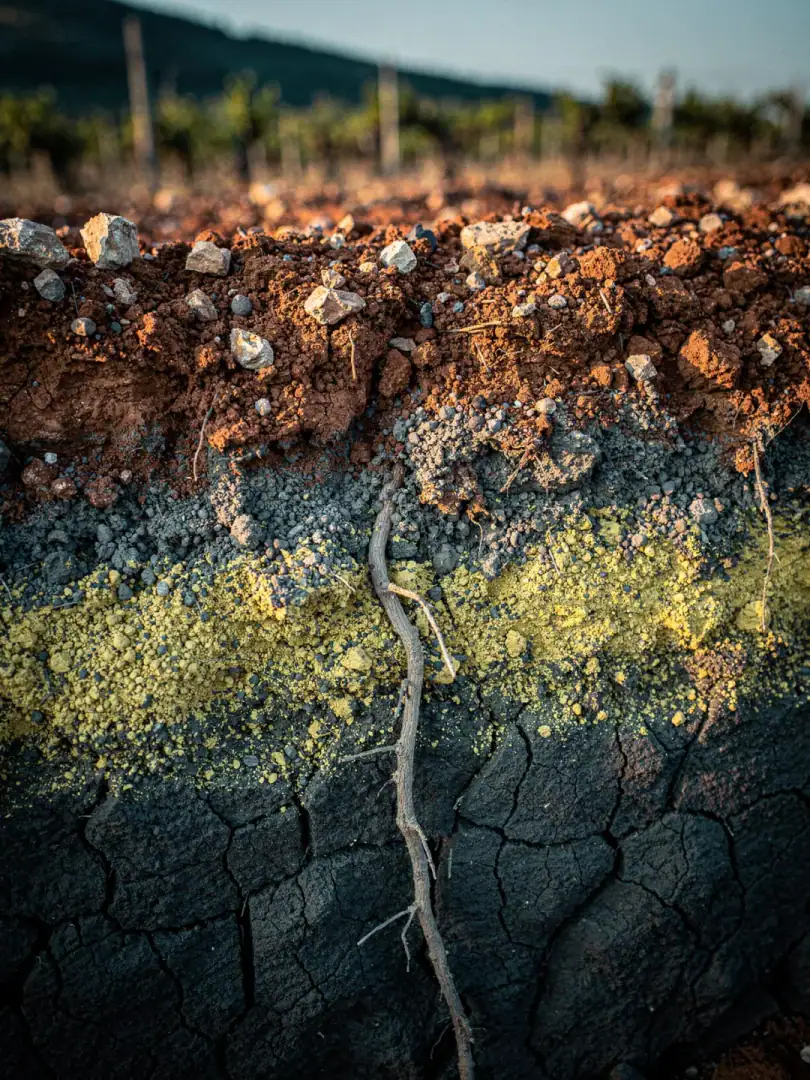
Dig a hole at the foot of the Vulture, right next to an Aglianico vine. After just a few spadefuls, the earth changes color: reddish-brown at first, streaked with pale limestone fragments, then darker and grainier. What lies here isn't ordinary farmland soil, but solidified volcanic ash.
The Vulture has been extinct for roughly one hundred thirty thousand years, but its legacy still lies everywhere in the soil. Over millennia it hurled out ash, pumice, and lava, which settled in alternating layers. Each eruption left behind its own color: red and blue from iron compounds, sulfur-yellow in the lapilli — the small solidified rock granules — grey from pure ash. Hardly one vineyard in Basilicata resembles the next.
This material has a decisive advantage: it lets water pass through almost unhindered. The fine sand formed from ash and lapilli drains so well that waterlogging on the Vulture's slopes is practically unheard of. At the same time, the weathered ash holds plenty of phosphorus, magnesium, and potassium. Young vines need these nutrients to grow, and on ordinary clay soil they're often in short supply.
Where the subsoil is loose and nutrient-rich at once, a vine grows vigorously but not indiscriminately. The Aglianico vine's roots push down through layers of ash and lapilli to considerable depth, always searching for the water held in cracks within the underlying tuff or lava rock. It's precisely this detour through porous but cool rock that keeps the vines green even in a dry August.
One rumor persists stubbornly: that the wine tastes mineral because the root absorbs rock particles and passes them on into the glass. That's not quite true. The vine only takes up dissolved ions, in amounts far too small for anyone to taste. What actually matters is something else: water balance, nutrient supply, and the warmth that dark rock stores during the day and releases again at night — a roundabout route, but an effective one.
Further south, around Matera, the volcano stops shaping the picture. There, limestone and clay from an ancient seabed that once covered the area take over — drier, harder ground on which Primitivo, rather than Aglianico, mainly thrives. Two soils, one region, two entirely different wines.
Weathered, iron-rich clay, streaked with pale limestone fragments — the topmost, humus-richest layer above the volcanic rock.
The root: This is where the fine roots sit. They grab whatever the rain brings, and are exhausted after just a few dry days.