Ponca & Terra Rossa
Soils
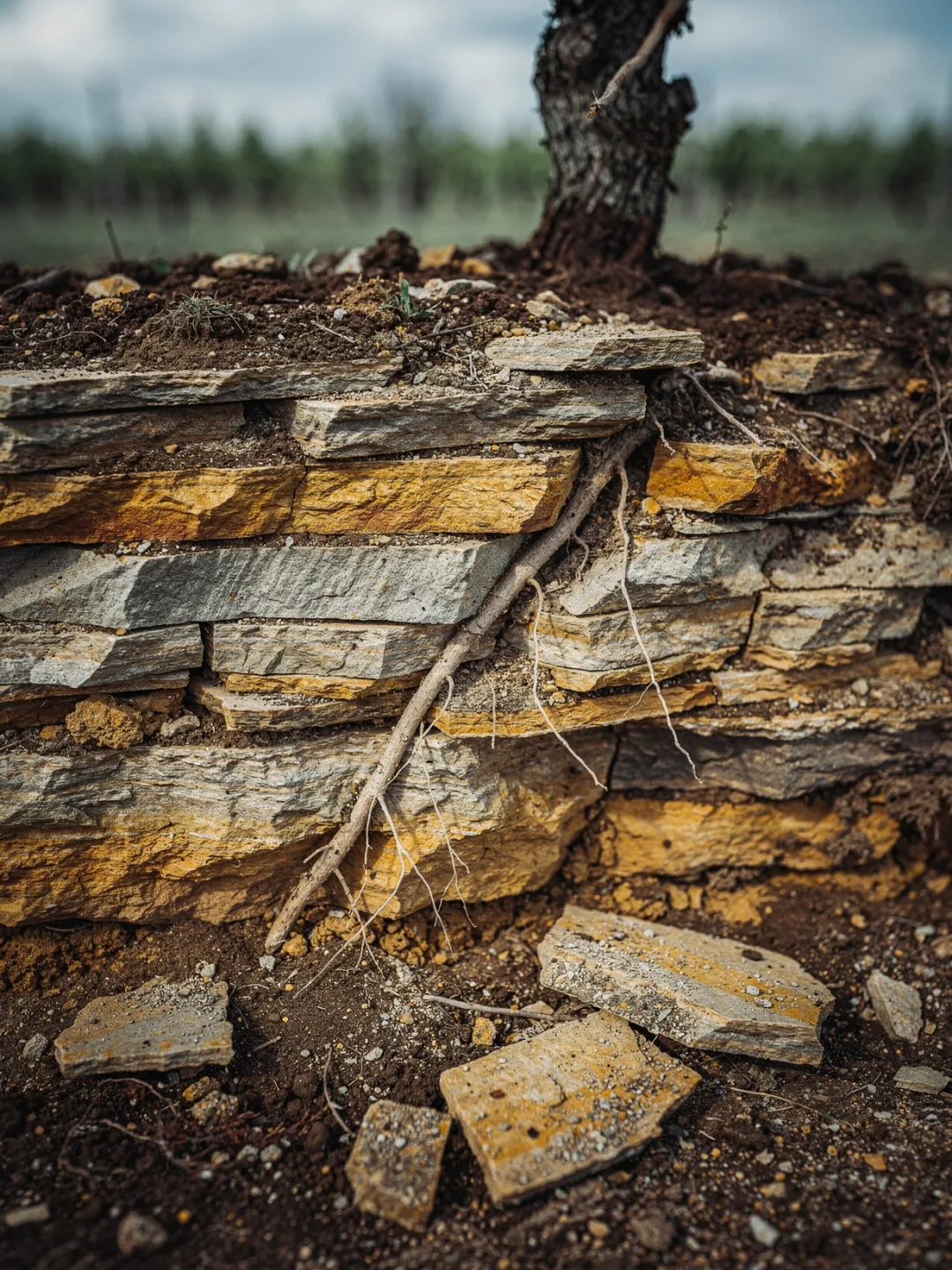
Dig a hole in one of the hills of Collio, and you won't get far. After barely twenty centimeters, the shovel hits slabs of gray marl and yellowish sandstone, layered thin like the pages of an open book. Locals call this rock Ponca. Geologists call it Flysch di Cormons.
It formed around forty million years ago on the floor of a warm sea. Sediment flows repeatedly slid down the continental slope of that time and settled in layers, fine clay as marl, coarser sand as sandstone, over and over, until the folding of the Alps lifted the whole formation out of the water. What today lies as a range of hills above the Collio was once seabed.
This layering makes Ponca both fertile and unstable. Water and roots pass easily between the slabs, which helps the vines through dry summers. But the soil also erodes quickly, sliding down entire slopes in heavy rain. That's why winegrowers in Collio don't plant their rows in straight lines but in curved terraces called ronchi, which follow the slope like contour lines on a map, holding the soil in place.
Twenty kilometers south, in the Carso above Trieste, the soil looks completely different. There, a thin layer of Terra Rossa sits atop hard limestone, a bright red, iron-rich earth that gathers in cracks and sinkholes rather than lying as a continuous layer. Between the rocks, there's barely enough soil for a single vine. That's exactly what forces the lean, mineral style of Vitovska.
The plain of the Grave to the west is different again. There, over millennia, the Tagliamento and Meduna rivers have washed down gravel from the Alps, meters deep and almost free of humus. Water drains away instantly. The vines drive their roots deep, and the wines turn out more straightforward than the delicate whites grown on Ponca. Three soils, one region, and three completely different wine styles, even though the grapes are often the same.
A thin, dark layer of leaves and grasses. On the steep ronchi terraces of Collio it barely holds; every heavy rain washes some of it downhill.
The root: This is where the fine roots sit and drink first, and after just a few dry days they're already exhausted.