Ash & Tuff
Soils
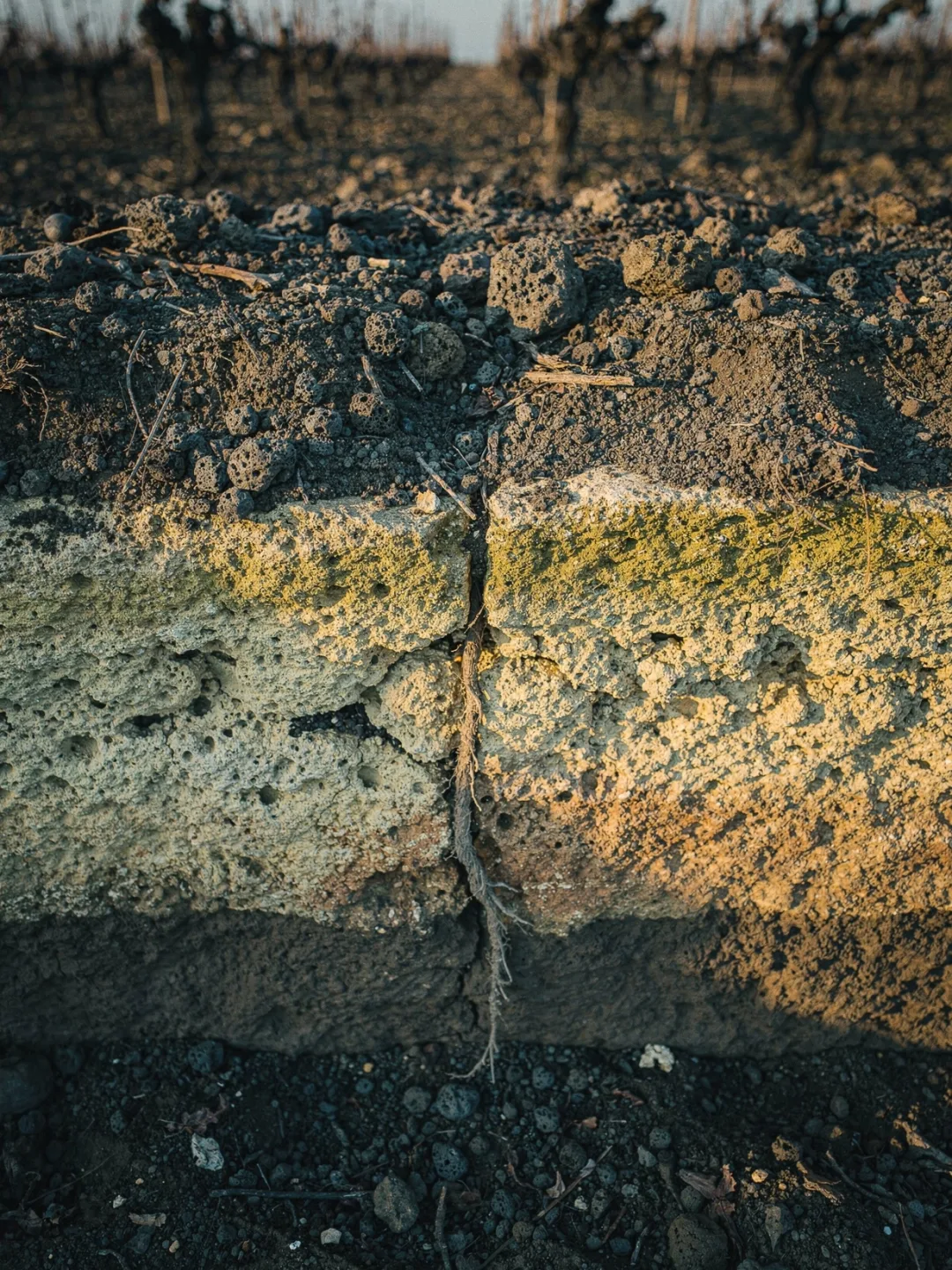
Dig a hole in an Irpinia vineyard, and the first thing you'll hit is something that doesn't really belong there: loose gray ash and small porous stones called lapilli, which look like solidified foam. This isn't Irpinia rock. This is Vesuvius.
The largest of these ash clouds struck the area as far back as the Bronze Age. Nearly four thousand years ago, a massive eruption of Vesuvius, which archaeologists call the Pomici di Avellino, buried entire villages up to twenty-five kilometers away under ash and pumice. It was a kind of Pompeii, a millennium and a half before Pompeii itself. What fell then now lies as a layer of humus over Irpinia's vineyards.
Beneath it follows yellow-gray tuff, compacted volcanic ash, porous enough that both water and roots can pass through it. The village of Tufo, which gives Greco di Tufo its name, sits literally on this rock, and beneath the rock lies sulfur. It was mined there from 1866 to 1984, with as many as thirteen hundred miners working underground while vines grew above. Some winemakers explain the mineral, faintly smoky tone in Greco by the roots reaching down into sulfur-bearing rock. This has never been proven. Still, the closeness of these two worlds beneath the same soil is real.
Only beneath that, often not until a meter down, does Irpinia's true subsoil appear: gray-brown clay marl, the compacted remains of an ancient seabed that existed before the volcanic ash and still holds water like a sponge to this day. When August dries out the upper ash layer, the roots down there still find what they need.
This sequence — loose ash on top, porous tuff in the middle, dense marl below — forces the Aglianico root to search. It grows deep, sometimes several meters down. That's exactly what makes Taurasi so concentrated: small berries, a high skin-to-juice ratio, plenty of tannin and color. A vineyard on pure clay marl, without the ash layer above, yields a different, softer wine. You can taste the difference, even when the two parcels often lie only a few hundred meters apart.
Loose, dark volcanic ash and small porous lapilli stones, deposited by eruptions of Vesuvius over thousands of years, most extensively by the Bronze Age eruption known as the Pomici di Avellino.
The root: The fine roots sit here, among loose material that lets water pass through quickly and dries out just as fast.