Where Sea Meets Mountain
Climate
Geographically, Campania clearly belongs to southern Italy. But anyone who equates that with uniform heat is mistaken. Between the coast on the Gulf of Naples and the hills of Irpinia, barely a hundred kilometers inland, lie entirely different worlds.
Along the coast, on Vesuvius, in the Campi Flegrei, and on Ischia, the sea moderates the extremes. Winters are warm, and frost is virtually unknown. The wind blowing across the gulf quickly dries the grapes after rain. Rot has a hard time here.
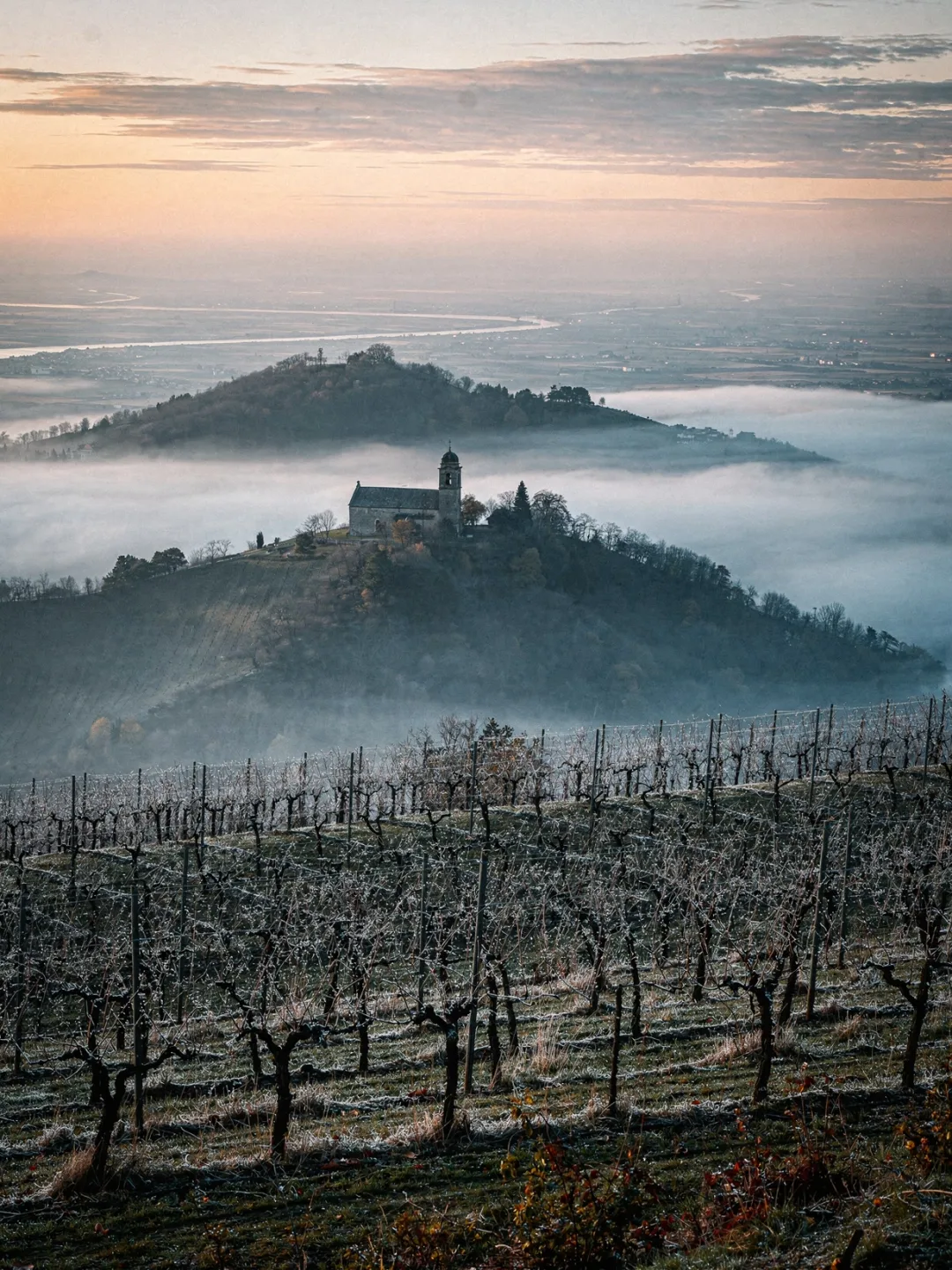
In Irpinia, where Taurasi, Fiano di Avellino, and Greco di Tufo grow, things look different. The vineyards lie between four hundred and seven hundred meters, winter regularly brings snow, and in summer the temperature swings between day and night far more sharply than on the coast. It's exactly this swing that locks the acidity into the grape, while the daytime sun ensures ripeness.
This elevation explains why Aglianico doesn't ripen until October, sometimes not until mid-November — late for a grape variety growing in a region one imagines as sun-drenched. Without Irpinia's cool nights, the acidity would vanish long before the berry was even dark enough.
So anyone claiming all of Campania is uniformly warm has only seen the coast. Irpinia's winemakers sometimes call their climate continental, right in the middle of southern Italy. That sounds paradoxical. The contradiction dissolves in the glass anew each year, the moment the first sip of Taurasi reveals its acidity.