Red and White
Glassware
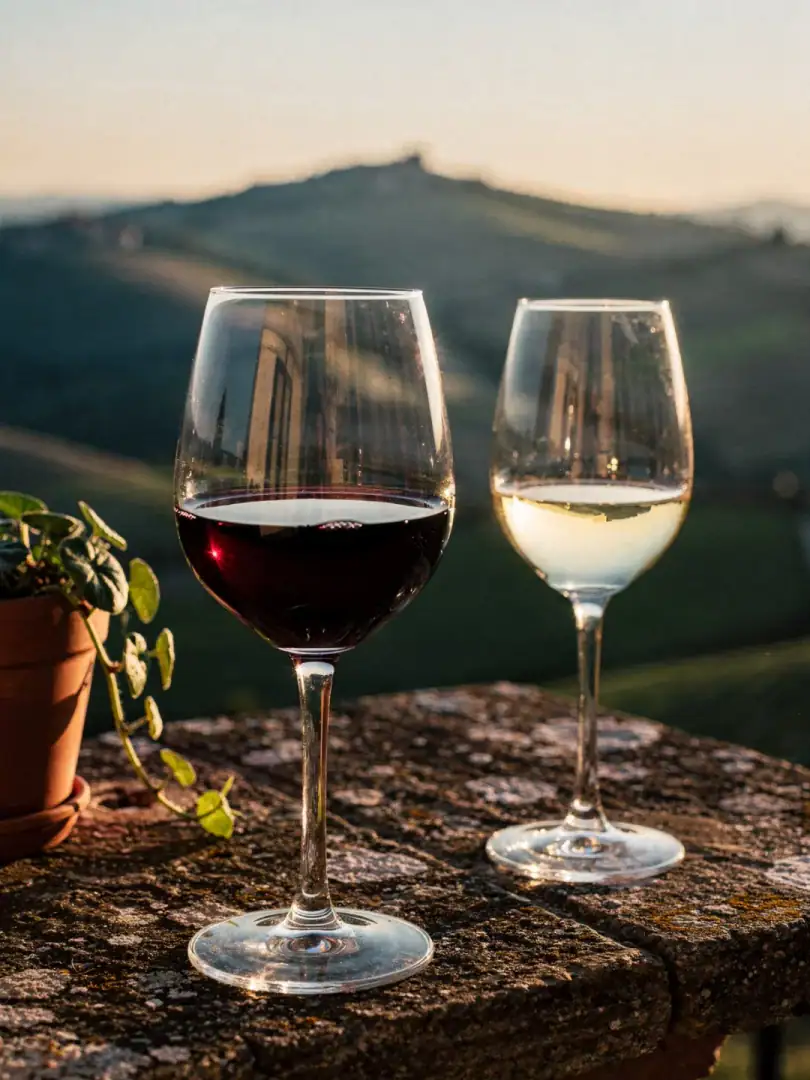
Anyone who packs just one glass for Campania is making the wrong choice either way. Taurasi and Fiano di Avellino are simply too far apart in flavor. A wine with as much tannin and acidity as Aglianico needs room. An aromatic white wine like Fiano needs the opposite: a narrower shape that holds the bouquet together.
For Taurasi, a large, bowl-shaped glass works well, similar to the one used for Barolo or Nebbiolo. The wide bowl gives the hard tannin room and time to round out in the glass before it reaches the mouth. A narrow glass, by contrast, suffocates it. For a young Taurasi at five or six years old, this isn't a luxury — it's practically essential. Otherwise, the acidity dominates every other impression.
Sixteen to eighteen degrees Celsius (about 61–64°F) is the right temperature, noticeably cooler than a heated living room in winter. A ten-year-old Taurasi additionally benefits from decanting, since it can seem closed off after such long bottle age. Half an hour of air awakens it remarkably.
Fiano di Avellino and Greco di Tufo want the opposite: a narrower, tulip-shaped glass that tapers toward the top, concentrating the aromas of hazelnut and citrus rather than dispersing them. Served too cold, Fiano loses nearly all its aromatics. Eight degrees Celsius (46°F) straight from an over-chilled fridge isn't enough; ten to twelve degrees (50–54°F) works better, even if that sounds unusually mild for a white wine.
Greco can handle the same glass shape, but slightly more chill, since its acidity is sharper than Fiano's and cold tempers it. For a simple, everyday Falanghina or a young Piedirosso, on the other hand, an ordinary, medium-sized glass is plenty. Not every wine from Campania needs the grand stage.