Volcano and Sea
Climate
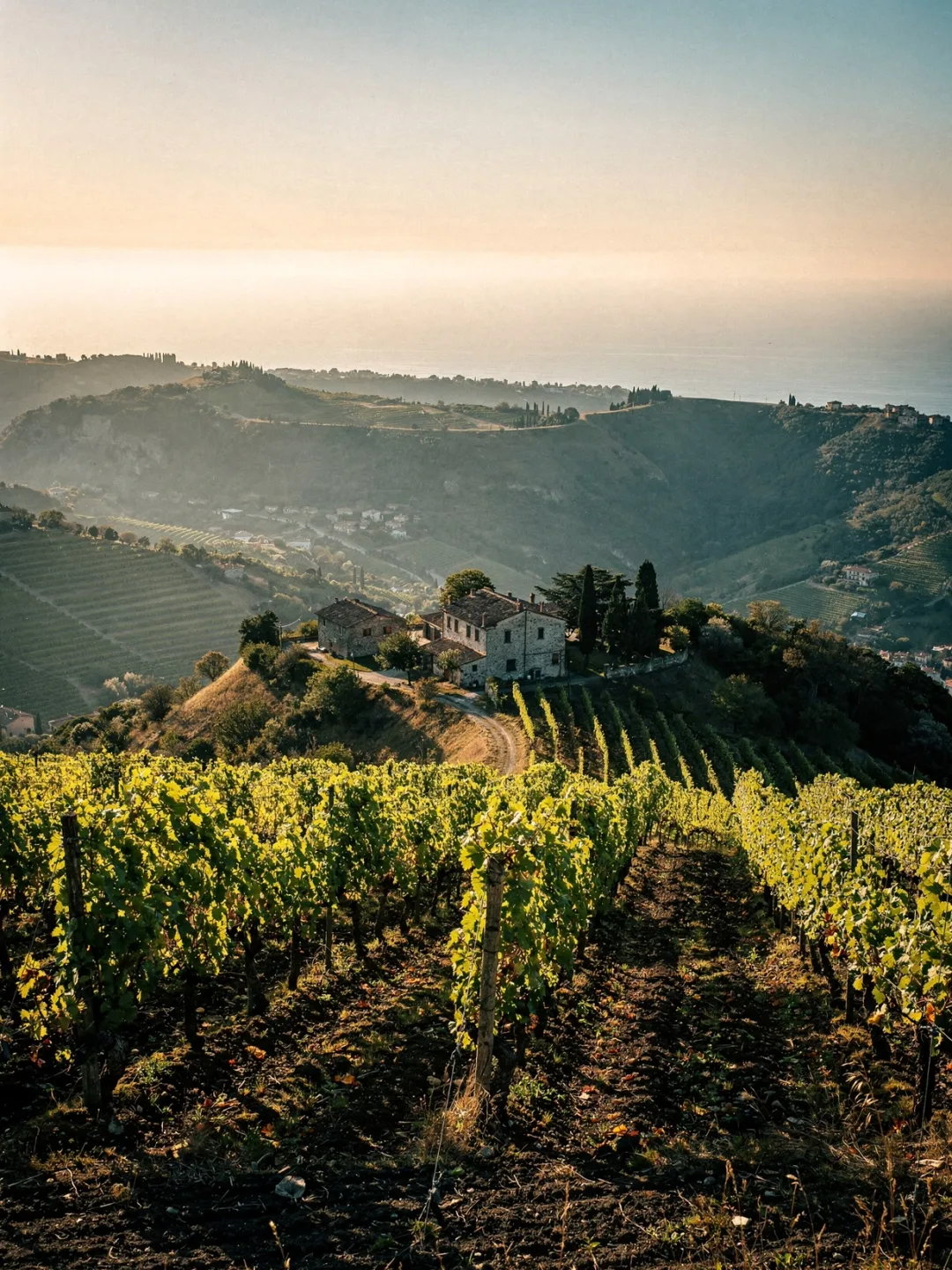
Lazio sits right on the border between two climate zones, and the Castelli Romani sit exactly in between. Only twenty-five kilometres separate the vineyards from the Tyrrhenian Sea. The wind that rises up from there each evening reliably cools the slopes, while the sun beats down for long hours on the old crater rim of the Colli Albani during the day.
The vines grow at roughly one hundred fifty to four hundred metres elevation, on the flanks of an extinct volcano whose best-known peak, Monte Cavo, reaches nearly a thousand metres. Two crater lakes, Albano and Nemi, sit right in the middle of this basin. They act like a heat reservoir, releasing moisture at night and softening frosts that do occur further out on the plain.
Piglio lies quite differently, a good fifty kilometres to the east, at the foot of the Monti Ernici inland. Here the sea breeze is almost entirely absent. Instead, the temperature swings between day and night much more sharply than on the coast. This swing locks in the acidity of Cesanese, which otherwise fades quickly during ripening in late summer — a continental streak in the middle of an otherwise Mediterranean region.
Rain falls in Lazio mainly in autumn and winter. Summers usually stay dry, which suits the free-draining volcanic soils well. They hold almost no water but release it immediately once it falls, rather than pooling it for days.
Here too the harvest calendar has shifted. In the past, the Malvasia harvest usually began in early September; today it often starts as early as late August. Winemakers in Piglio are now replanting at higher, cooler sites to preserve the acidity in Cesanese for longer.