Macigno & Flysch
Soils
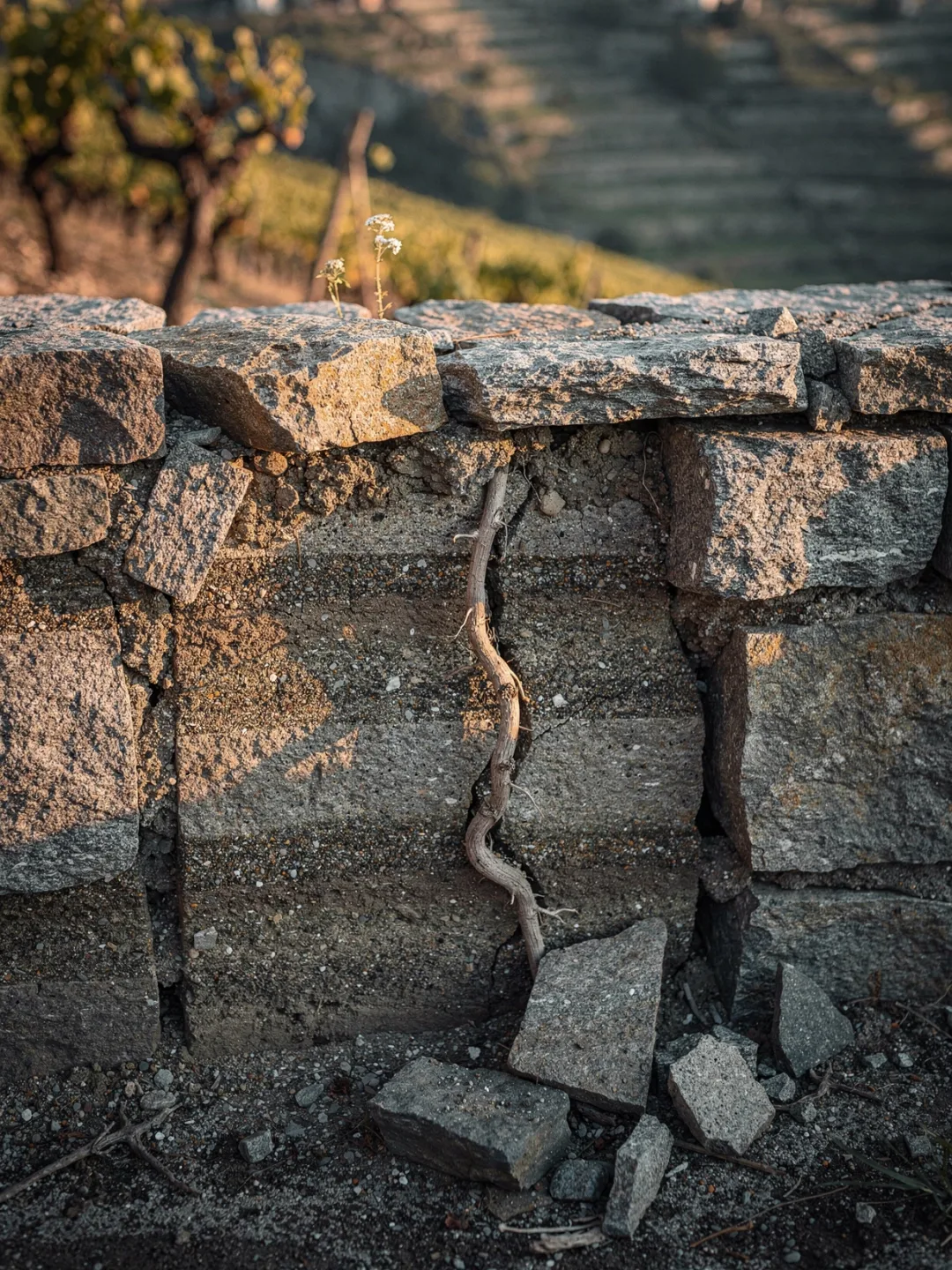
Dig a hole in a vineyard above Manarola. You'll quickly hit hard, gray sandstone: Macigno, formed millions of years ago from sand and mud deposited by rivers at the bottom of an ancient sea. The pressure above compacted it all into rock, which today lies in thick layers. Without this rock, the Cinque Terre wouldn't exist. Farmers broke it out and stacked it into the walls on which they then planted again.
When weathered, Macigno breaks into angular, loose chunks. Water runs through quickly, while roots find little to hold onto. This forces the vine to dig deep. What it gathers in nutrients along the way is scarce. Little water, little food, a lot of stress — exactly what produces the small, thick-skinned berries needed for Sciacchetrà.
In the west, in Dolceacqua, the soil looks completely different. There, marl and fine-grained sandstone alternate in thin layers. Such an alternating sequence is called flysch; winemakers simply call it sgrutto. When wet it breaks almost like clay, when dry it crumbles into fine sand. This very alternation holds moisture better than the hard sandstone of the east coast.
Closer to the sea, around Ortovero, there are even blue marls full of fossilized shells, remnants of a seabed from roughly five million years ago. Rossese roots that reach here find more limestone and more water than in the sandstone of the Cinque Terre — one reason why the same name Rossese produces two different wines in two parts of the region.
Along the coast, people like to say that the salt from the sea spray travels through the roots into the wine. That's not quite true. Sea spray doesn't even reach the uppermost terraces — some sit a hundred meters above the water. The salty note in Pigato or Rossese comes from somewhere else — from scarce water, thin skins, and an acidity that feels almost like salt on the tongue without chemically being one.
The terrace walls themselves are almost always built from the very rock found beneath them — Macigno in the east, flysch in the west. So anyone looking at the wall already knows, before taking the first sip, what soil the wine behind it comes from.
A thin, dark layer of decomposed leaves and root remnants, on the terraces of the Cinque Terre rarely more than a hand's width thick.
The root: This is where the fine roots sit. They take in whatever the rain has just brought — and after just a few dry days, they're the first to run empty.