Sea Versus Mountains
Climate
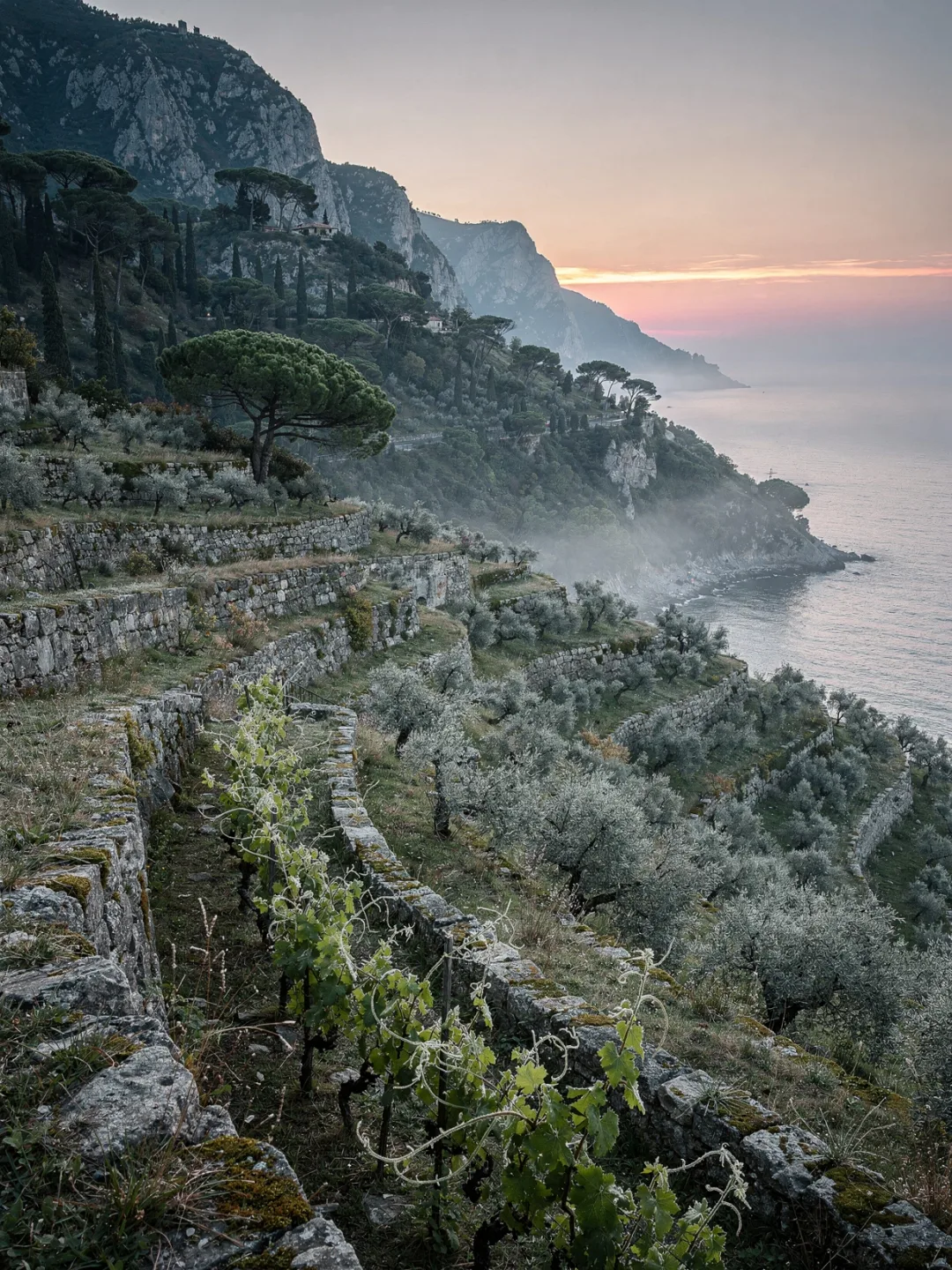
The Ligurian Alps and the Apennines push in like a wall between the land and the cold air from the north. In places they rise to almost two and a half thousand meters and plunge nearly vertically to the coast. Below, the Mediterranean stores warmth all year round. In between remains a narrow band of mild, Mediterranean climate — in some places only a few kilometers wide before the mountains turn steep again. Liguria is rarely wider than thirty kilometers, from the beach to the first peak.
Along the coast, this means mild winters and dry, hot summers, with frost almost unheard of. Just a few kilometers inland, as soon as the mountains steepen, the climate shifts. It turns noticeably cooler and harsher, almost continental compared to the coast right next door. Between the sea and a mountain village often lies no more than a half-hour drive — and yet two completely different climate zones lie in between.
Within the region, a second contrast also shapes every vintage: Levante versus Ponente, east versus west. The Cinque Terre in the Levante get more rain and more moisture from the open sea. This is ideal for Bosco and its thick skin. The Riviera di Ponente in the west, more sheltered and sunnier, lets Rossese and Pigato ripen longer and more gently. One and the same region, two climates.
The dry-stone terrace walls amplify this effect further. The stone stores heat from the sun during the day. At night it slowly releases that warmth back to the vines, a natural oven made of schist and sandstone. Especially on the steepest slopes of the Cinque Terre, where the sun hits nearly straight on, this small thermal buffer often makes the difference between a ripe harvest and a green one.
Around one thousand five hundred hectares of vineyard are scattered across all of Liguria. That's a fraction of what Piedmont or Tuscany cultivate. Climatically, though, the land is favorable: the growing season starts early and ends late, because the sea warms the air in spring and buffers the first cold snaps in autumn. What's missing isn't the climate. What's missing is flat ground.