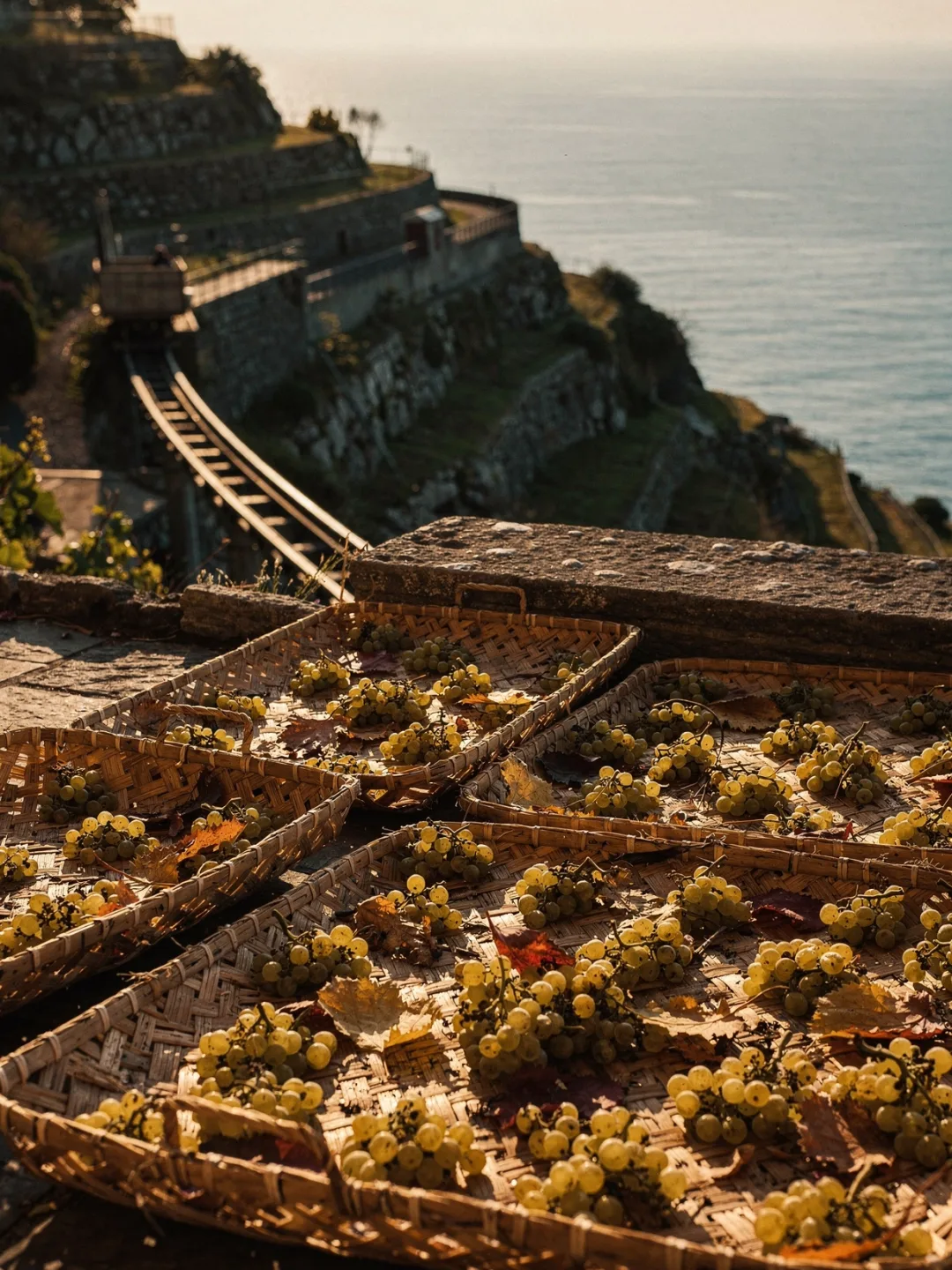
Drying for Sciacchetrà
Production
Where the Cinque Terre are steepest, there's no road to the vineyard. Only stone steps. As late as the 1970s, winemakers carried grapes down the slopes in baskets on their backs. Sometimes across hundreds of meters of elevation. Only small rack railways, locally simply called monorotaie, made the harvest easier. They stop wherever a crate happens to be full, rather than only loading at the top or bottom, and today around fifty of them run through the terraces of the Cinque Terre.
For Sciacchetrà, mostly Bosco grapes are spread out on mats or racks after harvest, where they dry naturally for weeks until their sugar content corresponds to an alcohol strength of at least nineteen degrees. Only then are they pressed and fermented. The finished wine may not be sold before October 1st of the following year, and a Riserva not before three years of aging.
With Ormeasco in the far west, production runs exactly the other way around. For Sciac-trà, whose name literally means to crush and drain off, the red grapes sit on their skins for just a few hours. Then the pale-colored juice is drawn off and fermented further without the skins. This produces a coral-colored rosé with the scent of red blossoms, quite different from the denser, longer-macerated red wine made from the same berries.
In the cellar, there's little room to maneuver for the dry white wines. The rules of the Cinque Terre DOC dictate exactly which grapes may go into the bottle and in what proportion. At least forty percent must be Bosco, no more than forty percent Albarola and Vermentino combined. For Pigato and Vermentino from the Riviera Ligure di Ponente, the opposite logic applies — ninety-five percent must come from the grape that gives the wine its name, leaving little room for blending.
All of this remains hand labor to a degree hardly seen anywhere else in Italy. Large harvesting machines don't fit on terraces a meter wide. Many vineyards can only be reached on foot or by rail. Anyone making wine here earns, above all, one thing with every bottle: the time the work has cost.