Limestone Marl & Flint
Soils
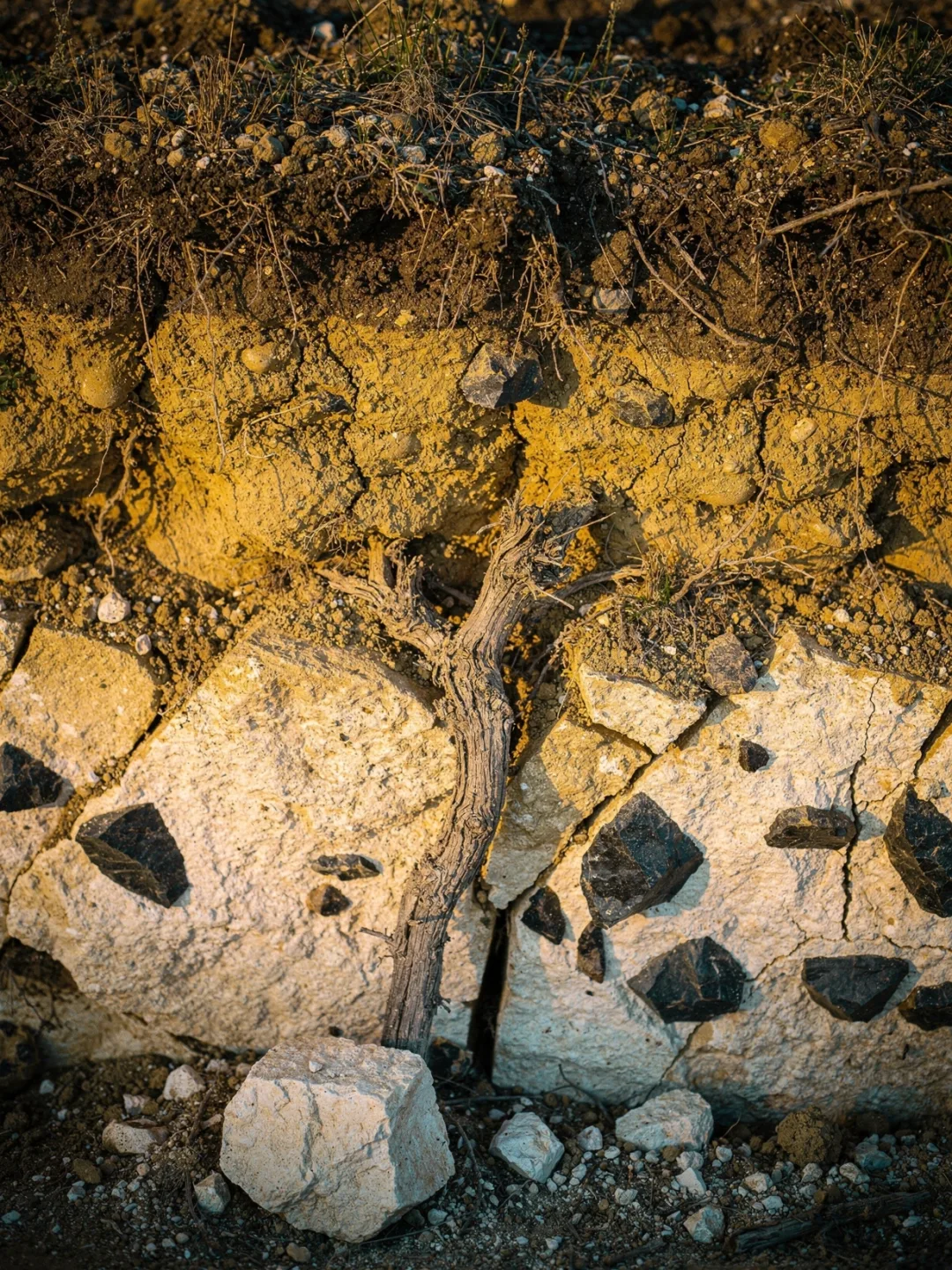
Dig a hole in a vineyard near Larino or Guglionesi. You'll be digging through a history that begins in the sea. What today lies as hill country above the Biferno valley was, millions of years ago, seabed — mud, sand, and shell remnants that settled layer by layer and were later compressed into rock. Experts call the result calcareo-marnoso-selcioso: calcareous, marly, and studded with flint.
This layer isn't soft rock. It fractures into hard, pale slabs interspersed with dark flint nodules, sharp-edged as glass. For a vine root, this is hard going: it must squeeze through cracks instead of simply growing through. That very effort forces it deep down, where it can still find water even in a dry August.
Closer to the sea, the picture changes. Around Campomarino and Termoli, the soil turns both sandier and more clay-rich. The rivers Trigno, Biferno, and Fortore built it up over millennia. Such soils store less heat and more water, which suits white varieties like Trebbiano and Falanghina, meant to stay fresh.
In the hills, where Tintilia thrives best, the effect of poor soil shows especially clearly. Low nutrients and little readily available water slow growth, keeping the berries small — and a small berry carries proportionally more skin than juice, and skin means color, tannin, and aroma. That's why Tintilia wines from these slopes feel denser than those from the flatter valley sites.
The zone where Tintilia may grow isn't a single valley, but several at once. These include the Biferno valley, the areas around Fortore and Trigno, and central and upper Molise up into the Volturno valley. Each of these zones brings its own variation on the same limestone-marl bedrock, sometimes with more clay, sometimes with more flint. Two bottles of Tintilia from different valleys rarely taste alike, even though both labels carry the same DOC.
A thin, dark layer of decomposed leaves and organic matter, in the hills around Larino rarely thicker than a hand's width.
The root: This is where the fine roots sit. They grab whatever rain brings and are the first to dry out in summer.