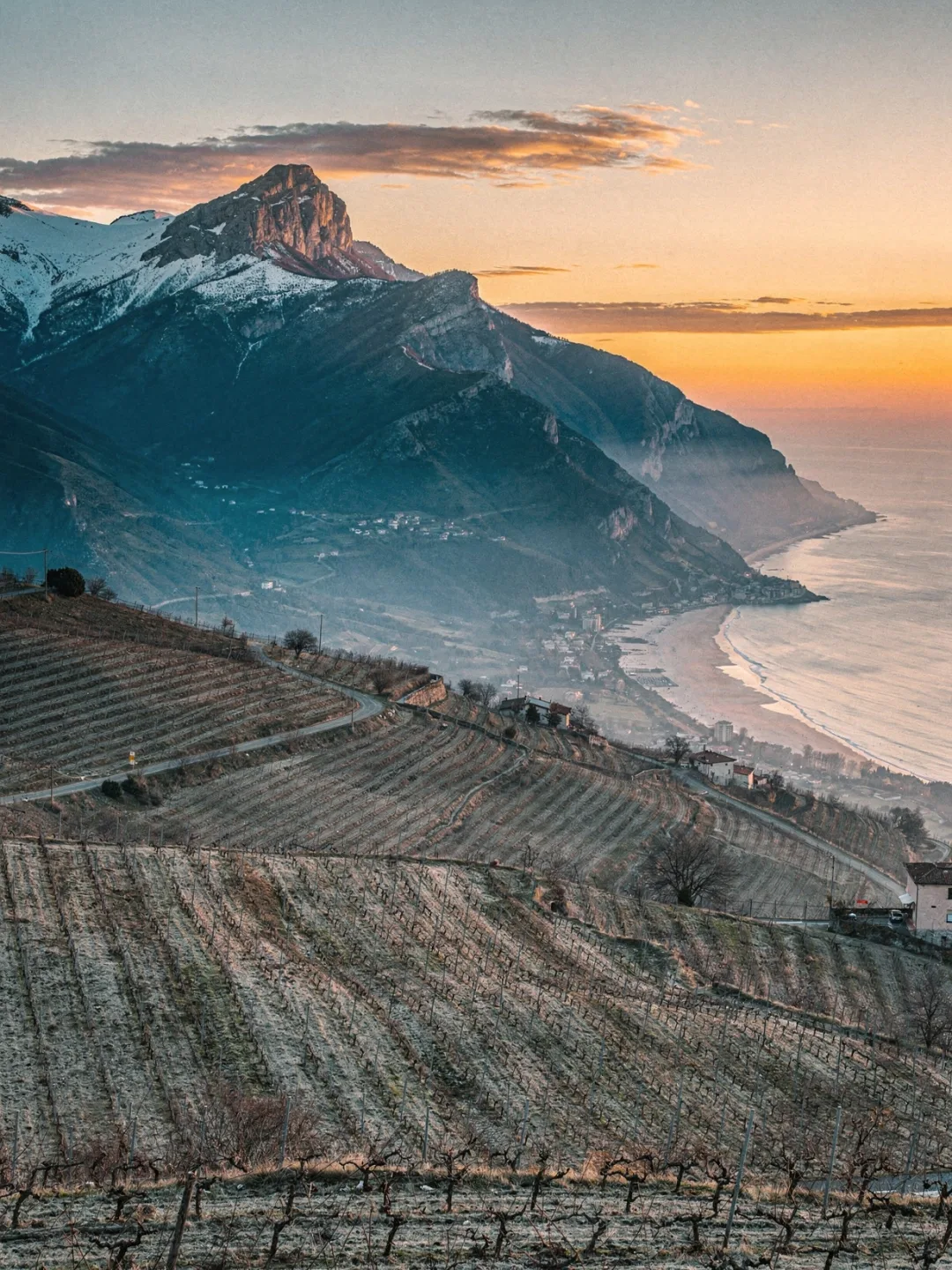
Sea Meets Matese
Climate
Between the mild Adriatic and the summit of Monte Miletto lies an entire climate, even though the distance in between seems short. On the coast near Termoli, winters are mild, averaging around eight degrees Celsius in January. Summer stays dry and warm, with around twenty-five degrees in July and August.
Higher up, in central Molise around Campobasso, the numbers look different. The annual average temperature there is only about thirteen degrees. Snow falls regularly in winter, since the Matese range to the west rises above two thousand meters at its highest peak, Monte Miletto. This contrast between the warm coast and the cool highlands is the region's real trump card.
Rainfall splits the land as well. On the coast, about six hundred millimeters fall per year, while in the mountains it exceeds fifteen hundred. Growers planting near the coast rarely need to worry about excess moisture. Those planting at altitude can usually count on enough water without any need for artificial irrigation.
For Tintilia, this difference in altitude has become a fixed rule. The DOC requires its vines to sit at least two hundred meters above sea level, and in practice the best sites often lie considerably higher, on the slopes around Isernia and in the Biferno valley. Cool nights at this altitude preserve acidity, while the day still delivers enough warmth for the berry to ripen properly.
Autumn shows both faces of Molise at once. While people still swim on the coast, the leaves are already turning color in the mountains. Between September and October, harvest begins at different times depending on altitude. A producer growing both Tintilia at height and Trebbiano near the coast never picks everything on a single day, but spread out over weeks.