Tintilia & Montepulciano
Grape Varieties
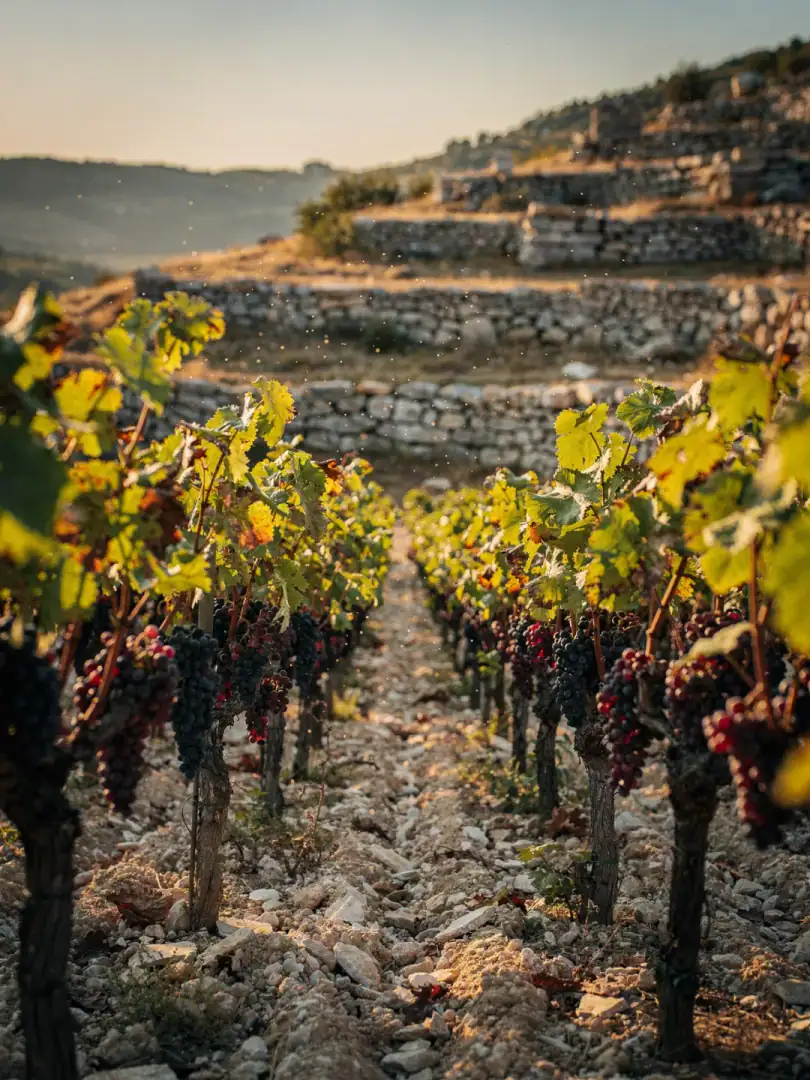
One variety belongs entirely to Molise: Tintilia. It grows nowhere else in meaningful quantity, its name hints at its intense color, and it yields so little that it nearly went extinct. In the glass it shows deep ruby red with violet reflections. Acidity and tannin sit at a level that surprises many newcomers — tannin being the rough sensation felt on the gums after a sip. Alongside comes a scent of dark cherry, plum, a touch of licorice, and black pepper.
In terms of sheer volume, though, another grape rules. Montepulciano covers far more acreage. It forms the backbone of Biferno Rosso, where it's blended with ten to twenty percent Aglianico — the rules require at least seventy percent Montepulciano. Aglianico itself actually hails from Campania and Basilicata, but it has grown in Molise for so long that no one considers it foreign anymore.
Among the whites, Trebbiano Toscano has always dominated, making up seventy to eighty percent. It's rounded out by other varieties permitted in Molise, such as Bombino Bianco, a thin-skinned grape with mild acidity that doesn't overheat on the warm Adriatic coast. Together the two make up Biferno Bianco. Falanghina is also gaining ground here, showing a distinct, more mineral-driven side. Then there's the rare Greco del Molise, barely found outside the region.
Comparing labels quickly reveals the difference from the neighboring regions. The same varieties also grow in Abruzzo and Puglia. But in Molise, vines mostly sit between two hundred and seven hundred meters above sea level, rarely on flat ground. That lowers yields and pushes ripening back — one reason Tintilia shows so much structure here, whereas the same grape in warmer sites would taste burnt out.
This blending isn't entirely new. The Molise DOC of 1998 already permits over thirty different grape varieties within the same territory, both native and imported. That makes the region something of a small laboratory: try what works, without forgetting the one variety found nowhere else.