Sant'Agata & Lequio
Soils
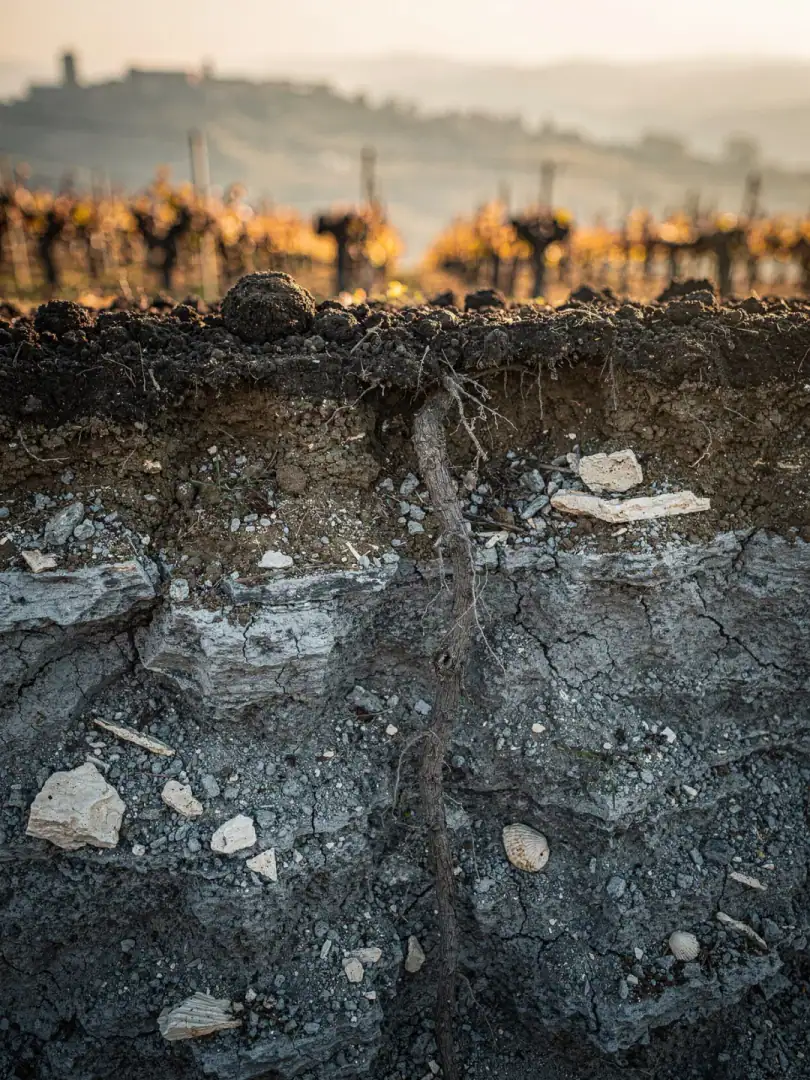
Dig a hole in a vineyard near La Morra, and after twenty or thirty centimeters, the earth turns gray-blue and fine as powder. This is Marne di Sant'Agata Fossili, a marl of silt, clay, and a bit of sand, rich in calcium carbonate from the shells of tiny marine organisms. About eight million years ago, the sea still covered this area, which later became the Piedmont basin. The difference lies in the detail.
Water passes through this soil, yet it's held remarkably long. The roots barely have to fight their way through, but they also find little nourishment — a trade-off that gives Nebbiolo grapes plenty of aroma and comparatively gentle tannin. The vine needs nothing more. Wines from this soil, such as those from La Morra or Barolo itself, have long been considered the more fragrant, more approachable wines of the Langhe.
Just a few kilometers east, around Serralunga and Monforte, the subsoil changes. Rarely is it this obvious. There lies the Formazione di Lequio, a harder sequence of alternating marl and considerably more sandstone. It's older than the Marne di Sant'Agata and resists weathering more strongly, keeping the overall soil leaner and stonier.
On this hard subsoil, roots must dig deeper, out of necessity, and the berries stay smaller with thicker skins. That takes effort. Most of the tannin sits in the skin, which is why wines from Serralunga are traditionally considered the most powerful and long-lived Barolos of all — they often need ten years before becoming approachable. Ten years is normal.
Two soils, just a few kilometers apart, yet two completely different expressions of the same grape. The boundary often runs right through the middle of a slope. This explains why, since 2010, Langhe winemakers have been officially permitted to distinguish more than one hundred eighty individual vineyard sites — each with its own name, each with its own share of these two rock types.
In northern Piedmont, around Gattinara, none of this applies anymore. A completely different origin. There, Nebbiolo, called Spanna in this area, never grew on marine marl but on porphyry from the collapse of a Valsesia supervolcano roughly two hundred eighty million years ago. Volcanic rock instead of seabed, and the wine tastes correspondingly different: tighter, more mineral, with an almost smoky edge you won't find in the Langhe.
A thin, dark layer of decomposed leaves and root remnants, barely half a hand's width thick on most Langhe slopes.
The root: This is where the fine roots sit. They grab whatever rain happens to bring — and are the first to dry out.