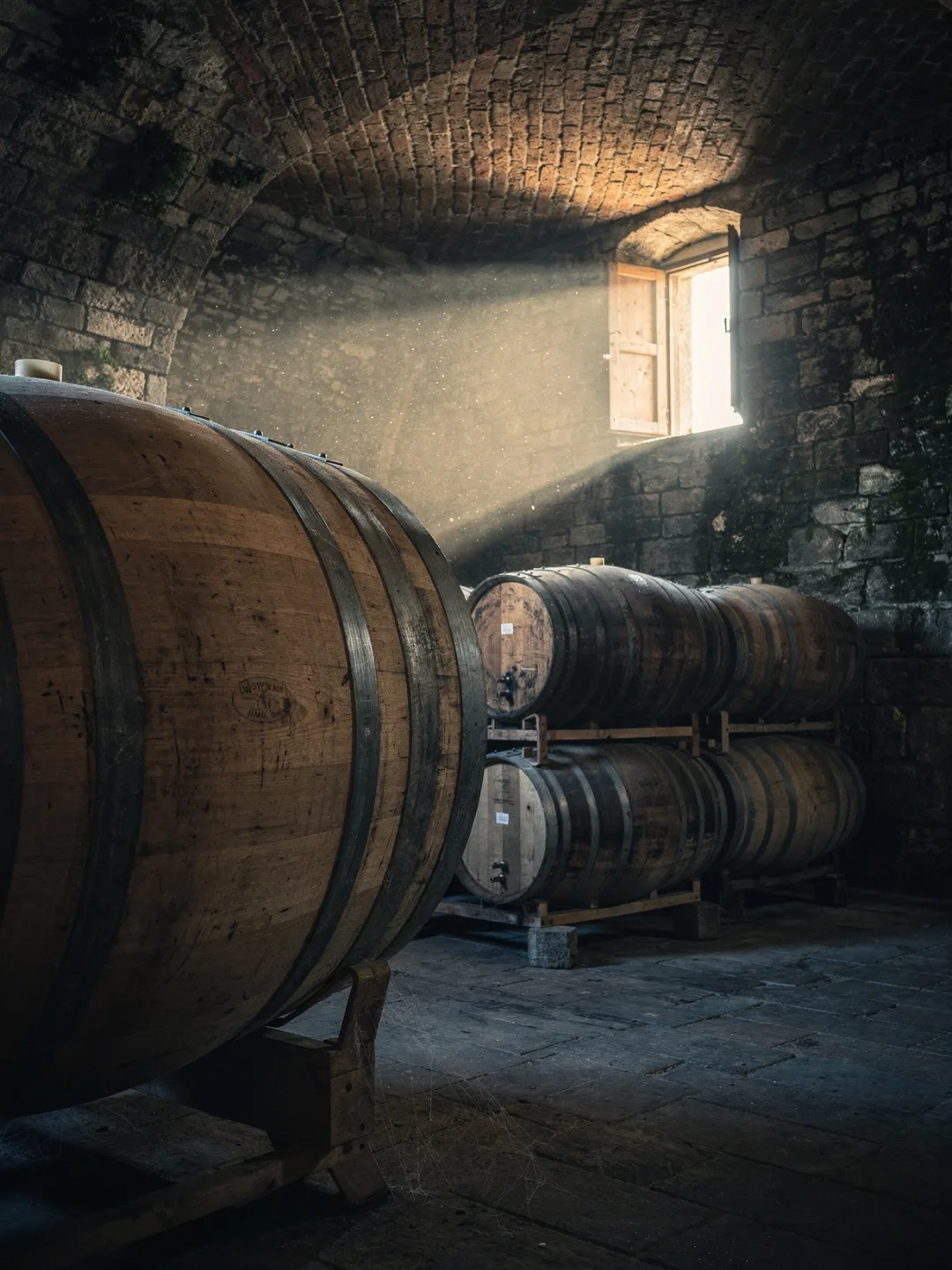
Botte versus Barrique
Winemaking
Until the 1830s, Nebbiolo was often not even fully fermented. Cold cellars stopped fermentation prematurely, leaving behind residual sugar and a bit of carbonation — a sweetish, semi-sparkling wine. It was the Frenchman Louis Oudart who introduced more hygienic cellars and let fermentation run its full course. Since then, Barolo has been dry, and this single technical change is still considered the birth of the modern wine.
How long the must stayed on the skins afterward was a subject of debate for decades. Traditionally, it was left for three to four weeks, sometimes longer, to extract every last bit of tannin from Nebbiolo's thick skins. More time meant more tannin. That produced powerful but, for years, closed-off wines.
In the 1980s, young winemakers like Elio Altare drastically shortened this period, sometimes to just one week, and aged the wine afterward in small French barriques instead of the large Slavonian oak casks. Two paths, one goal. The wine became softer, darker in fruit, quicker to drink — and from then on clashed with the old school over who got to define Barolo.
The regulations now set only minimum aging times, not methods. A Barolo must age a total of thirty-eight months, eighteen of them in wood, before it can be sold; the Riserva requires sixty-two months. Barbaresco needs only twenty-six months, nine of them in wood, with its Riserva at fifty. The rules stayed strict. Whether the wood is large or small, no one dictates anymore.
Moscato d'Asti works completely differently. Here, the must ferments for only a few weeks in a sealed pressure tank, the autoclave — the so-called Martinotti or Charmat method, named after the oenologist who patented it in Asti in 1895. Fermentation is stopped as soon as the wine has enough sweetness and carbonation, usually in under a month. For Alta Langa, the sparkling wine made from Pinot Nero and Chardonnay, the opposite applies: at least nine months on the lees, in the bottle, using the classic method from Champagne. Between these two extremes lies the entire range of Piedmontese cellar work.