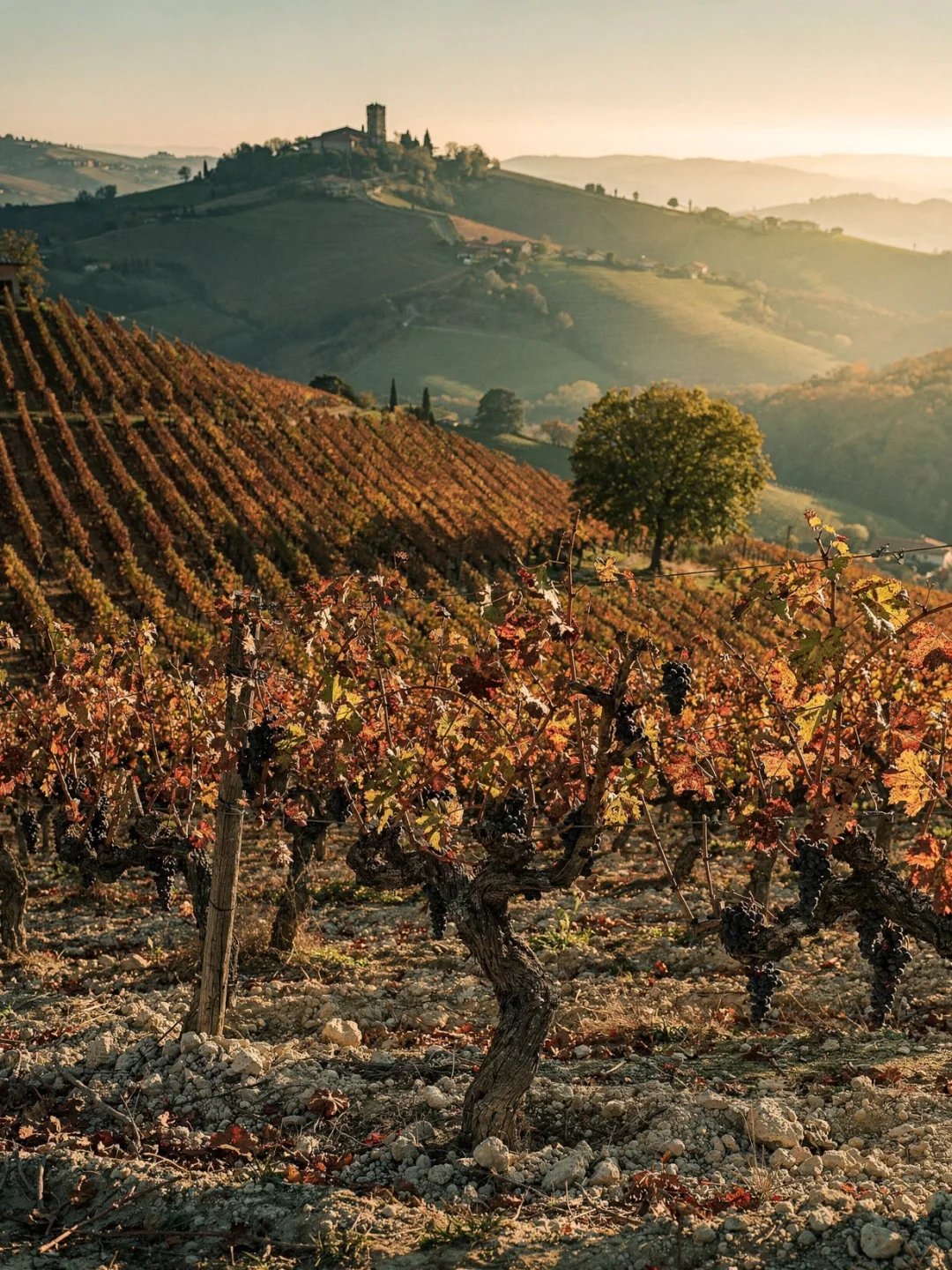
Nebbiolo and Its Siblings
Grape Varieties
Dolcetto comes off the vine first in September, Barbera follows a few days later, and only after that, often not until October, is Nebbiolo ripe enough for pressing — the sequence even has its own name: vendemmia nobile, the noble harvest. The vine buds early and ripens late, a long journey that only succeeds on the best, sunniest slopes. Patience pays off.
Despite its fame, Nebbiolo remains a minority in its own homeland. It covers about nine percent of Piedmont's vineyard area, while Barbera alone accounts for roughly thirty percent. That's a lot. Growers planted Nebbiolo only where it would truly ripen — on the steep south-facing slopes known as bricchi. Only there is the effort worthwhile. Everywhere else, hardier varieties grew, ones that still produced a yield even in a cool year.
Under other names, Nebbiolo also grows elsewhere in Piedmont. In the north, around Gattinara, the same grape is called Spanna and grows on volcanic rock from an ancient supervolcano instead of on calcareous marl; across the Alps in Valtellina, it's known as Chiavennasca. One grape, many faces. The differences between these wines come almost entirely from soil and altitude, hardly from genetics.
Barbera itself is no stopgap solution, even though it lives in Nebbiolo's shadow. It brings plenty of acidity with little tannin, ripens reliably, and yields dense, dark wines that are drunk every day yet can still age. Dolcetto, on the other hand, whose name sounds sweet, makes dry, soft red wines with low acidity — the name refers to the sweetness of the grape on the vine, not in the glass. Only the berry is sweet.
Among the white varieties, Arneis has the strangest history. It used to be planted between rows of Nebbiolo in Roero because birds preferred pecking at its sweet, early-ripening grapes rather than the more valuable black berries nearby — a living scarecrow. After the war it was nearly pulled up, until winemakers rediscovered it in the 1970s. Today it proudly carries the nickname Nebbiolo Bianco. That, too, is Piedmont. Further south, around Gavi, Cortese produces fresh, lean white wines, and for the sweet, lightly sparkling Moscato d'Asti, a third white variety does the work: Moscato Bianco, botanically the same Muscat known from German vineyards too.