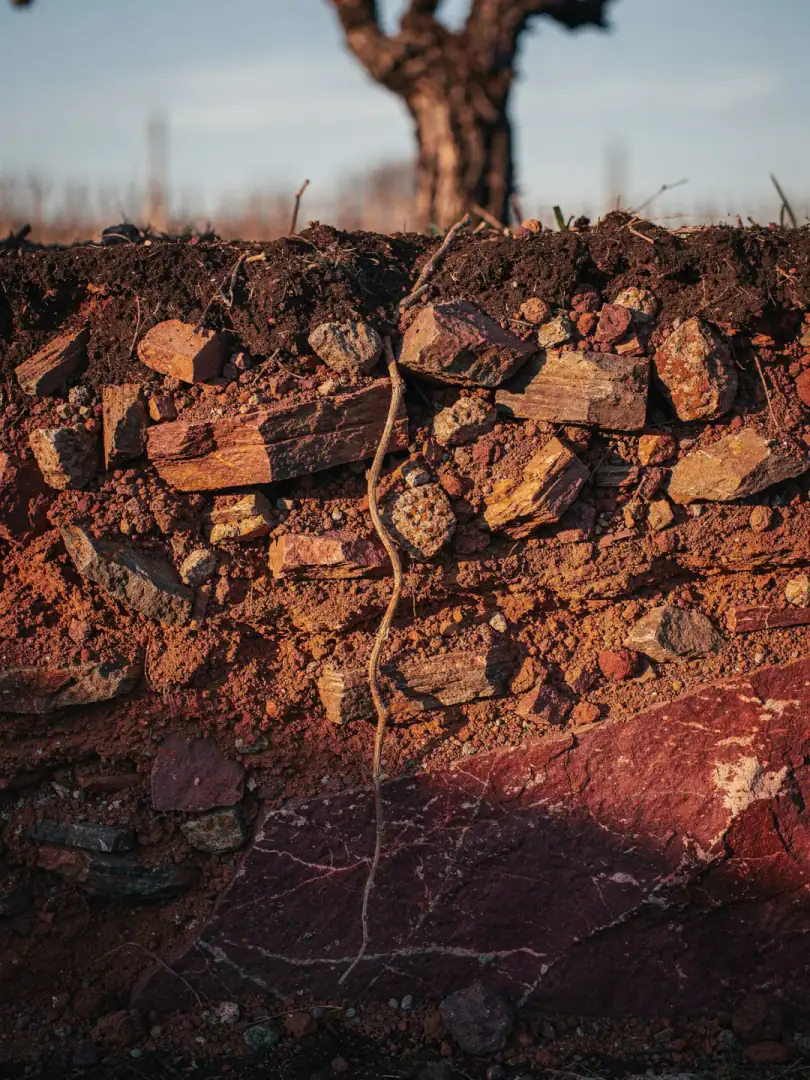
Quartz Porphyry & Dolomite
Soils
Dig a hole in a vineyard in the Bolzano basin. After just a few spade strokes you'll hit reddish rock, hard and splintery: quartz porphyry, the bedrock on which half of Bolzano stands.
Its story begins around 280 million years ago, deep in the Paleozoic era. Massive volcanoes spewed ash and lava across the entire Etschtal. What remained was a rock layer up to four thousand meters thick, stretching over more than two thousand square kilometers — Bolzano sits, quite literally, on a cooled volcanic field.
Weathered, the porphyry breaks down into loose, reddish rubble. It stores heat during the day and releases it again at night, and because it holds hardly any nutrients, it drives the vine's roots deep down. That's exactly what Lagrein needs: the variety is considered heat-loving. It thrives best on lean, stony soils that slow its growth and keep the berries small and the skins thick.
Just a few kilometers further south, around Kaltern and in the Überetsch, the ground changes completely: instead of red volcanic rock, there's pale, lime-rich clay, interspersed with jagged dolomite chunks, and in places so-called Kampferde from old moraine deposits. Vernatsch and Gewürztraminer grow here on lighter, cooler soil. You can taste the difference: wines from limestone come across finer and less powerful than the dense Lagrein crus from porphyry.
The same stone that carries the vines also shapes the city. South Tyrolean porphyry is used for paving stones, and facades around Bolzano to this day are built from the very same rock. Walk through the old town, and you're treading on the same bedrock that, just a few kilometers away, ripens the Lagrein.
A thin, dark layer of leaves and barely decomposed plant matter. In the warm basin it breaks down quickly and rarely amounts to more than a hand's width.
The root: This is where the fine roots sit, soaking up the first rains — and, in high summer, the first to dry out.