Galestro & Alberese
Soils
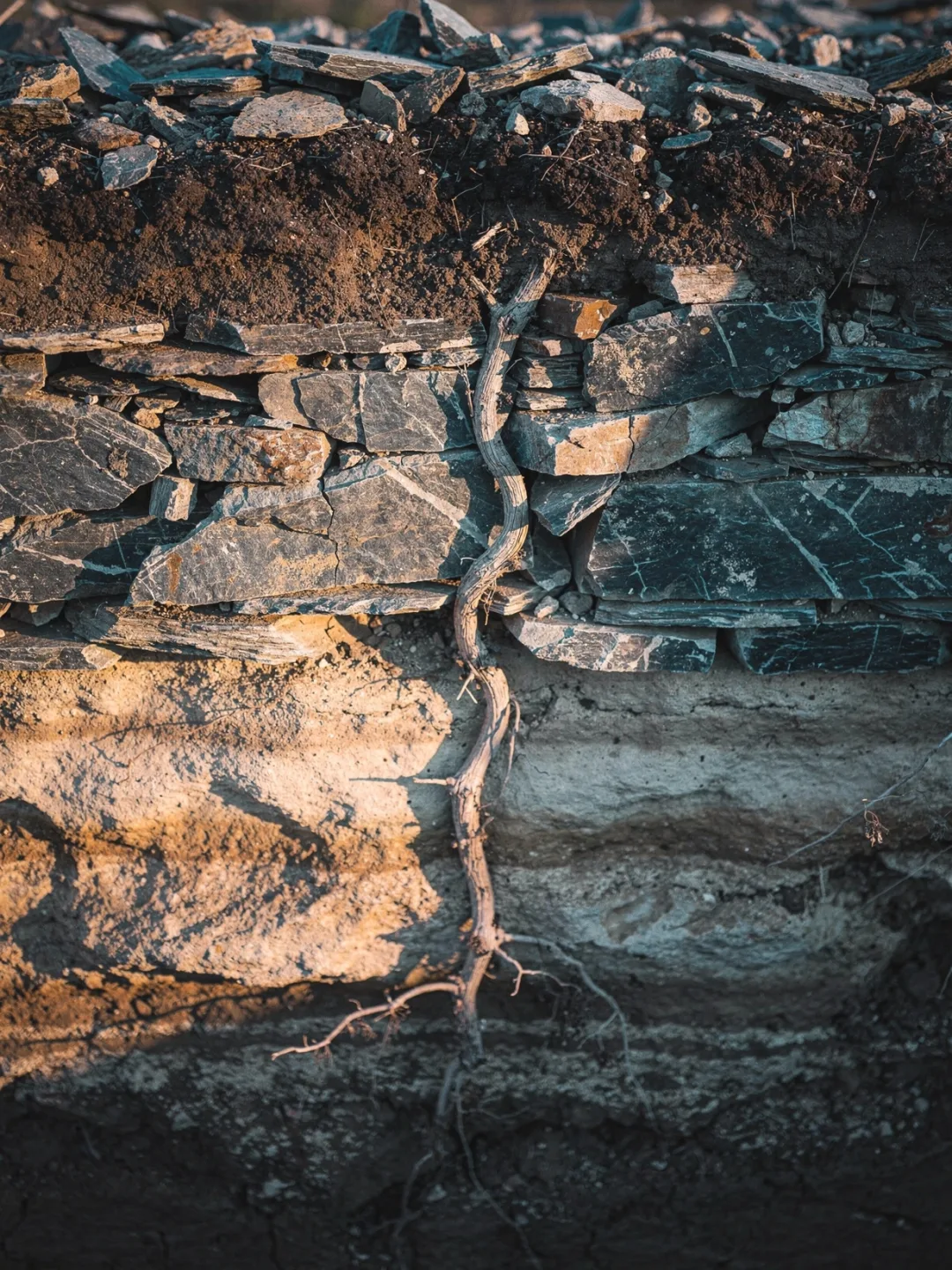
Dig a hole in a Chianti vineyard. After twenty centimeters, you'll hit stone: blue-gray flakes, thin as roofing slate, loosely stacked and sharp enough to cut yourself on. That's Galestro.
Its story begins on the seafloor. What today forms a range of hills above Tuscany was, millions of years ago, mud beneath the water; pressure compacted it into rock, and weathering has been breaking it apart again ever since. What remains is a layer of loose flakes through which air and water can pass. That's exactly what a vine root needs.
It forces its way through. Finding little in the way of nutrients or water, it drives deep — three meters, four, sometimes even six in old plantings. In August, the soil on top is bone-dry, while below it's still moist, and this difference decides whether a vine survives the heat or gives up mid-ripening.
The result is small berries. A small berry has proportionally more skin than juice, and the skin is where color, tannin, and most of the aromatic compounds are found. That's why a wine grown on lean soil tastes more concentrated than one from the rich valley floor, even though the cellar work was identical.
The second soil here is called Alberese, a hard, pale limestone marl. It also breaks into flakes but is considerably harder and holds more water, which is why its wines seem more austere and take longer to open up. Both soils often lie in the same vineyard, just a few meters apart. That's why two rows from the same estate can taste different, even if nothing was done differently.
One misconception persists stubbornly. People often read that a wine tastes “mineral” because the vine absorbs minerals from the rock and passes them on into the glass. It doesn't. What comes in through the roots are dissolved ions in such tiny amounts that no one could actually taste them. The soil works indirectly instead: through the water it holds or releases, through the heat its stones store, and through the depth it forces the roots to reach. That indirect path is the whole point.
A thin, dark layer of decomposed leaves and root remains. In a Chianti vineyard, rarely more than a hand's width deep.
The root: This is where the fine roots sit. They take up whatever rain has just brought — and are the first to dry out.