Porphyry & River Gravel
Soils
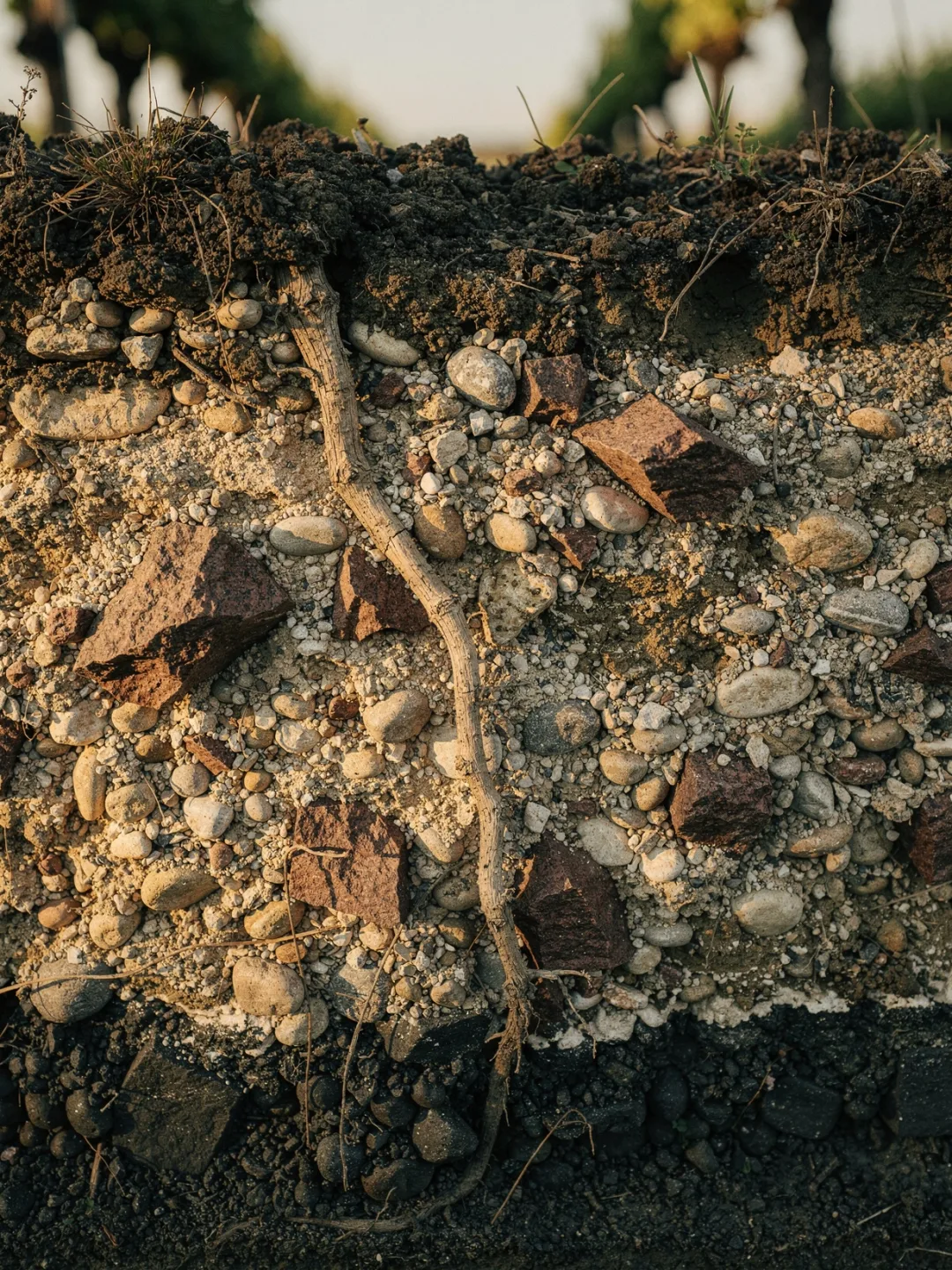
Dig a hole in a vineyard on the Campo Rotaliano. After just a few spadefuls, you'll hit round rubble: pale gray, water-worn pebbles, mixed with reddish fragments of porphyry. This is no coincidence. The soil here is a massive alluvial fan, built up by the Noce river, which over millennia carried rock down from the Dolomites and the Val di Non and deposited it where it meets the Adige.
Water passes through this rubble almost unimpeded. There's hardly any clay to hold it back, so the topmost layer dries out quickly in summer. The vine responds the way it always does: it drives its roots deep, two, three, sometimes four meters down, searching for moisture between the stones. This is exactly what Teroldego needs to develop its thick skin and dark color.
Further up, in the Val di Cembra, the soil looks completely different. There's no river gravel here, but solid bedrock: reddish porphyry, solidified from volcanic eruptions around 280 million years ago, now cut into steep terraces. More than seven hundred kilometers of dry stone walls hold the slopes together, stacked by hand over generations of winemakers. Some terraces are so narrow that only two rows of vines fit on them.
Both soils store heat in their own way. The pale gravel of the Campo Rotaliano reflects sunlight back onto the grapes, helping them ripen faster than the thermometer would suggest. The dark porphyry of the Cembra Valley, by contrast, stores the day's heat within the rock itself and releases it slowly at night. This keeps vines on the steep porphyry slopes protected even when temperatures turn cool.
Porphyry is also a poor, barren rock. It contains almost no limestone and little nitrogen, which naturally keeps vines growing weakly on it and producing small, concentrated bunches. Winemakers in the Cembra Valley therefore fertilize very little, and hardly need to: the soil itself limits the yield. What remains produces white wines with remarkably high extract for their elevation.
A thin, sandy-loamy layer, cultivated for centuries and containing little organic matter.
The root: This is where the fine roots sit. They draw on rainfall and are the first to be depleted during a dry summer.