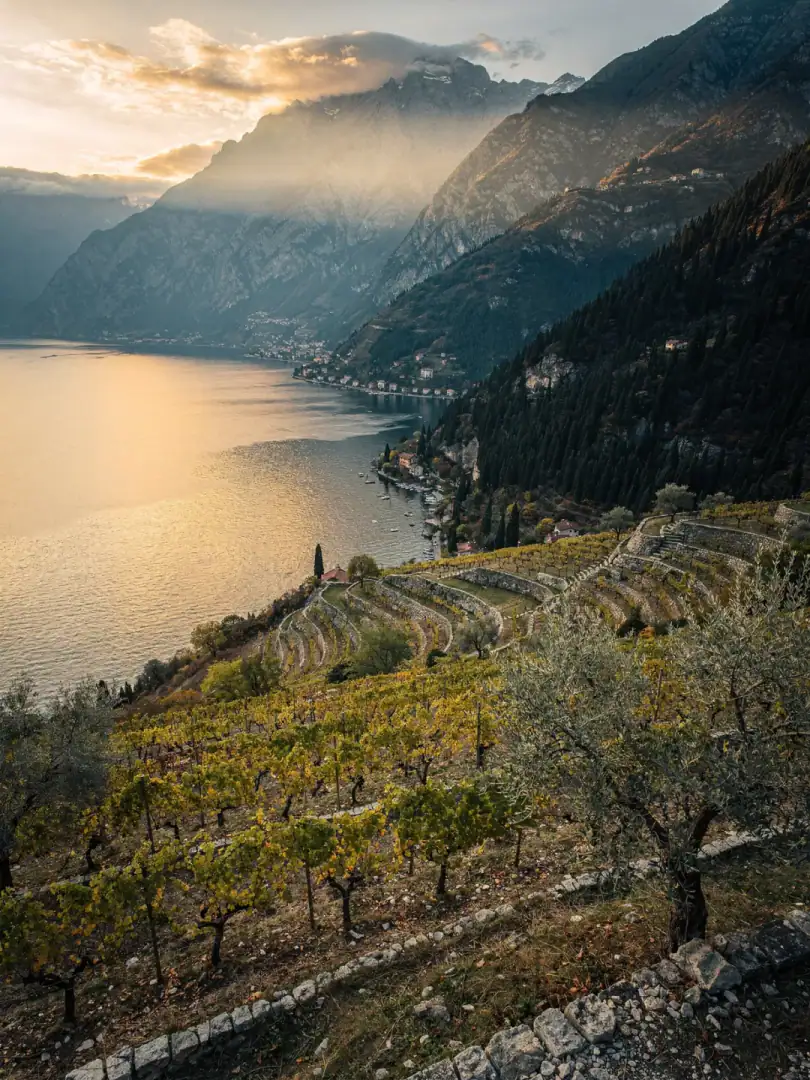
Lake Garda Meets the Dolomites
Climate
In Trentino, two climate zones lie just an hour's drive apart. In the south, near Arco and Riva del Garda, Lake Garda reaches right up to the mountains. Olive trees grow there alongside vines, right in the middle of the Alps. In the north, in the Val di Cembra, a harsh mountain climate prevails instead, with cold nights and short summers. Between them lies the broad Adige Valley, connecting both weather worlds.
Responsible for the warmth in the south is a wind with its own name: the Ora. It blows inland from the lake at midday, carrying the warmth of the water's surface up into the vineyards, up to a thousand meters in elevation. At night the direction reverses, and cooler air flows back down from the mountains toward the lake. This daily exchange dries the grapes quickly after rain. Fungal diseases have little chance as a result, an advantage many warmer wine regions don't have.
On the Campo Rotaliano, where Teroldego grows, the difference between day and night matters most, since the plain is squeezed between two mountain ranges that funnel cold air downward like a chute. During the day, heat builds up over the gravel; at night, cool air flows down from the side valleys and locks the acidity into the berries. Without this interplay, Teroldego would lose the powerful, almost saline freshness that sets it apart from milder red wines from the Po Valley.
The Alps also act as a shield. They keep cold northern winds away from the valley. They also intercept some of the rain that would otherwise sweep in from the north. Still, it isn't entirely dry: in autumn, at harvest time, humid air from the Mediterranean occasionally brings spells of rain that force winemakers to watch the forecast closely. A rainy September can decide, within a matter of days, whether a vintage succeeds.
Hardly any other Italian wine region farms vines across such a vast range of elevations, from around two hundred meters at Lake Garda to nearly nine hundred meters in the Val di Cembra, with entire growing seasons in between. A winemaker in Trentino can therefore move between Mediterranean climate and mountain autumn in a single day, without ever leaving the valley. This range is the region's true raw material, even more so than any single grape variety.