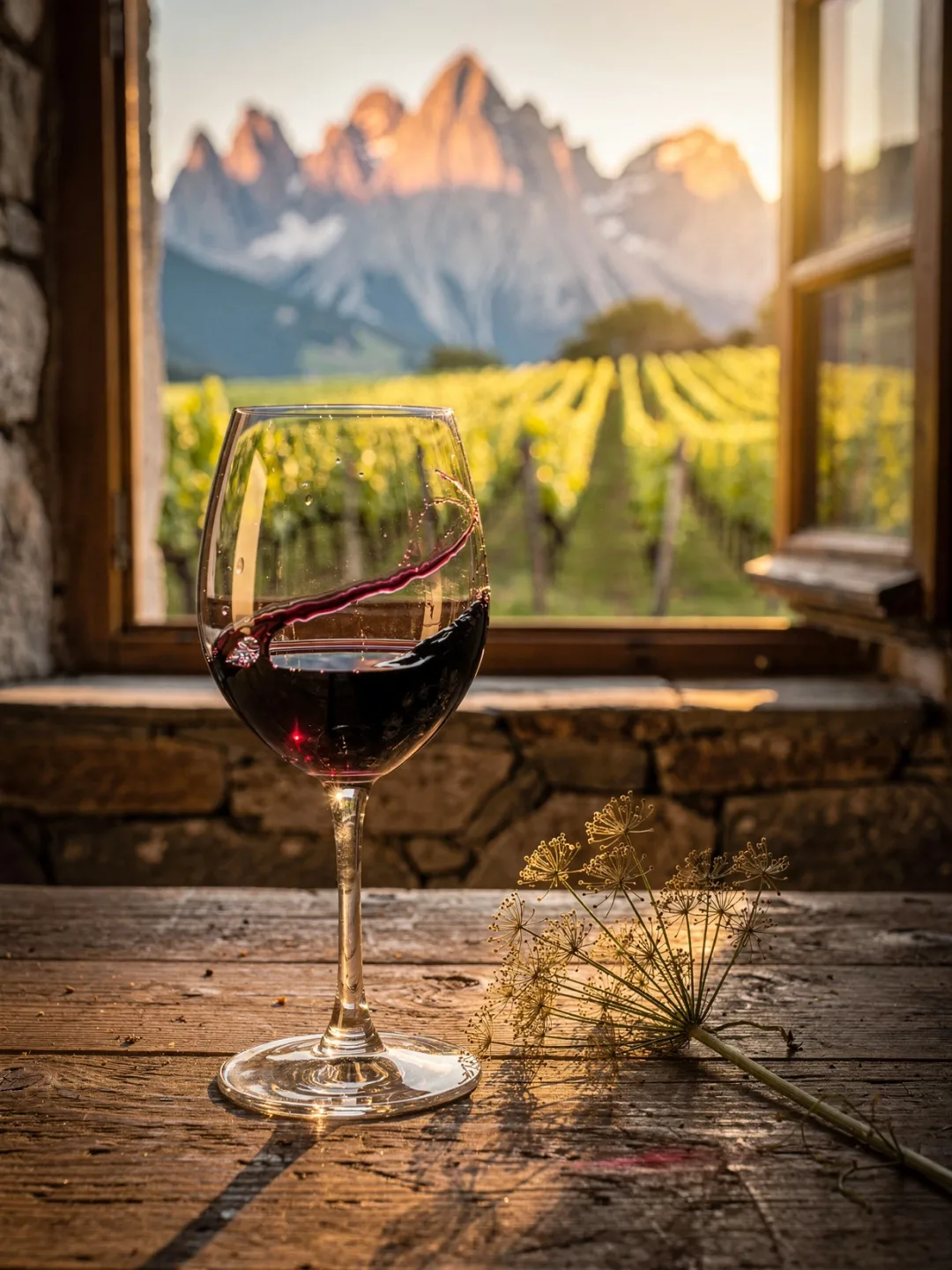
On a Teroldego
Tasting
Take a Teroldego and hold it up to the light. The color is dense. Often only a narrow violet rim shows through at the glass's edge, even in wines with several years of bottle age. This comes from the berry's thick skin, grown on the barren gravel of the Campo Rotaliano, which stores unusually high amounts of pigment. A pale Teroldego is almost always a sign of a weak vintage.
Smell it twice: once with the glass still, once after swirling. In the still glass, blackberry and blueberry come first, dark and almost sweet. After swirling, violets follow, along with a hint of black pepper and often an earthy, almost wild note that reminds some tasters of wet autumn leaves in the forest. This third layer sets Teroldego apart from most other Italian red wines and makes it recognizable in a blind tasting.
In the mouth you meet two powerful partners at once. The acidity is high and fresh, a legacy of the cool nights at the foot of the mountains. The tannin is firm but not bitter, provided the wine comes from a good vintage and isn't drunk too young. Together, these two traits make Teroldego a wine that practically demands fat and salt in food, otherwise it comes across as stern and closed.
Set a glass of Marzemino next to it and the difference is immediate. Where Teroldego is dense and dark, Marzemino shows itself bright, fragrant, with fine rather than firm tannin. The fruit leans toward red rather than black berries, joined by a distinct violet note that Mozart apparently liked so much he wrote it into an opera. Two reds from the same province, grown barely thirty kilometers apart, yet they could hardly taste more different.
Count the finish at the end. With a simple Teroldego Rotaliano, the flavor lingers for five to eight seconds; with a Riserva from old vines, often more than twenty. It's precisely this length, not the power and not the color, that separates a good Teroldego from a great one. Once you've counted it in your mouth, you'll look for it in every glass from then on.