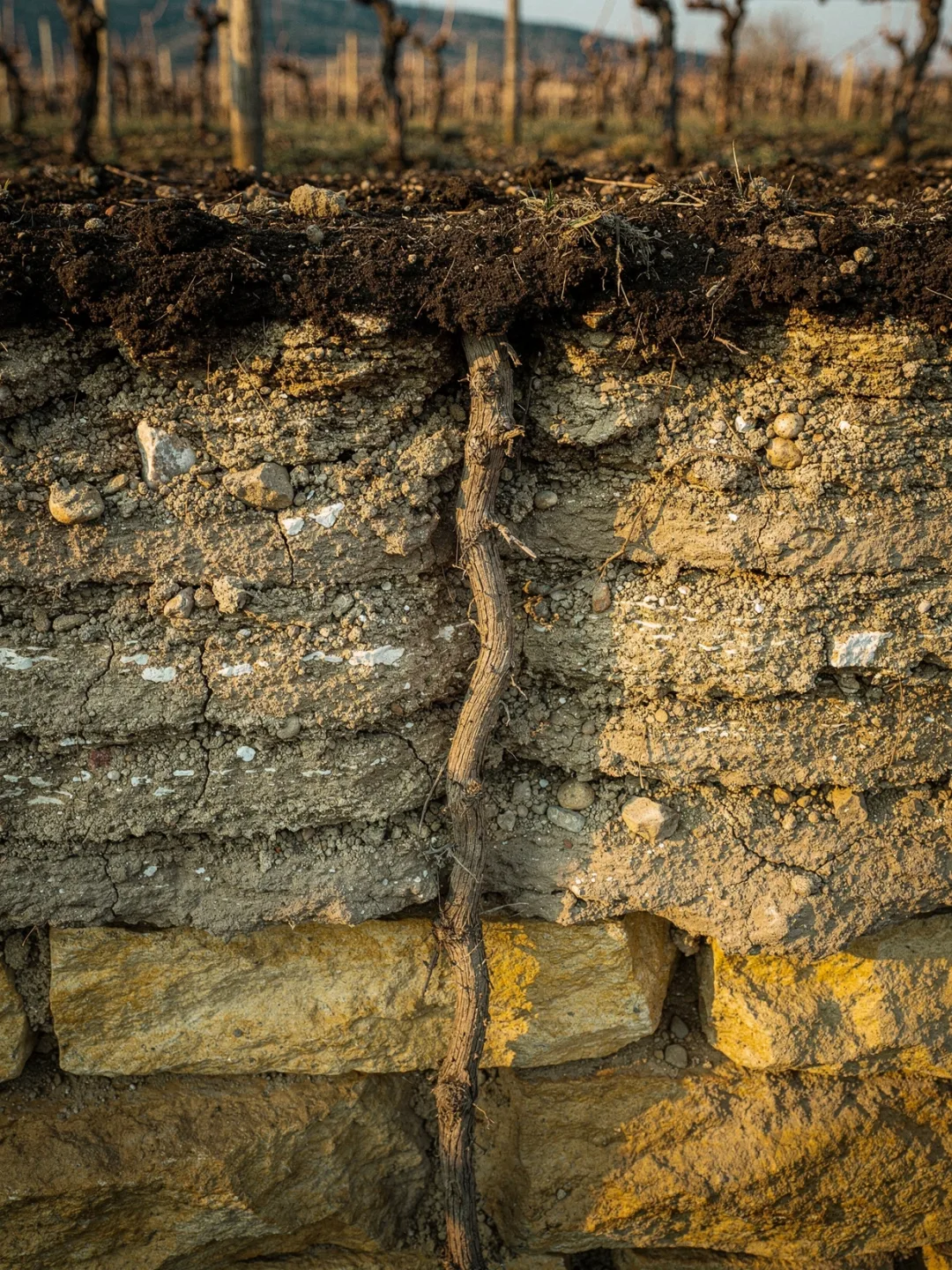
Limestone Marl & Tuff
Soils
Dig a hole in a vineyard near Montefalco. After just a few spadefuls, the soil turns grey and dense: limestone marl, mixed with clay, a remnant of the ancient seabed that once covered the region millions of years ago. Sand grains within it reveal that rivers once deposited sediment here too.
Clay stores water like a sponge and releases it to the vine only once August has dried out everything else. Limestone, meanwhile, provides structure. It lets excess water drain away, so the roots neither drown nor go thirsty. This exact balance is what Sagrantino needs to fully ripen its thick, tannin-rich skin. On pure sandy soil, it stays thin and green.
Deeper down, the roots hit arenaria, compacted sandstone from the same marine era. It breaks in hard layers. Few roots manage to force their way through, and that's precisely what drives them even deeper into the soil. The result is small, thick-skinned berries, and nearly all of Sagrantino's tannin, the very trait that makes it so distinctive in the glass, sits in that skin.
Fifty kilometers west, beneath Orvieto, the soil looks entirely different. There lies yellow-orange tuff, formed three hundred thousand years ago from the last eruption of the Monti Volsini volcanic group, studded with black slag fragments. Beneath it lie the fine clay and sand layers of the former Lago Tiberino, a lake that covered large parts of Umbria for three million years.
Tuff is porous and lets water drain quickly, which is why Grechetto and Procanico ripen earlier here than Sagrantino does in the east. The Etruscans exploited the same property in reverse: they dug their cellars directly into the soft stone, where temperatures barely shift throughout the year. Two soils, one region, two utterly different wines.
A thin, dark layer of decomposed leaves, olive foliage, and root remnants. On the hills around Montefalco, rarely more than a hand's width thick.
The root: This is where the fine roots live. They absorb whatever rain brings and are the first to dry out once August heat arrives.