Tannin Needs Room
Glassware
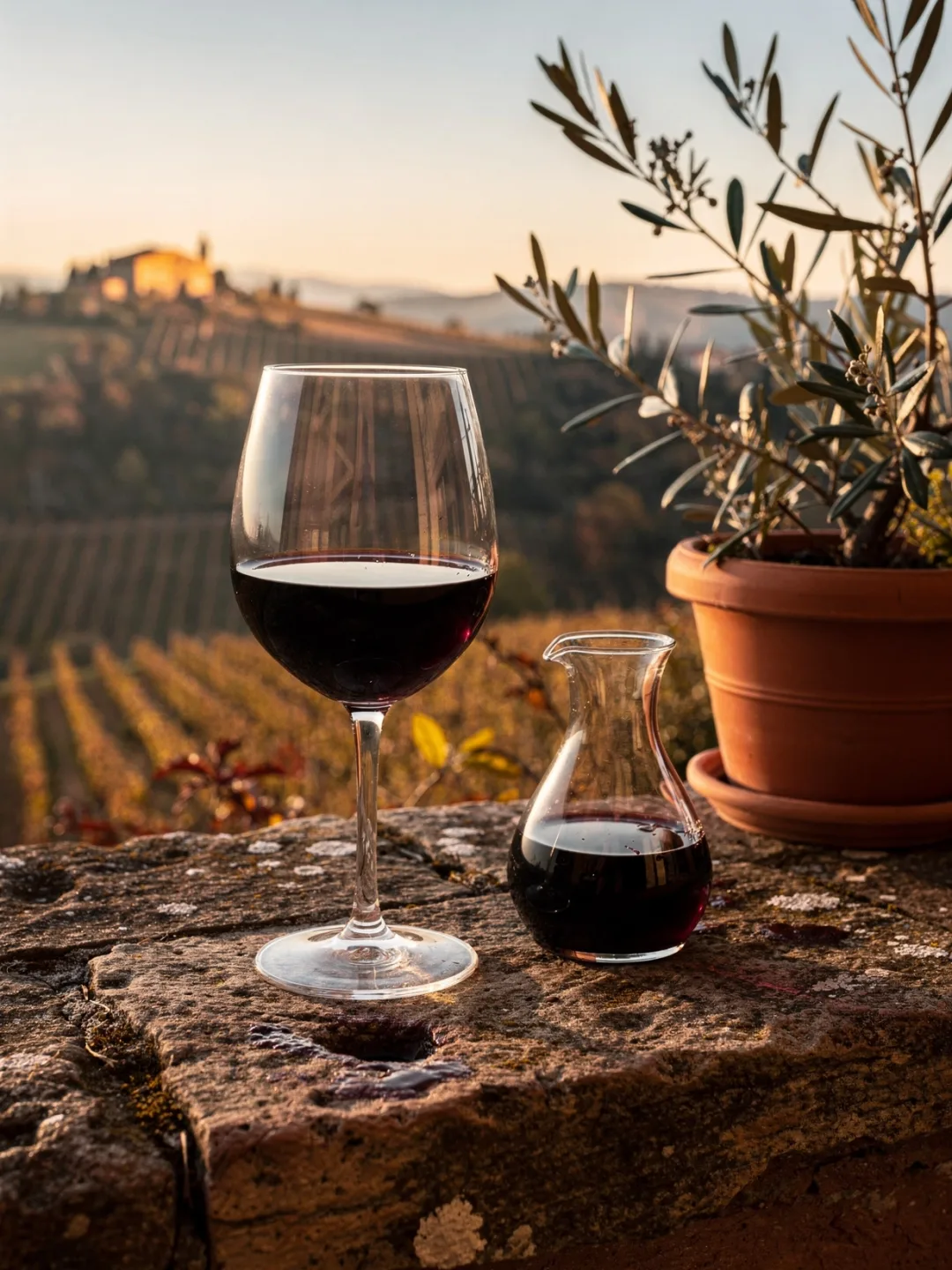
Few wines call as clearly for a large glass as Sagrantino, whose tannin content is the highest ever measured in any grape variety, and a glass that's too narrow concentrates that power onto a single point on the tongue. A rounded bowl with a wide opening spreads it instead across the entire surface of the mouth. More room, less harshness.
Connoisseurs therefore reach for a large Bordeaux or balloon glass, similar to the one used for Barolo, because the wide surface exposes the wine to more oxygen and softens the hard tannin even in the glass. Sixteen to eighteen degrees Celsius. Cooler than most kitchens today consider room temperature.
A young Montefalco Sagrantino benefits from thirty minutes to an hour in a decanter, since without air it seems closed and rough, but with it, berry and spice aromas open up. Older vintages need less time. Ten years in the bottle rounds out the tannin on its own.
Sagrantino Passito calls for a smaller glass, similar to one used for port, served cooler at twelve to fourteen degrees, and in tiny pours of fifty to sixty milliliters. Any more would be too much. Given its alcohol and sugar content, a full glass would tire the palate within just a few sips.
Orvieto and Grechetto need the exact opposite: a narrow, upright white wine glass, served cold at eight to ten degrees, so the citrus fruit and floral aromas don't dissipate too soon. A glass that's too large works against them here. For a wine that thrives on coolness, a warm glass is the biggest mistake you can make.
One final rule applies to both colors: never fill to the rim. Doing so robs Sagrantino of room to swirl against its own tannin, and robs Orvieto of the cool headspace where its volatile citrus aromas need to gather.