Baccalà and Bigoli
Wine & Food
Four provinces, four different cuisines, and one wine that adapts precisely to each of them. Around Verona, people eat Pastissada de caval, a horse-meat stew marinated for days in red wine and spices, then braised for hours. It's traditionally served with the same robust wine used in the marinade: Amarone, or at least a mature Valpolicella Ripasso.
The reason lies in balance. Next to Amarone, a delicate dish would be overwhelmed, lacking the structure to hold its own. A braised dish rich in fat and deep roasted flavor, on the other hand, needs exactly this power and tannin so it doesn't feel heavy itself. Salt and fat bind the tannin and round it out. That's why the very same wine that can taste almost too austere when young pairs perfectly with such a hearty dish.
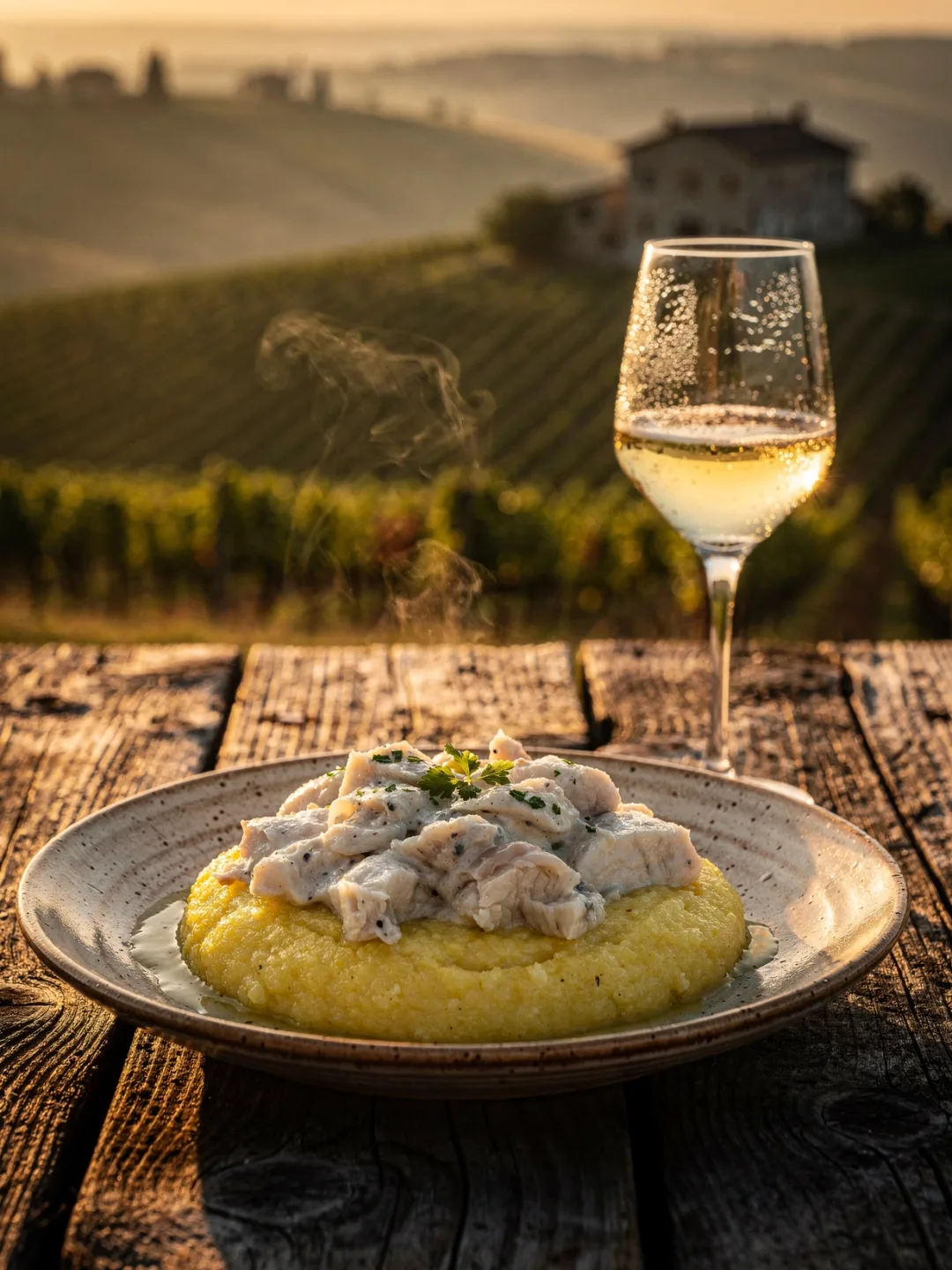
Further east, around Vicenza, Baccalà alla vicentina reigns supreme. This is dried cod, soaked in water for days and then braised for hours in milk, onions, and anchovies until it turns creamy and falls apart. No red wine suits this dish — instead, a chilled Soave works best, its acidity cutting through the milk while its subtle salinity echoes the anchovies rather than fighting against them.
Bigoli, thick pasta made using a press, are usually served with duck ragù or in salsa, a sauce made from anchovies and slow-braised onions. Both call for a wine with body, but without the sheer power of Amarone. A Bardolino Superiore or a straightforward Valpolicella fills exactly that gap between light and heavy.
To finish, something sweet. In Verona, that often means Pandoro, the star-shaped cake that's been made here since the late nineteenth century. Alongside it comes Recioto della Valpolicella, the sweet ancestor of Amarone, or Recioto di Soave made from Garganega. The same simple rule applies to both: the wine in the glass must always be sweeter than whatever's on the plate beside it.