Clay over Shale
Soils
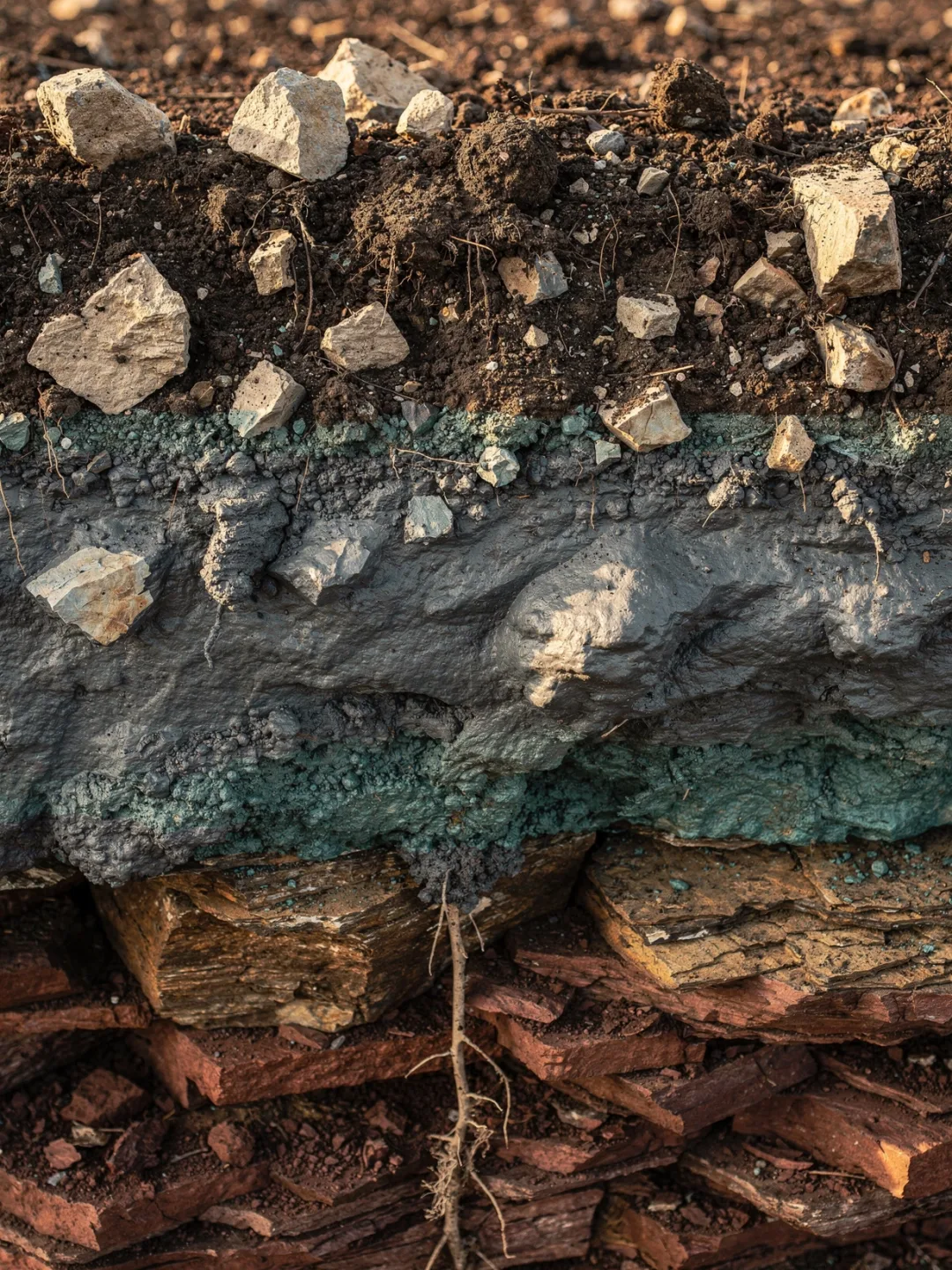
Dig a hole on the Beamsville Bench, just below the escarpment. After a few spadefuls, the earth turns heavy and sticky, almost blue-gray, clinging to the spade like modeling clay. Welcome to Iroquois clay. It's named after a glacial lake whose shoreline lay here some thirteen thousand years ago, a good thirty meters above today's water level of Lake Ontario.
Above it lies a thinner layer of glacial till, the debris left behind by the glaciers. Loam mixed with fragments of limestone and dolostone that rolled down from the edge of the escarpment. This upper layer still lets water through fairly well. The clay beneath does not. Winegrowers therefore lay drainage pipes, often a meter deep, otherwise the roots would drown in their own vineyard.
Dig deeper still, and eventually you hit rock: Queenston shale, a reddish-brown, iron-rich stone deposited over four hundred forty million years ago at the bottom of a shallow sea. Further up, beneath the hard dolostone edge of the escarpment, this same layer also underlies Niagara Falls. Only a few roots reach this depth, usually those of old vines thirty or forty years old. Where they manage it, they draw up water that has long since disappeared on hot August days.
This clay is actually meager for most plants. For vines, that's precisely the advantage: low available nitrogen slows growth, the vine channels its energy into the grapes rather than the foliage, and the berries stay small, especially on old vines thirty or forty years old. Small berries have more skin relative to juice, and color and tannin sit in the skin. That's why Cabernet Franc and Riesling from the bench taste more concentrated than the same variety from the flatlands closer to the lake.
Loamy glacial debris with fragments of limestone and dolostone that once rolled down from the escarpment. Water still passes through fairly well here.
The root: Fine roots seize the moment as soon as rain falls — the layer is thin and empties again after a few dry days.