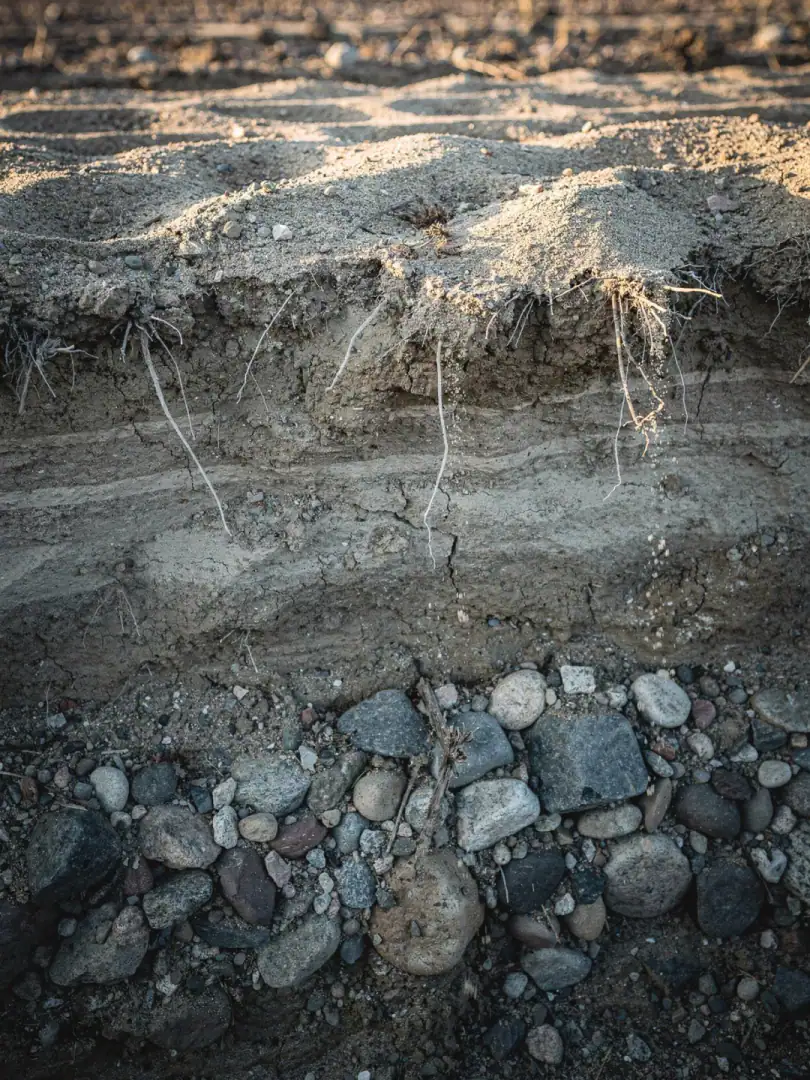
Sand Over Glacier
Soils
Dig a hole on the Black Sage Bench near Osoyoos, and the shovel sinks in with surprising ease. No stones, no resistance — just fine, pale brown sand that slips through your fingers like beach sand. This isn't river sediment but an ancient migrating dune, blown up by the wind long after the glaciers had vanished.
Some 30,000 years ago, an ice sheet covered the entire valley, in places more than two kilometers thick. It finally melted away for good around 13,000 years ago, leaving behind rubble, gravel, and finely ground rock flour. This collected in a massive glacial meltwater lake that once filled half the valley floor. When the lake dried up, it left behind fine layers of sand and silt, and the wind did the rest.
Sand holds almost no water. What falls in the morning has already drained away by the afternoon, forcing the vine to send its roots deep down, sometimes three or four meters, just to find any moisture at all. That effort costs energy that would otherwise go into growth. The result is smaller, thicker-skinned berries. Relative to the juice, they carry more color and more tannin, the compound that leaves a furry sensation in the mouth.
Beneath the sand of the Black Sage Bench lies a layer of fine silt, deposited on the bed of that glacial meltwater lake, more densely packed and holding a bit more water. Deeper still lies hard glacial till: a tough mix of rubble and clay compacted by the glacier itself, which almost no root can penetrate. On the Naramata Bench at the other end of the valley, the sequence looks similar, only with more weathered granite in the subsoil instead of pure sand.
What these layers have in common is a lack of nutrients: they force the vine toward concentration rather than volume. A vineyard on heavy, rich alluvial soil down on the valley floor often yields twice as much as one up on the bench above, yet tastes thinner. That's why nearly every serious winery in the Okanagan Valley sits not down in the valley itself, but elevated on the old terraces and dunes along its edges.
Fine, pale brown sand, blown up by the wind from old dunes. Holds almost no water and lets rain drain away within hours.
The root: The vine grows hardly any fine roots here, because there's nothing to draw on. What's left are concentrated, thick-skinned berries.