Desert and Frost
Climate
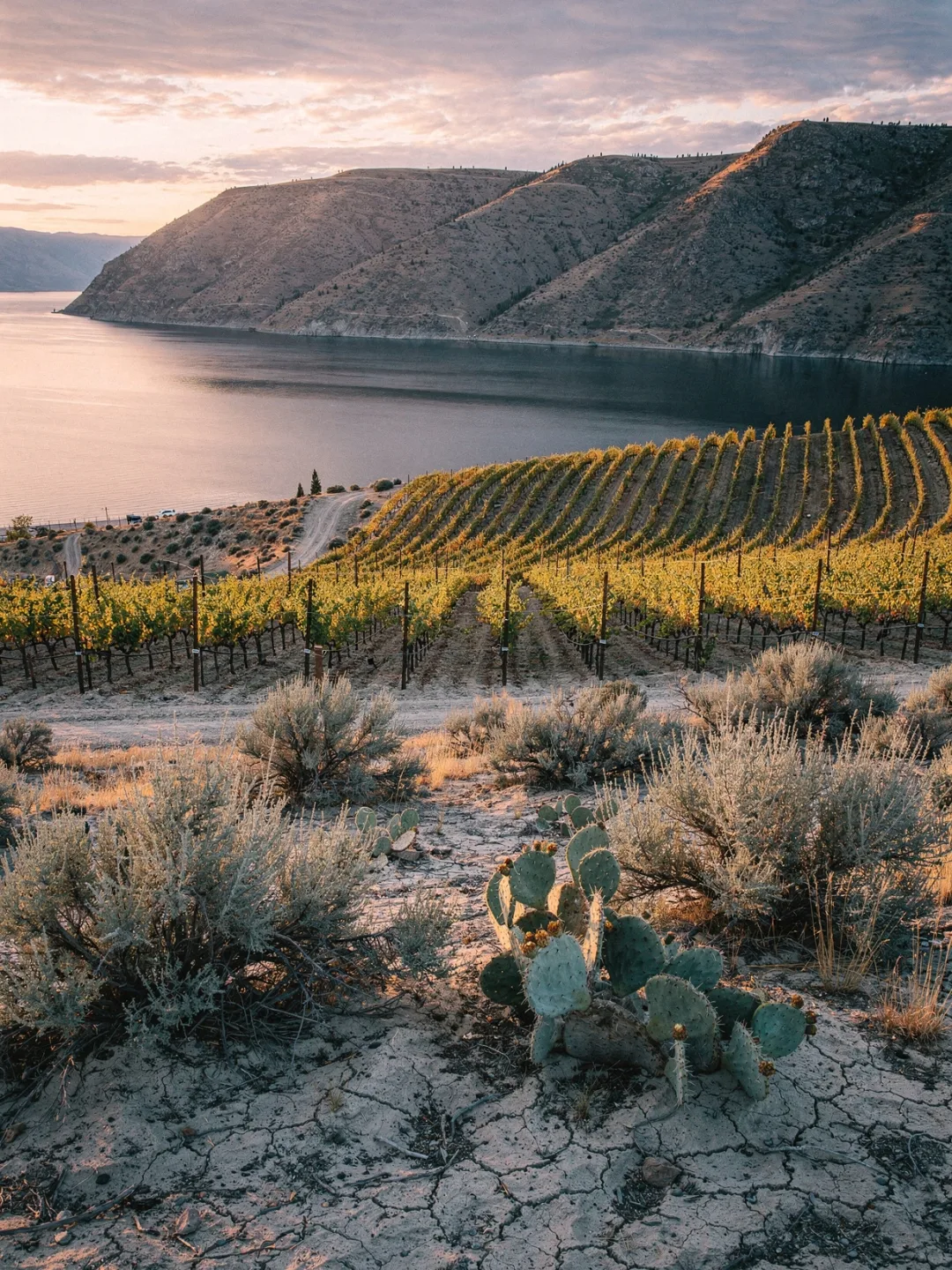
Two mountain ranges stand between the Okanagan Valley and the Pacific: the Coast Mountains and the Cascades. Both hold back the rain before it reaches the valley. Osoyoos in the south therefore gets only about 300 millimeters of precipitation a year. That's not quite enough for a true desert, but cacti, rattlesnakes, and sagebrush grow there anyway, and some call Osoyoos the northernmost extension of the Sonoran Desert.
During peak summer, daytime temperatures in Osoyoos easily climb past thirty degrees Celsius. At night they often drop by fifteen to twenty degrees, since dry desert air barely retains heat. For the vine, this is a gift. During the day the berry accumulates sugar; at night the acidity is preserved rather than breaking down in the heat, and this interplay keeps even bold red wines from the south feeling fresh.
A single valley, spanning a climate range of over a hundred and fifty kilometers from south to north: around Osoyoos, growers count roughly 1,600 growing degree days per season, a measure of how much warmth is available to the vines overall. Around Kelowna, it's often only around 1,200. That's why Cabernet Sauvignon ripens reliably in the south, while in the north even Pinot Gris and Riesling push up against their limits.
Okanagan Lake itself acts as both a heater and a cooler. In winter, the warmth stored from summer slowly releases back out, protecting the vineyards along its shores from lethal frost. In summer, the same lake cools the air that drifts over the terraced slopes at night. Plant just a few hundred meters from the shore, and you lose almost all of that protection.
How fragile that protection can be was revealed in January 2024. Between the 11th and the 15th, temperatures across the valley fell below minus twenty degrees Celsius, in parts of the North Okanagan for more than fifty hours straight. The vines, not hardened off due to a mild start to winter, froze right down to the roots. In the end, the industry reported a crop loss of 97 to 99 percent and economic damage of around 440 million Canadian dollars.