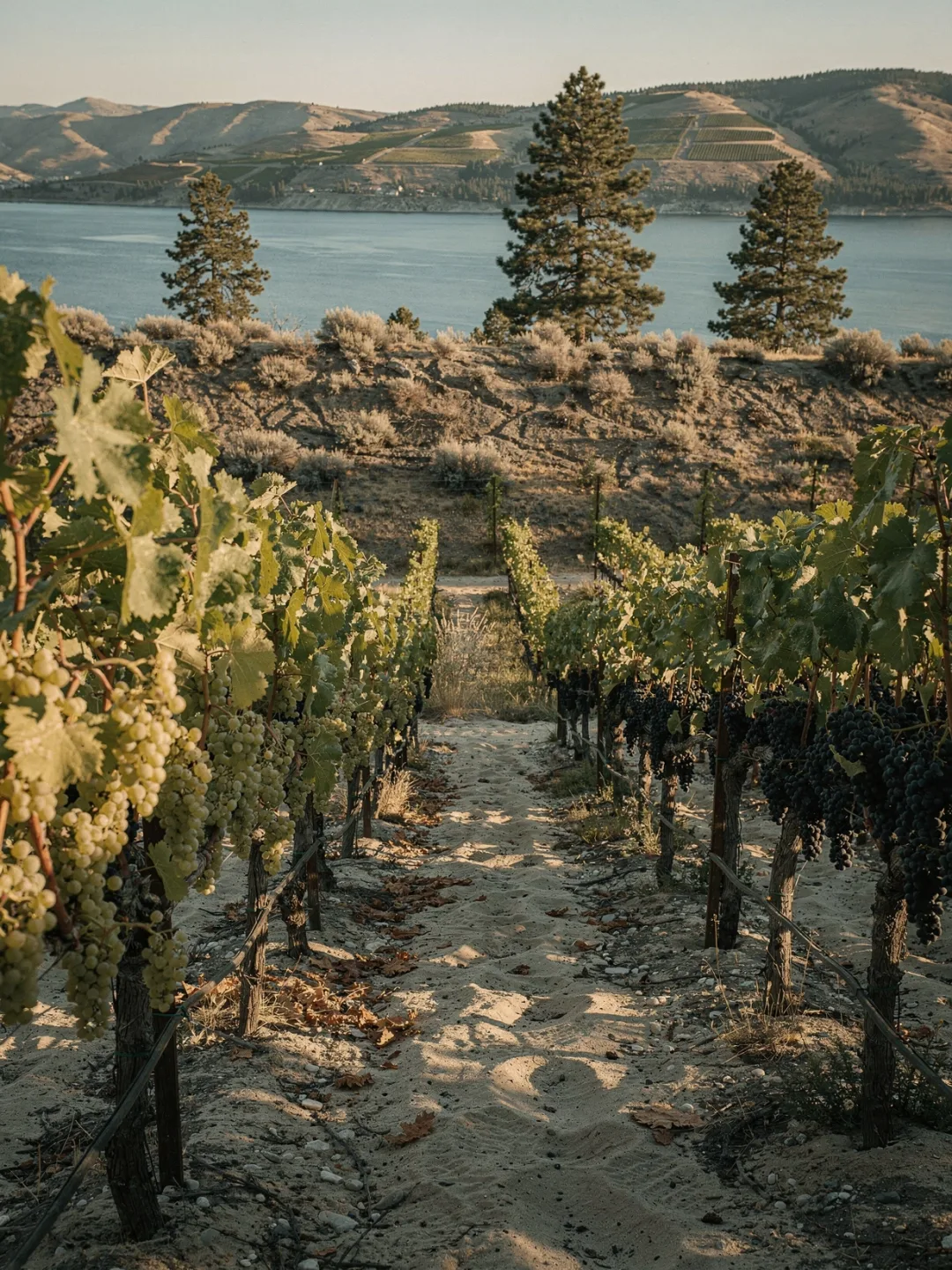
Merlot Meets Ehrenfelser
Grape Varieties
A winemaker in the Okanagan Valley rarely answers the question of the most important grape variety the way you'd expect: Merlot. It covers around 650 hectares, ahead of Pinot Noir, Pinot Gris, and Chardonnay. Yet a single answer falls short, because the valley is too long and too varied for that.
Down south, around Osoyoos and on the Golden Mile Bench, Cabernet Sauvignon, Cabernet Franc, and Merlot ripen into bold Bordeaux blends. It's that warm there. On the sandy Black Sage Bench just across the way, the same family of grapes grows, benefiting from even more warmth radiating off the pale sand below. Roughly a hundred and fifty kilometers further north, around Kelowna and in Lake Country, that warmth often isn't enough anymore.
Head further north to the Naramata Bench, and the tone shifts entirely. Weathered granite and sandy loam keep the roots busy. Cool nights off nearby Okanagan Lake preserve acidity, and this combination produces Pinot Noir with bright fruit and fine tannin, rather than a heavy jammy note.
Few varieties are as woven into daily life here as Ehrenfelser. It was bred in 1929 in Geisenheim from Riesling, crossed with a vine once thought to be Silvaner. DNA analysis decades later revealed it was actually the Alsatian variety Knipperlé. Ehrenfelser ripens earlier than Riesling. It also tolerates a cool summer, which is why it found a second home in the Okanagan Valley — one that today is larger than its first home in Germany.
Add up all the acreage today, and red varieties cover nearly half the vineyard land, whites about a third. The rest is split among niche varieties like Gewürztraminer or Syrah. As recently as the 1990s, the ratio was reversed. A warmer climate and the reputation of the southern Bordeaux blends have tipped the scales in just two decades.